The Office 2007 upgrade has caused an outcry from users as the familiar menu options have been dramatically rearranged. This has made the transition difficult for the average user, as they’re often unable to find options they’re used to. Thankfully there are some tricks to ease the pain!
The Quick Access Toolbar
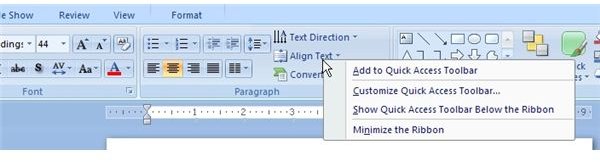
The Quick Access Toolbar is a short strip at the very top left of Office 2007 products (with the exception of Outlook), which contains a few commands by default but can be customized with anything available by menus. If you are unable to find certain commands in 2007, or you use a command frequently but find it difficult to access, you can add it to this toolbar.
If you can find the command in the new ribbon area (the new pictographic shortcuts under the menu headers), simply right-click on it and choose “Add to Quick Access Toolbar” and it will instantly show up in the toolbar. If you cannot find it in the tabs, click on the down arrow to the right of the ribbon and select “More Commands”. You’ll see a list of Popular Commands on the left; if the one you want is not listed, click to choose “All Commands”. Scroll down to the one you wish to add and double-click it and hit OK. You can also re-order the commands using the arrow at the far right.
Office 2007 Menu Commands Reference Sheet
If you’d like to see all of the Office 2007 menu commands with a menu as to where they can be found, Microsoft has prepared one that you can download and print to use as reference. It can only be viewed if you can open Excel 2007 files. This reference guide is available for free from the Microsoft website:
https://office.microsoft.com/en-us/training/HA102295841033.aspx#2
Office 2003 to 2007 Interactive Guides
If you do not have Excel 2007, you may install the Interactive Guides. These are very user friendly and won’t take up much space on your hard drive, although each piece of software has its own separate guide so if you have Word, Excel, and Outlook, you’ll have to download and run three of these. To use, download, install, launch and click ‘Get Started’. The program will show you a screen as the 2003 version of the Microsoft software looked. Click on the menu item you seek (for instance, go up to the File menu and click on “Open”). The 2003 screenshot will then disappear and be replaced by the 2007 version, and it will then show you the location of the menu command in its new location! Bear in mind, this should only be relied upon temporarily as you learn the new menu locations. Being permanently dependent upon this interface will dramatically slow your production; it is only intended to assist you with the transition.
Free interactive guides may be downloaded here:
https://office.microsoft.com/en-us/training/HA102295841033.aspx


