Connecting your motherboard to your PC case, can be tricky. We help make sure the power switch is connected to the right pins on your motherboard.
Pins and Plugs
PCs usually have two power buttons. The first is found on the rear of the device, on the PSU (power supply unit) and is known as the “master” power switch. It is also sometimes called the ‘hard’ power switch. In most cases you won’t need to use this, unless moving the computer or preparing the system to be serviced.
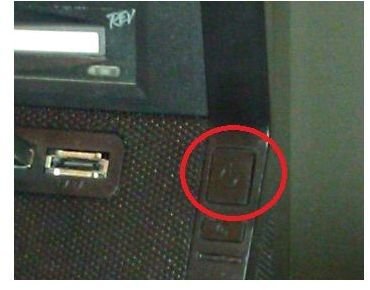
The second power switch is on the front of the case, which is connected to the motherboard power switch. This is sometimes referred to as the ‘soft’ switch.
While jumpers and connectors can usually be found quite easily on a motherboard, power switches and hard drive activity connectors might prove to be a little trickier to identify. If you don’t have the original motherboard manual to hand and can’t find a suitable replacement online, you will need to spend some time identifying the various connector arrays on your motherboard.
What the Power Switch Does
As you might expect, the power switch is there to start and shutdown your PC. While you might have no power switch on the PSU, you will always find one on the front of the computer.
It is connected to the motherboard by means of a couple of lengths of insulated wire and a connector plug, and sits in an array alongside various other connectors that may or may not be wired up to the case.
Additionally, in some operating systems the power switch can be reconfigured; in Windows 7, rather than being used to shut down the PC is can also be used to send the computer into Hibernate mode, a useful means of putting your computer to sleep with all of your usual applications left open. Pressing the power switch again will then “wake” the PC.
Identifying the Power Switch Connector
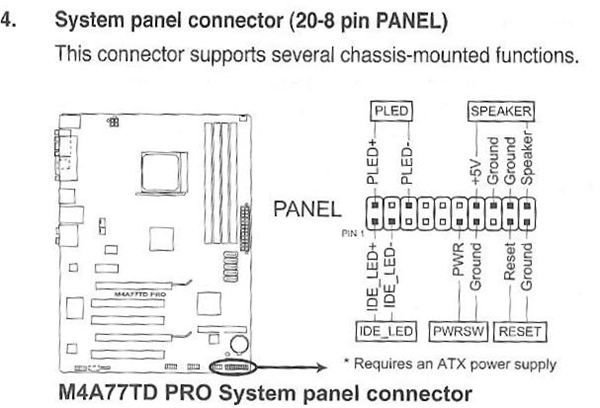
Situated on the motherboard, the power switch connector can be difficult to identify. It will be a collection of two or more pins in a row, and should be marked, often with the letters PWR.
You might have several collections of pins on your motherboard, depending upon the age of the device. If you are unable to refer to a manual (or search for one online using the model name printed on the mainboard) then you need to look for a collection of pins, possibly in 6 x 2 or 8 x 2 array formation.
Identifying the Motherboard Power Switch on the Front Panel Array
On most motherboards you should see two or three collections of pins. Some of these will be jumpers – these are small trios of pins that can be used to set or reset various hardware configuration settings on your computer.
Other collections of pins will be for USB. Whether you have USB connectors on the front panel of your PC or not, the USB pin array will always be situated away from the front panel array.
The front panel array is where you would typically expect to find the motherboard power switch. Along with this you should find the HDD LED connector, the RESET switch connector and connectors for microphone and headphone jacks on the front of your PC case.
References
Source:
- Author experience
Image:
- Image scan by author from ASUS M4A77TD PRO motherboard manual
- PC Tower photo by author