Facts about Europa, Jupiter's Fourth Largest Galilean Moon
The Facts
Europa is named after the beautiful Phoenician princess who, according to Greek mythology, Zeus saw gathering flowers and fell in love.
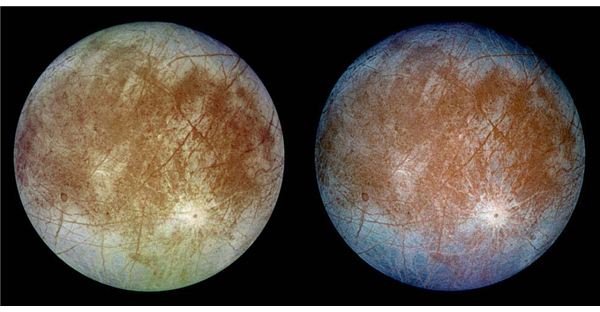
Europa is one of the brightest object in our solar system. When seen with a telescope the surface of Europa is rich in beauty.The long, dark lines are fractures in the crust, some of which are more than 3,000 kilometers (1,850 miles) long.Europa is best seen with colour filters.
Most of the images taken by hubble or NASA are colour enhanced using a combination different wavelengths from infrared to ultraviolet.
Although Italian astronomer Galileo Galilei is accredited to the discovery of Jupiter’s 4 largest moons it was German astronomer Simon Marius who named the four moons of Jupiter: Io, Europa, Ganymede, and Callisto. All four are named after mythological figures. Both astronomers claimed to have discovered them, around 1610, and it is highly likely both did so independently. A dispute over priority relegated Marius into relative obscurity.
This image shows two views of the hemisphere of Europa. The left image shows the approximate natural color appearance of Europa. The image on the right is a false-color composite image.
The Facts
1. Europa is the smallest of the four Galilean moons of Jupiter
-
Diameter (km): 3,138
-
Mass (kg): 4.8e22 kg
-
Mass (Earth = 1) 0.0083021
-
Surface Gravity (Earth = 1): 0.135
-
Mean Distance from Jupiter (km): 670,900
-
Mean Distance From Jupiter (Rj): 9.5
-
Mean Distance from Sun (AU): 5.203
-
Orbital period (days): 3.551181
10.Rotational period (days): 3.551181
11.Density (gm/cm³) 3.01
12.Orbit Eccentricity: 0.009
13.Orbit Inclination (degrees): 0.470
14.Orbit Speed (km/sec): 13.74
15.Escape velocity (km/sec): 2.02
16.Visual Albedo: 0.64
Surface Composition: Water Ice
Credits:
This post is part of the series: Jupiter’s Moon, Europa, One of the Galilean Moons
Read the facts about the fourth largest Galilean moon of Jupiter, Europa. Mythological, physical, orbital and theoretical facts about Europa are available in this series.