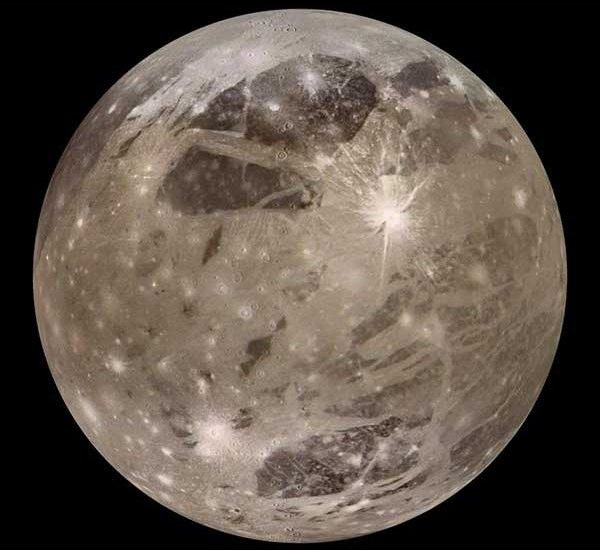
Ganymede is not only Jupiter’s largest moon—it is the largest natural satellite in the Solar System. It is larger even than the planets Pluto and Mercury. Ganymede is believed to have an iron core, and is the only moon known to have its own magnetosphere. Spark your interest? See below for more.
The Facts
Ganymede
Credit: NASA
-
First Observed: 7 January 1610
-
Discoverer: Galileo Galilei
Advertisement -
Position among Jupiter’s moons: 7th from the planet
-
Average distance to Jupiter: 1,070,400 km (665,115 mi)
Advertisement -
Rotation: synchronous with Jupiter (9hr 55m 30s)
-
Orbital period: 7days 3hr 41m 45.6 s (7.154 Earth days)
Advertisement -
Orbital Inclination to Jupiter’s equator: 0.20 degrees
-
Eccentricity: 0.0013
Advertisement
-
Diameter (equatorial): 5,268 km (3,273 miles)
-
Mass: 1.4819 x 10 kg (3.26703x10²³ lbs) (twice the mass of Earth’s moon)
Advertisement -
Mean Density: 1,936 kg/m3 (120.86 lbs/ft3)
-
Gravity: 0.146 x Earth’s gravity
Advertisement -
Escape Velocity: 2.741 km/s (1.64 mi/s)
-
Surface temperature (average): -163 C, -262 F, 110 K
Advertisement -
Surface pressure: trace
-
Albedo: 0.43 +/- 0.02
Advertisement
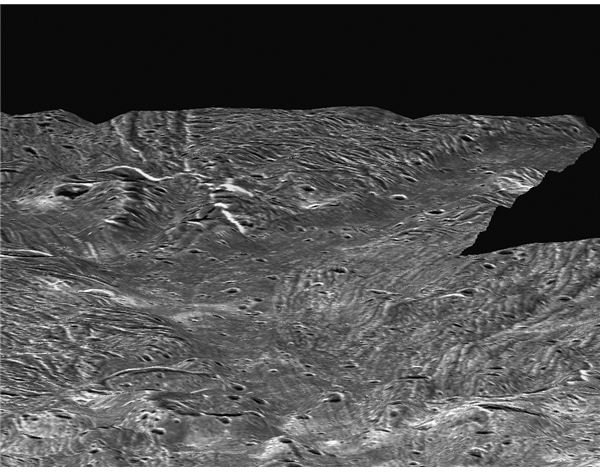
Ganymede Topography
Credit: NASA
Intriguing Features
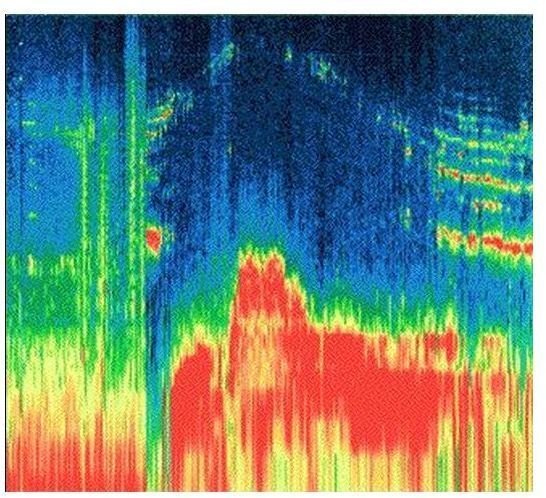
Spectrogram of Ganymede’s Magnetosphere
Credit: JPL/NASA
- Unique construction. It is believed Ganymede contains a metal center—liquid iron—encased by rock, which is in turn encrusted in ice. This makes Ganymede the most centrally concentrated solid body known in the Solar System!
-
Bring a compass. Ganymede has the distinction of being the only moon with a magnetosphere of its own, though largely overshadowed by Jupiter’s huge magnetic fields. The mechanism or mechanisms behind producing it remain uncertain, but evidence hints at an iron core. This suggests the so-called dynamo mechanism is at least partly responsible for it.
-
An atmosphere containing ozone. Although Ganymede’s atmosphere isn’t very substantial, its constituents are of great interest. In addition to monatomic and diatomic oxygen, the Hubble Space Telescope has revealed the presence of triatomic oxygen—ozone.
Advertisement -
Underground ocean? Ganymede might have an ocean layer lying beneath its icy exterior, but if so, it would exist as liquid only due to high pressure. Despite the presence of abundant water and some oxygen, Ganymede is likely incapable of supporting life.
-
An atmosphere, but no ionosphere? Because of Ganymede’s magnetosphere, oxygen molecules from its atmosphere should be ionized by electron. So far, however, there has been insufficient evidence to indicate the presence of an ionosphere. More detailed data is required.
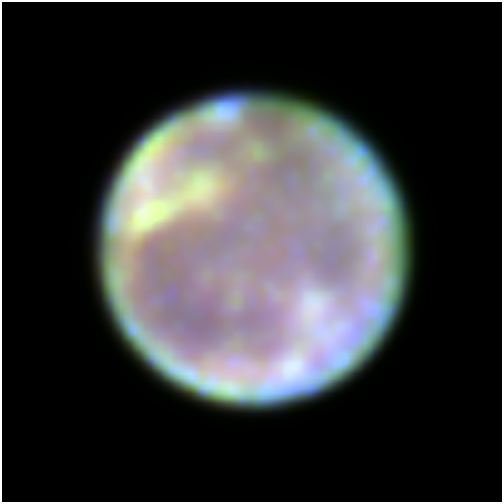
Hubble Finds Ozone
Credit: NASA
References and Resources
UCLA Institute of Geophysics and Planetary Physics: The Permanent and Inductive Magnetic Moments of Ganymede , by MG Kivelson.
Siderius Nuncius: Galileo’s First Jupiter Observations
UCLA SPINLab: Sulfur’s Impact on Core Evolution and Magnetic Field Generation on Ganymede
Also from Bright Hub: Trojan Asteroids: Jupiter’s Own Asteroid Belt , by MJ Logan.