What is the Higgs boson particle? Short answer: It’s the mediator of mass in a Higgs field. What does that actually mean? Read on to find out.
The Four Forces of Physics and Bosons in General
According to physics, there are four fundamental forces in the Universe: gravity, electromagnetism, the strong force, and the weak force. Each of these can be visualized as a field surrounding the source of the force, i.e. gravity field, magnetic field, electric field, etc. According to quantum physics, everything is both a wave and a particle at the same time, so according to particle physics, these fields all have associated particles that mediate them. Force-mediating particles are called gauge bosons, and there’s a different kind for each force:
- Graviton - mediates gravity
- Photon - mediates electromagnetism
- Gluons (8 kinds) - mediate the strong force
- W+, W-, and Z bosons - mediate the weak force
According to the Standard Model of particle physics which currently explains the latter three forces, all of the gauge bosons should have zero mass. This is true for the photon and gluons. The W+, W-, and Z bosons not only have mass, however, they have lots of it (subatomically speaking). This called for an explanation. The current prevailing hypothesis, proposed in 1964, is called the Higgs mechanism.
The Higgs Mechanism
According to Einstein’s famous mass-energy equivalence equation, the energy (E) and mass (m) of a given object are interchangeable with each other at a rate specified by E = mc2. An object can be composed of lots of energy and no mass, some energy and some mass, or lots of mass and no energy.
The Higgs mechanism, named after Dr. Peter Higgs of the University of Edinburgh, is a mechanism that confers mass on other elementary particles by converting some of their energy into mass. Like the four fundamental forces, it can be visualized as a field - a Higgs field - except it occupies every part of the entire universe all the time and doesn’t have a source. Also like the four forces, it comes with a particle. This is the Higgs boson particle. Instead of mediating a force, it mediates mass.
The current hypothesis is that the particle has a similar amount of mass to the W and Z bosons. There may also be more than one kind (like there are eight kinds of gluons). The Higgs boson is the only elementary particle in the Standard Model whose existence hasn’t been documented yet.
Proving Its Existence
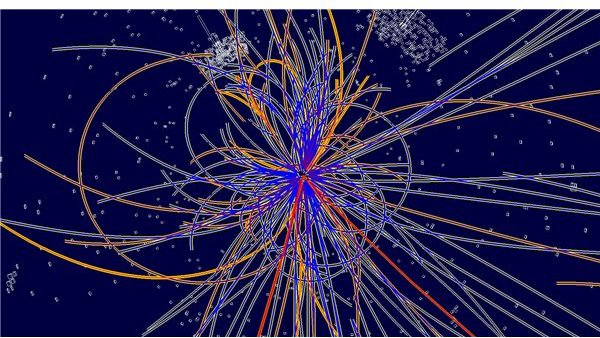
The existence of elementary particles are documented via high energy particle collisions. The faster a particle is going before the collision, the more information about the target can come out of it. Some elementary particles only form in isolation - where they can be detected - at very high speeds.
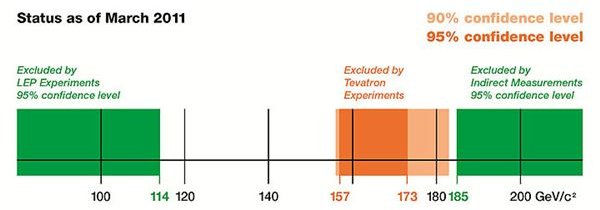
Accelerating a particle to high speed takes a lot of energy. CERN’s Large Hadron Collider - able to accelerate particles up to 3.5 TeV (terra electron volts) each for a total of 7 TeV in a head-on collision - is the first collider that definitely has enough power to produce a Higgs boson particle (though Fermilab’s Tevatron accelerator does too, at least theoretically). So far, particle collisions at Fermilab and CERN have significantly narrowed down the range of possible masses that it could have. The goal now is to keep narrowing it down until it is found - or until the entire range is eliminated, which would mean reformulating or rejecting the original hypotheses about its mass or existence.
References and Photo Credits
Giancoli, Douglas C. 1991. Physics: Principles with Applications 3rd ed. Prentice Hall.
Massive results for scientists homing in on Higgs boson
Picture of Higgs boson potential mass range by Aesir.le, public domain
Picture of simulated Higgs boson detection by CERN , allowed educational/informational use.
This post is part of the series: Particle Physics in Cosmology
The Standard Model of particle physics identifies the elementary particles of matter and provides an explanation for three of the four fundamental forces of nature - electromagnetism and the strong and weak forces, using force mediating gauge bosons and a mass mediating Higgs boson particle.