The Drake Equation, forged out of the same mold that created SETI, has directed the thoughts of scientists when it comes to the possible existence of extraterrestrial life for decades. But what does it consist of, and how have its considerations changed over time? This article explains.
A History
The Drake Equation was originally formulated by Frank Drake for the 1960 Green Bank meeting. This meeting consisted of astronomers, physicists, biologists, everyone who would need to be included in a discussion of the possibility of extraterrestrial life. Since then, it has become the guiding light of SETI theorists.
The Drake Equation is sometimes mislabeled the Sagan Equation, under the mistaken assumption that it is Carl Sagan who came up with this formula, and not Frank Drake. This is somewhat understandable, as Carl Sagan was one of the most outspoken proponents of SETI, but still incorrect.
The Drake Equation
Here is the equation:
N = R* x p x n x l x i x c x L
N is the number of civilizations in our galaxy who are technologically advanced enough that communication is possible. This number is a big lonely 1, plus the odd conspiracy theory and a caveat for our own relative ignorance as a youthful spacefaring civilization.
R* is the average rate of star formation per year in our galaxy. We have a reasonably good guess at this number, given large quantities of scientific data that have undergone much analysis over the years to arrive at it: NASA and the ESA come to 7 for our own galaxy.
p is the fraction of stars out of the sum total that have planets (exoplanets ), while n is the average number of these planets that can support life per star. These quantities are a bit more up in the air, especially given recent developments in detecting exoplanets which have indicated that these numbers could in fact be quite high. The current estimate is generally between .2 to .6. Limiting the n value is our own bias that life must occur on Earth-like planets in an Earth-like way, known as the Rare Earth Hypothesis, making it almost infinitesimal. But what about silicon-based lifeforms as opposed to carbon, or even more exotic creations? The n value could very well be higher by fact of our limited imaginations.
l is the fraction of these planets that actually end up developing life; i is the fraction of those planets that develop intelligent life: those which develop civilizations; c is the fraction of those civilizations which develop technology that releases detectable signals into space; L is the length of time required for them to do so. These variables are, obviously, particularly resistant to attempts of quantification, or even just getting a ballpark guess. Our understanding of how civilizations develop as the general case is somewhat limited. Based on studies of our sole case—Earth—it has been proposed that the leap between favorable conditions towards life and the creation of life itself is not that big of one, though this is of course highly speculative and highly variable. The further leap from life to civilization took the better part of a billion years in our case, but can this number really be generalized to all potential civilizations? It’s quite difficult to be scientific about these proposed quantities.
Keep in mind that the Drake Equation was never really intended to be an actual calculation, but rather, a general guide by which one can conduct thought experiments on the possibility of life on other planets. Many scientists, including Drake himself, have plugged numbers into this equation, but there is significant disagreement about them amongst the scientific community, including cries of arbitrariness and not enough evidence to make a legitimate attempt at calculating N.
Variations, Alternatives, & Extensions
As would obviously arise with a popular theory, a number of changes to the Drake Equation have been proposed over the years. Check out the equations below (sorry, no math support on this site!) and the explanations below.
**

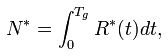
N* describes the number of stars in the galaxy, and T, the age of the galaxy. The uppermost integral demonstrates the relationship between the number of stars in the galaxy, the rate of star formation, and the age of the galaxy. Using this, a more timely version of Drake’s Equation may be derived, here assuming the rate of star formation is constant (which it isn’t, but again, this is not intended as an equation you actually calculate. This expression merely encourages you to take into account the age of a galaxy when considering the likelihood of spacefaring life arising from it.)
Additional variables that have been suggested for Drake’s Equation include n, the reappearance number, or how long it takes for a spacefaring civilization to reemerge on a planet after an older one on the same planet has ended in some form or another. It is fathomable that over the course of a lifetime of a planet, enough intelligent species may collapse due to environmental damage, nuclear warfare, superviruses or other similarly destructive means, and another civilization and/or species may rise to take their place.
Another factor to consider: m, sometimes referred to as the METI number (Mesaging to Extra-Terrestrial Intelligence.) This would be the fraction of technologically advanced civilizations that deliberately engage in interstellar communication, or at least attempt to. It is not too difficult to formulate the concept of a civilization that attempted to avoid contact with others to protect itself from warfare or exploitation by a potentially more advanced civilization.