LIGO Detectors May Prove Einstein's Prediction of Gravitational Waves
Einstein’s Prediction of Gravitational Waves
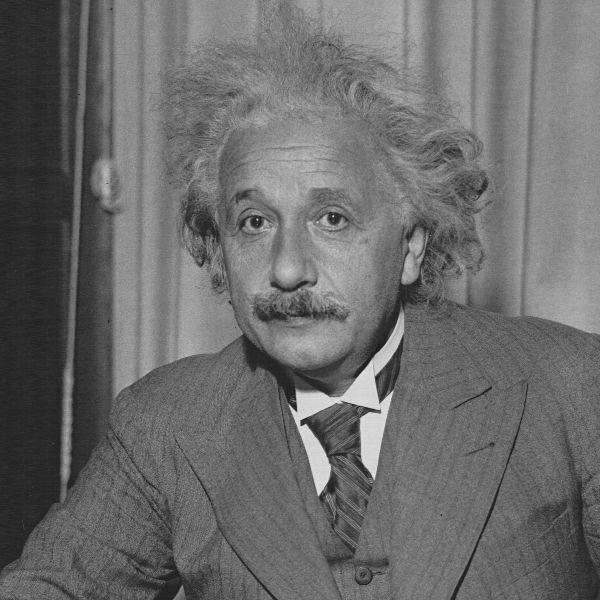
Almost one hundred years ago the great Albert Einstein published the theory of General Relativity and gravitational waves were one of the major predictions of this theory. Gravitational waves are a disturbance in the curvature of space-time caused by the motions of matter and they propagate as a wave, traveling outward from a moving object or system of objects. Important examples of systems which emit gravitational waves are binary star systems, where the two stars in the binary are white dwarfs, neutron stars, or black holes. (Even seemingly less dynamic systems, like our solar system, generate gravity waves as the planets revolve around the sun, but at much smaller amplitudes.) But when Einstein predicted gravitational waves, technology was not at the point where detection of gravitational waves was possible.
By the 1970s, scientists realized the applicability of laser interferometry to gravitational wave measurements. One of them was Rainer Weiss, who is now professor emeritus of physics at MIT. Based on his design, LIGO was built and this project was funded by the National Science Foundation. So scientist started working on laser interferometry and in August 2002, LIGO started searching gravitational waves. Its aim is to detect the gravitational waves from black holes, binary stars, neutron stars and the remnants of gravitational radiation left over form the Big Bang.
How Laser Interferometers Detect Gravity Waves
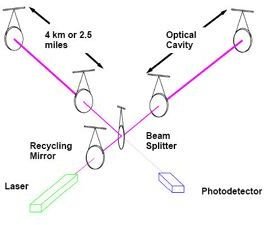
A laser interferometer is the basic device used at LIGO to detect the ripples in space-time or gravitational waves. In the interferometer, two mirrors hang far apart, forming one “arm” of the interferometer, and two more mirrors make a second arm perpendicular to the first. Viewed from above, the two arms form an “L” shape; it is known as a power-recycled Michelson interferometer with Fabry-Perot arms. A beam splitter is located at the corner of the L, through which laser light enters the arms. The light reflects between the mirrors repeatedly before it returns to the beam splitter and some light will travel toward a photodetector.The photodetector can measure the time taken by the light to travel between the suspended mirrors. According to Albert Einstein’s general theory of relativity, the relative distance between the mirrors will change very slightly when a gravitational wave passes by and at the same time the amount of light falling on the photodetector will vary .The photodetector produces a signal which shows how the the amount of light falling on it changes over time. Thus a gravitational wave is detected by LIGO.
Diagram of a Laser Interferometer
LIGO Observatories
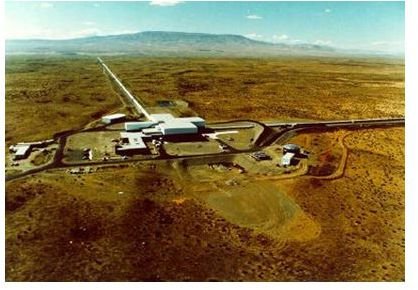
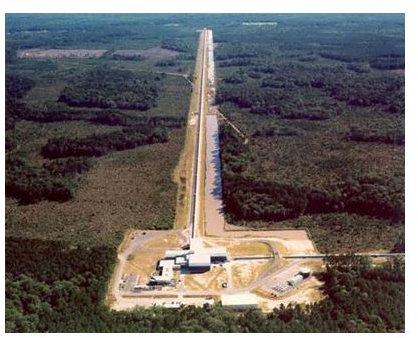
A team of researchers from MIT and Caltech jointly operate the LIGO. Currently there are two observatories - one is the LIGO Livingston Observatory in Livingston, Louisiana and another one is, the LIGO Hanford Observatory, on the Hanford Nuclear Reservation located near Richland, Washington. These observatories are separated by 3,002 kilometers.
Images of Existing LIGO Observatories
Einstein@Home
Do you want to contribute in this LIGO research ? If your answer is yes then visit Einstein@Home. Its a program where your computer is used to process LIGO data. You just need to install the software, which works when your computer is idle. It is adware and virus free.
Credits for Images
1. Einstein - Stanford University
2. Laser Interferometer - MIT
3. Hanford Observatory - NASA
4. Livingston Observatory - Caltech