Information on the Discoveries of Extrasolar Planets or Exoplanets
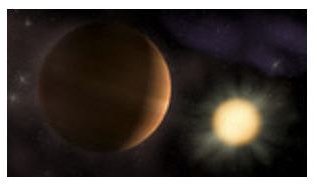
First Extrasolar Planets Discovered
For all of human history we’ve looked up at the night sky and wondered what was out there. Noble gases, cosmic dust, suns similar to our own and those that are wholly different that are born and die each minute. Since the first telescope was constructed and humankind embarked on its journey to the stars, we’ve asked ourselves a burning question: are we alone? In recent years we’ve come much closer to an answer, and while we’ve not yet gotten a call from E.T., we now know for certain that there are planets out there where he might live.
As of July 3, 2008, the existence of 307 planets outside of our solar system have been confirmed by astronomers and other scientists. Put simply, an extrasolar planet—less frequently referred to by scientists as an exoplanet—is defined as any planet that orbits a star other than our own.
The first definitive discovery of an extrasolar planet is attributed to radio astronomers Aleksander Wolszczan and Dale Frail, whose 1990 discovery revealed the existence of two planets orbiting the pulsar star PSR 1257+12. The data regarding the presence of the planets, as well as the pulsar itself, were published in 1992. Though many scientists refuted these findings at the time, it is now generally accepted by the scientific community that the data is substantiated and confirmed, and that this was indeed the first discovery of its kind.
Michel Mayor and Didier Queloz of the University of Geneva announced on October 6, 1995, their detection of an extrasolar planet orbiting the main-sequence star known as 51 Pegasi. The planet was designated as 51 Pegasi b, setting the standard for extrasolar planet nomenclature (a lower case letter after the name of the star, b for the first planet, c for the second, etc.). From this point forward, the discovery rate of extrasolar planets exploded due to rapid advancements in technology.
Detecting Extrasolar Planets
There are two basic methods of detecting a planet circling a star outside of our own solar system; indirect methods and direct methods. At present, most of the extrasolar planet discoveries have been made via indirect means. As a light source, planets are extraordinarily faint in relation to their parent stars. With the current state of technology, this makes it difficult to directly image a planet unless all circumstances at the time of viewing are absolutely perfect.
In order for there to be any chance whatsoever of directly imaging an extrasolar planet, several conditions must be met. The planet must be exceptionally huge, on the order of many times the size of our own gas giant, Jupiter. The giant planet must be a considerable distance from its parent star, so that the planet is well beyond the range of glare created by the star’s own magnitude of brightness.
Additionally, the planet itself must be so hot that it gives off a substantial amount of infrared radiation of its own.
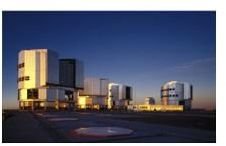
The first extrasolar planet to be directly imaged via infrared—2M1207 b in 2004—was also the first to be found orbiting a brown dwarf star. The image was collected by a group of astronomers at the European Southern Observatory’s Very Large Telescope (VLT) array in Chile. The status of 2M1207 b as a planet was confirmed in December of 2005.
For now, indirect methods—which are most effect when the extrasolar planet has its orbit in roughly the same plane as Earth’s—are the most commonly used method of detection. The transit method, whereby the amount of light given off by a star is dimmed by a planet passing in front of it from Earth’s perspective, has also proven to be reliable. Transit and gravitational microlensing are currently the most common methods of extrasolar planetary detection. The so-called wobble method—where a planet’s existence can be discerned by the impact it has on its resident star’s behavior—was in the past the most commonly used detection method. Today, the technique is used primarily to support data already collected by more modern means.
One of the most exciting extrasolar planet discoveries was announced on April 24, 2007 regarding the most Earth-like extrasolar planet discovered to date, Gliese 581 c. The excitement was generated due to this planet’s positioning in its parent star’s so-called habitable zone, which would allow water to exist in a liquid state: a necessity (as far as we know) for supporting life. It was later determined that another planet in the same system, Gliese 581 d, was a more viable candidate for supporting life as we know it. Subsequent studies have determined that it’s more reasonable that Gliese 581 c has conditions similar to our solar system’s planet Venus.
Kepler Space Observatory and other NASA Projects to Continue Searching
The search for extrasolar planets will be moving from the ground into space, with the launch of NASA’s Kepler Space Observatory in February 2009. According to the NASA mission objective Kepler is “NASA’s first mission capable of finding Earth-size and smaller planets around other stars.” The Kepler Space Observatory will use the transit method of detection.
Exciting advances are on the horizon as older technologies are improved and new ones are developed. NASA’s Space Interferometry Mission is slated to launch in 2014, and may have the capability of detecting Earth-like planets orbiting stars relatively close to our own planetary system. NASA’s Terrestrial Planet Finder probes will endeavor to directly image extrasolar planets, as will the European Space Agency’s Darwin mission. With these and other projects looming just over the horizon, the possibly of finding our home planet’s extrasolar cousin is no longer relegated to the realm of science fiction.
Photo Credits:
Left: Artist’s conception of a massive extrasolar planet orbiting a star in transit. From earth, the dimming light of the star is measured as the planet crosses the face of its parent star. Credit: J. Hall, Lowell Observatory. Copyright: Lowell Observatory.
Right: Very Large Telescope (VLT) array at the European Southern Observatory, Chile. Copyright: ESO, European Organisation for Astronomical Research in the Southern Hemisphere