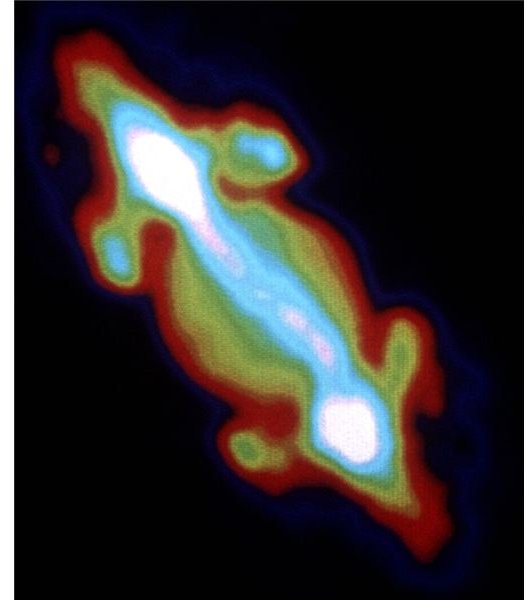
We may take the complexity of our eyes for granted, but astronomers do not. Interferometry is a technique that uses a number of telescopes together to provide a more accurate picture of the heavens than a single telescope can provide.
Two “’eyes” are better than one
The name “interferometry” may sound like a complex concept, but the basis for it is as simple as our own two eyes. Humans may take binocular vision for granted, but this biological breakthrough is what allows for depth perception and our eyes’ uncanny ability to detect motion.
Take a moment to try an experiment: touch a finger to your nose, then move it out a handspan. Close one eye, then the other. Do you notice the separation between the two images? That separation is called parallax. Move your finger out further and repeat the experiment. The separation between the two images decreases. If the separation between the viewing positions and the separation between the viewed object in the images is known, then it is possible to determine the distance between the line connecting the viewpoints (this line is referred to as a baseline) and the object. The longer the baseline, the greater the resolution of the distance measurement. With a long enough baseline, extremely small changes in position can be detected.
It might seem impractical to apply this principle to astronomy, but there are a number of ways in which to do so. One means is to move the position from which you are observing by separating your measurements in time, allowing the change in the Earth’s position to provide the baseline. Naturally, such an approach can suffer from problems caused by the long span in between observations. Thankfully, modern communications technology allows observatories to be networked across vast distances, creating “synthetic” telescopes with resolutions far in excess of anything achievable with a single instrument.
While it is possible to use interferometric techniques with optical telescopes (in fact, astrometry employs optical interferometry in estimating the distances of stars and locating extrasolar planets ) , these techniques are most commonly used in the case of radio telescopes. Since the resolution of a telescope is in direct proportion to the frequency of light detected, radio telescopes suffer from decidedly lower resolution than their optical cousins. Thanks to real-time computer networks and data storage capabilities, the images from multiple telescopes can be combined, allowing radio astronomy to achieve resolutions orders of magnitude better than can be achieved otherwise.
Credits
Image by NASA