String Theory and Dualities, Branes and M Theory
Duality Clears the View
As physicists struggled to find a way to compactify each of the five string theories into our four observable dimensions, they stumbled upon an amazing phenomenon. Perhaps there were not 10 dimensions to deal with—perhaps there were 11!
They came to this conclusion as they studied a mathematical phenomenon known as DUALITY. This is a phenomenon in which two theories act the same in different situations. There are three types of dualities, S, U, and T. We will start with T here because it created the major breakthrough.
T-duality applies specifically to closed strings such as described in the Type II theories and the herterotic theories. The energy of the closed strings is determined by the number of times they are wound in a circle. If the circle is compactified, the two Type II theories become one, and the two herterotic theories become one. That reduces the number of string theories from five to three!
S-duality deals with the relationship between the magnetic charge and the electric charge in the quantum world. In the ‘real world’ they are inversely proportional. In other words, if the electric charge is high, the magnetic charge is low, and vice versa, and the coupling between the two forces is very weak. In the world of strings, at high energies, the coupling between the two forces becomes extremely strong, thus creating the electromagnetic force. The Type I theory weak coupling is equivalent to the strong coupling of one of the herterotic theories, thus relating them. It was now obvious that each of the string theories were but special cases of one all encompassing theory.
But this coupling was true only if there were an 11th dimension that had not previously been discovered. Apparently this 11th dimension had always been there, but was too small to show up until high energies were considered. The 11th dimension appeared to be the environment that carried gravity.
A Universe Formed of Membranes
Originally, the open strings of the Type I theory were considered to be “free floating,” with their end points moving freely. But the concept of an 11th dimension called that into question. For open strings to fit into this embryonic “Theory of Everything,” one end had to be attached to something so that the attached end became a point.
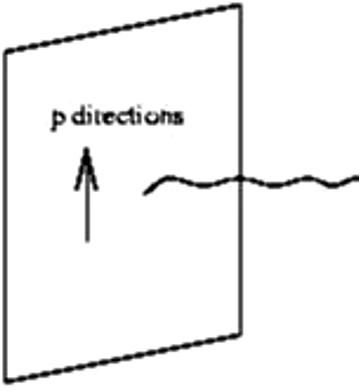
Let’s do a mind experiment. Consider that you have the world’s most powerful microscope and can actually see the one dimensional strings. As they vibrate at quantum speeds, they seem to form a two dimensional plane. It is like a membrane in the quantum world. A string can attach one end to this membrane and thus solve the problem posed by the 11th dimension.
In the illustration above, the term p stands for the number of dimensions the membrane moves in.
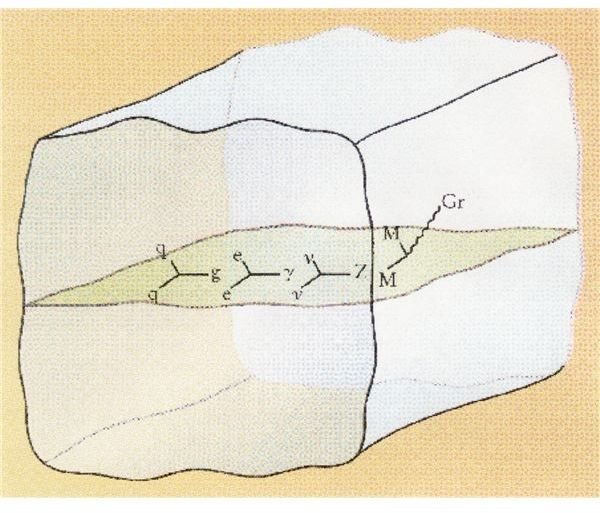
In this developing theory, the membranes became known as branes. Branes can have any of nine dimensions. There are 0 dimension branes—strings—2 dimension branes—the membranes we’ve discussed—and 3 dimension branes—volumes which is the universe we live in!
Yes, this M theory as it has come to be called, postulates that our universe is a brane within a larger volume of other branes, perhaps other universes. In the illustration below, the graphs are Feyman diagrams describing the quantum world of our universe. In the greater volumn are other branes–other universes. How many? The theory is too embryonic to specify yet. It is not even well understood by its most rabid proponents yet, but they are certain they are on the right track to a theory of everything.
They have some good reasons for being positive. The basics of the theory has explained a great deal about black holes. For example, the creation of certain types of black holes can be described by a five dimensional brane—a 5-brane—and open strings travelling down a 1-brane with all of them wrapped on a five dimensional torus. This effectively creates a one dimensional object—a black hole.
Hawking radiation from black holes has also been explained by string theory as open strings traveling in both directions, interacting, and emitting radiation as closed strings.
The theory also explains why gravity is the weakest of the four forces. Since it propagates through the 11th dimension, it can move between branes whereas the other forces cannot. Gravity therefore produces its force throughout the 10 spatial dimensions and so is dissipated.
During most of the development of string—now M—theory—the hit on it was that not only could it not be proven, it could not be proven false. That may soon change. Researchers at the University of California, Carnegie Mellon University and the University of Texas have developed an experiment to be performed with the Large Hadron Collider at CERN that will test several major predictions of the theory.
If the results are positive, it will prove Arthur C. Clarke’s tenet: “The universe may not only be stranger than we imagine, it may be stranger than we CAN imagine.”
Credits
String on membrane: Tata Institute of Fundamental Research https://theory.tifr.res.in/~mukhi/Physics/string2.html
Expanded universe: University of Oregon https://abyss.uoregon.edu/~js/21st_century_science/lectures/lec17.html
This post is part of the series: The Eleventh Dimension–Strings, Superstrings, Membranes and Multi-Universes
The development of string theory has given rise to some of the most esoteric concepts in physics. From what goes on inside a black hole to why there are so many subatomic particles to the possibility of multiple universes next to ours, the concepts are more than mind boggling.