Are we at the center of the universe? Is there a uniform distribution of matter and energy around us to indicate that we may be at the center? What does the evidence indicate?
If All Galaxies Are Moving Away From Us, Does This Mean We Are At The Center Of The Universe?
The question that is the subject here is one of the basic questions of cosmology. The immediate and simple answer is that if you consider the frame of reference as astronomers do, from any single perspective all galaxies are moving away from the observer. (Except for those in our local group which are under mutual gravitational attraction.) This is evidence of the uniform expansion of the universe. A simple balloon example will demonstrate this.
Balloons and Universes
Two ideas made their way out into the scientific public in the 20th century. One was that the universe was expanding, the other was that there was an origin in time to the expansion.
The first idea readily leads to a question, if it is expanding, what is it expanding into? More space? That means that space is expanding into space. But that does not make sense.
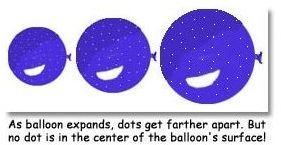
Think of a balloon that has dots on the surface and gets blown up. As the balloon gets filled with air it gets bigger and the dots separate, the “expand” in their distance from the other dots. The balloon itself expands, but it expands into space.
This is a common way to look at the expansion of the universe like a ballon, and the galaxies are the dots.
Image Credit, NASA, The Space Place
The Big Bang Was Not An Explosion
The second idea that entered the scientific consciousness was the Big Bang . This event occurred some 13.7 billion years ago, and it was explosion of space, not an explosion in space. The laws of physics began to take shape and form, but not all at once. For example, It took about 400-500,000 years for atoms to form.The universe that we see now was not the universe that was around at the time of the Big Bang. The physical laws that we see now, were not the physical laws present at the time of the Big Bang.
So what was the Big Bang? And how is an explosion different from the Big Bang? Consider an explosion that takes place some where in the desert. What do you see? First there will be a bright light. Then you will feel the shock wave followed closely by the sound wave, and followed by debris. And even after that, over the course of time, the debris will settle down leaving only a small trail of dust in the air. The geometric sequence of the explosion is like this: there is a central point, followed by a growing diameter (a function of the power of the explosion) getting larger and larger until the outer circumferential edge is reached; it is the furthest point where any debris is scattered. This scenario can explain the explosion, but it cannot explain the Big Bang.
If the Big Bang were an ordinary explosion, in an already existing space, we would be able to look out and see the expanding edge of the explosion with empty space beyond. But that does not happen. Rather the evidence shows that if you look backwards towards the Big Bang’s point of origin itself you do not detect some blazing hot point with bright lights showering everything in every direction. Instead you detect a faint background glow from the hot primordial gases of the early universe. This was detected by the COBE , the cosmic microwave background explorer satellite.
You don’t see a massive explosion, you see only a faint glow. In other words, there was no massive explosion first followed by a faint glow afterwards of “things” settling down. No, instead you see only a faint glow which is the cosmic microwave background radiation, the remnant of the Big Bank, which is uniform in all directions. This tells us that it is not matter that is expanding outwards from a point, but rather it is space itself that expands evenly.
In the Big Bang model there was no space and time before the Big Bang. There was not even a “before” to speak of. So, the Big Bang was very different from any explosion we are accustomed to and it does not need to have a central point. Put it like this, the “explosion” occurred everywhere at the same time. The result of the Big Bang was the creation of the physical universe that we live in, and are learning the laws of, that govern the motion of all the matter and energy in the cosmos.
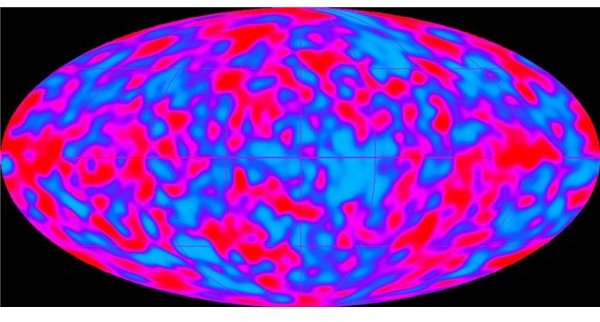
Image Credit:The Smoot Group
The Cosmological Principle
A uniform universe is one that is homogenous (the same in all locations) and isotropic (the same in all directions). This is the Cosmological Principle. This uniformity, of course, is over very large scales and distances because even just looking at our Solar system, it does not look homogenous and isotropic. It is diverse with very large objects and very small ones.
In 1924 Edwin Hubble showed that other galaxies exist outside our own. And he was the first to show that they were moving away from us at an increasing rate. Another discovery in the 20th century is that there is a great deal of structure in the distribution of the galaxies, it is not uniform. But most cosmologists still hold to the cosmological principle for philosophical reasons or because it is has not been contradicted by any large scale observation, even though on the small-local scale, structure is seen.
But the great caveat is that we see the Universe limited by the speed of light and the finite time since the Big Bang. The observable part is very large, but it may be very small compared to the whole universe.
The shape of the Universe beyond the observable horizon is unknowable, and more than that there is no way of knowing whether the cosmological principle has any validity on the largest distance scales possible.
The Void Model
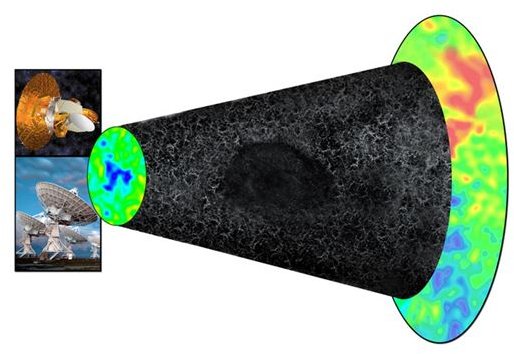
In 1998, studies of distant explosions called type Ia supernovae indicated that the Universe was accelerating. The observation relied on the repulsive force of a mysterious “dark energy.” Some cosmologists on the otherhand proposed that Earth was at the center of a void, and that gravity would create the illusion of acceleration. This would account for the effect of dark energy on the supernova observations. Instead of there being a repulsive force of dark energy, there was a void, and the Earth was at the center.
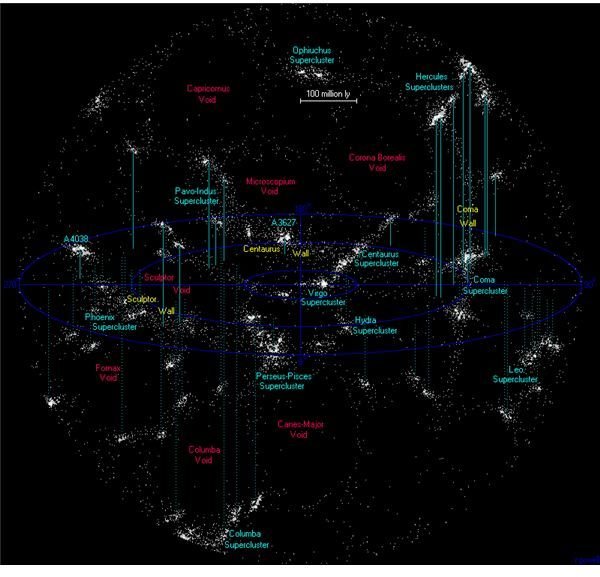
Image Credit**:** Bill Saxton , NRAO/AUI/NSF, NASA
Image Credit: Richard Powell , Atlas of the Universe
New Evidence To Support The Copernican Principle
Astronomers tested void models against the latest data, including subtle features in the cosmic microwave background radiation and ripples in the large-scale distribution of matter. They found that void models do a very poor job of explaining the combination of these data. This in turn supports the long held view first suggested by Copernicus. By moving Earth away from the center of the solar system, to an ordinary place in the solar system, he set a scientific principle in place, The Earth is not located in a special place. Since then astronomers have gone the extra step in saying that the solar system, the Milky Way and other astronomical objects themselves are not in a special place.
Dark Energy is being studied by the BOSS telescope. It will look for evidence that dark energy is responsible for the expansion of the Universe, and hence to support the Copernican principle .
Are We At The Center Of The Universe?
Hence the question “Are we at the center of the Universe” is answered yes, but only if every other observation point is also the center of the universe. The reason for this existential answer is that:
-
The Universe is uniform: it looks the same from all directions or observation points. There is no priviledged position.
Advertisement -
The large scale size of the universe cannot be supported by the Void Model where our appearance in this part of the universe can be explained because we are in a void.
-
Dark energy is showing that the Universe is expanding at an increasing rate, so every part of the Universe is expanding, also showing that there is no priviledged position.
Sources
Astronomers Find Enormous Hole in the Universe; https://www.nrao.edu/pr/2007/coldspot/
The Cosmological Principle; https://csep10.phys.utk.edu/astr162/lect/cosmology/cp.html
The Cosmological Principle, The Copernican Principle; https://abyss.uoregon.edu/~js/cosmo/lectures/lec05.html
Milky Way moving away from void; https://www.astronomy.com/asy/default.aspx?c=a&id=5669