General Information & Facts About the Constellation of Orion: The Mighty Hunter - Info on Stars, Mythology & More
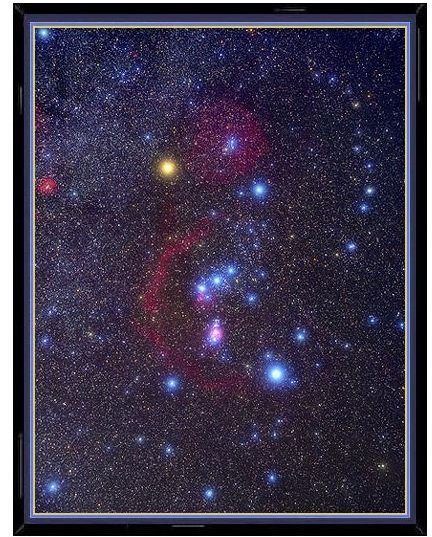
Basic Facts About the Constellation Orion
-
Abbreviation: Ori
-
English Meaning: the Great Hunter
-
Right ascension: 5°
-
Declination: +5°
-
Area: 594 sq. deg.
-
Visible Latitudes: between +85° and −75°.
-
Best Viewing: During January at 21:00 (9 p.m.)
Stars:
- Stars in the system: 81
- Number of bright stars: 8
- Brightest star: Rigel (β Orionis) (0.12m)
- Nearest star: GJ 3379 (17.1 light years)
- Messier objects: 3
Meteor Showers
- Orionids - This is a meteor shower that occurs when Earth passes through the dust from Halley’s comet. It appears within the constellation Orion. The best viewing time is between October 15 and October 29, but maximum visibility occurs during the morning hours of October 20-22.
Bordering Constellations
- Gemini
- Taurus
- Eridanus
- Lepus
- Monoceros
NOTE: The above photo of the constellation Orion shows, enlarged in their true color, the main “naked eye” stars that make up the shape of the constellation.
The Stars Of Orion
Here is a list of some of the best known stars in the Orion constellation
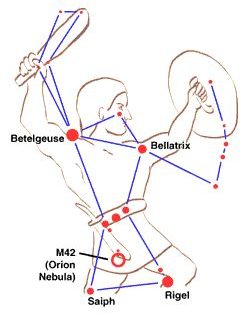
- Betelgeuse (Alpha Ori) is a giant red star located on Orion’s right shoulder. The star is larger than the orbit of Mars and is the second brightest star in Orion.
- Rigel (Beta Ori) located at the constellation’s left knee, it is a large blue supergiant star. It is one of the brightest stars in the sky and the brightest star in Orion.
- Bellatrix (Gamma Ori) “warrior woman,” is located at Orion’s left shoulder.
- Mintaka (Delta Ori) one of the three stars that make up Orion’s belt, it is the left-most star.
- Alnilam (Epsilon Ori) the middle of three stars that make up Orion’s belt.
- Alnitak (Zeta Ori) the third and right-most of three stars that make up Orion’s Belt.
- Saiph (Kappa Ori) located is at Orion’s right knee.
- Hatsya is at the tip of Orion’s sword.
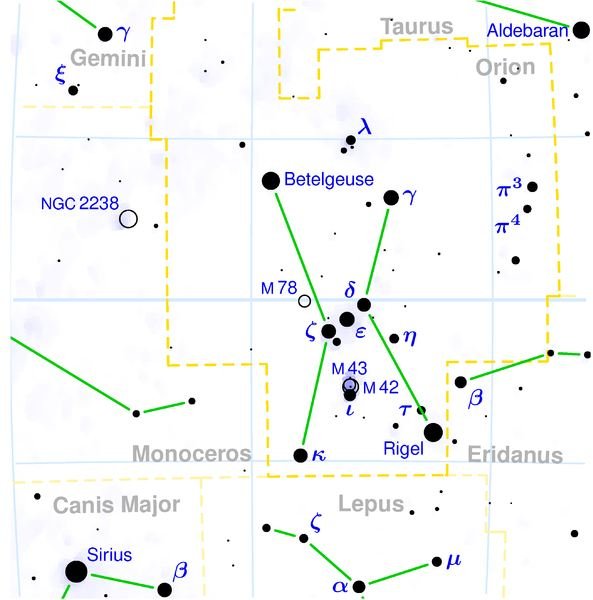
Image Credit: Torsten Bronger.
Messier Objects in Orion
Here is a list of the known Messier Objects in Orion:
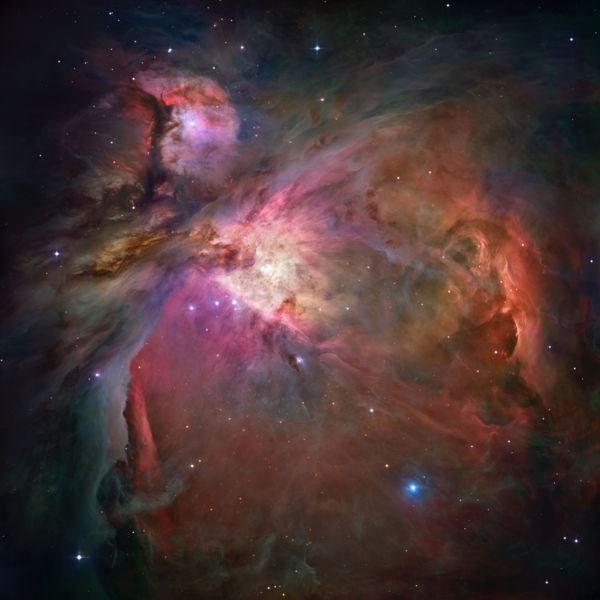
- M42: The Great Orion Nebula (diffuse nebula).
- M43: Part of the Orion Nebula, de Mairan’s Nebula (diffuse nebula).
- M78: A diffuse reflection nebula.
Meteor Showers - The Orionids
Halley’s Comet leaves plenty of dust behind as it travels through the solar system. As a result two meteor showers are the result of the Earth’s passage through the dust trail. The first is the Eta Aqarids, and the second is the Orionid meteor shower. The point of origin for the Orionid meteors is located within the constellation Orion.
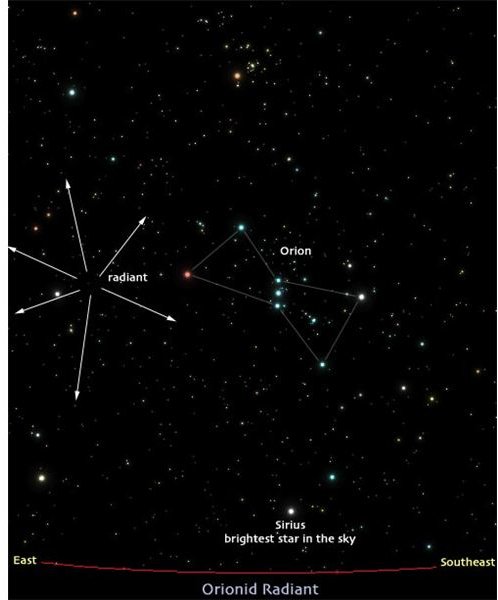
The Orionids are barely detectable on the beginning and ending dates Oct 15 through Oct 22. In the Northern Hemisphere will see around 20 meteors per hour at maximum, while observers in the Southern Hemisphere will see around 40 meteors per hour.
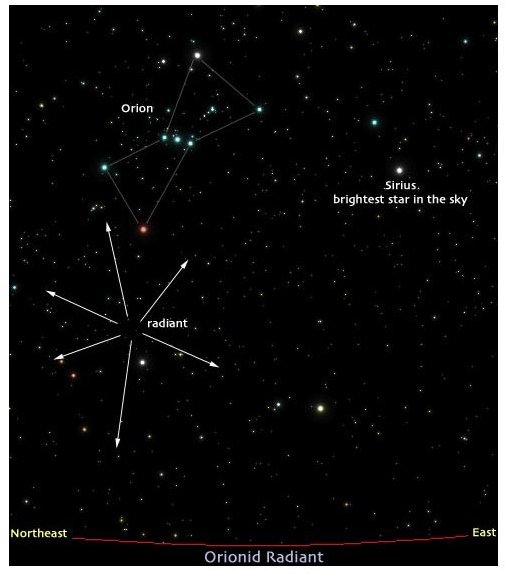
Image credit: https://meteorshowersonline.com/orionids.html
Orion: Myths and Origins
Orion is one of the best known and most recognizable star-patterns in the sky. Orion represents aheroic hunter of Greek myth. This constellation is rich in bright stars and nebulae lying on the edge of the Milky Way.
Orion is a well-known constellation and has had special significance for many cultures throughout history. It is hard to know when it was first identified, but it was probably first discovered by Sumerian and Babylonian astronomers 4000 years ago. However, the Orion nebula was not discovered until 1610.
The Mythology Behind the Orion Constellation
The Orion constellation was well known to the ancient Greeks. The picture below shows the great hunter Orion. He is holding a lion’s head instead of a bow or shield and is stalking Taurus, the Bull. Canis Major, his dog, is behind him and it is chasing Lepus, the Hare.
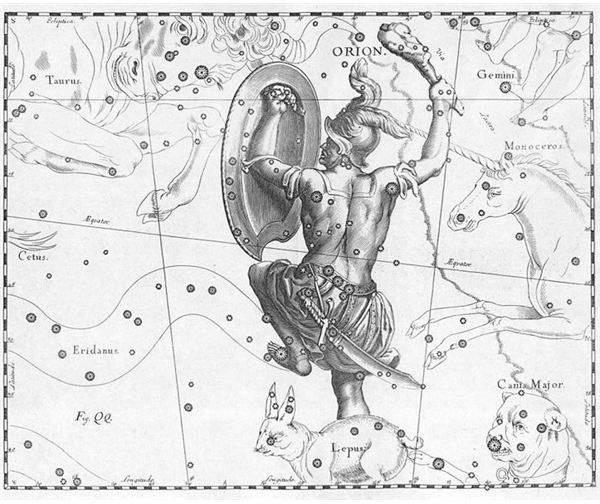
The constellation Orion was named after the Greek hunter Orion, who was supposedly put into among the stars by Artemis after she was tricked into killing him by her brother Apollo.
Another mythical story tells us that Orion was in love with one of the Seven Sisters, Merope, who form the Pleiades. Orion fancied Merope but she was not interested in him, despite anything he did. He pursued her for seven years. But then his life turned tragic when he stepped on Scorpius, the scorpion and he died. The Gods felt pity on him and put Orion and his dog in the sky as constellations.The animals that he hunted were placed up there near him except Scorpius who ended up on the opposite side of the sky so Orion would never be hurt by him again.
Navigation Aid
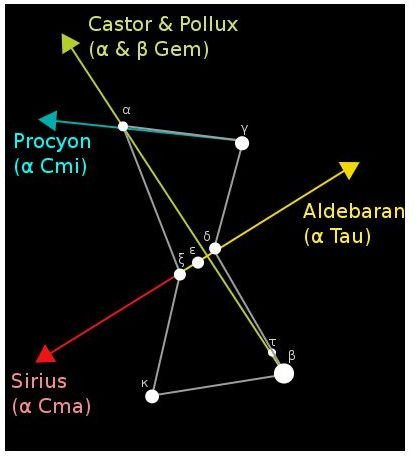
Because of its position in the sky, Orion can be seen by both the northern and southern hemispheres, making it a useful as an aid to locate other stars
- Sirius (α CMa) can be found by extending the line of the Belt southeastward. Sirius is the brightest star in the night sky with a visual apparent magnitude of −1.46.
- Aldebaran (α Tau) can be found by extending the line of the Belt northwestward.It is the brightest star in the constellation Taurus.
- The direction of Procyon (α CMi) can be seen as a line eastward across the two shoulders. It is the brightest star in the constellation Canis Minor. Although it looks like a single star it is a binary star.
- Betelgeuse points to Castor and Pollux (α Gem and β Gem) through a line from Rigel. Betelgeuse is a variable star and a red super giant. Castor and Pollux are the heads of the twins of the constellation Gemini.
- Sirius and Procyon can be located from Orion by tracing lines. These two stars are part of the Winter Triangle, the other star is Betelgeuse.
Sources
https://www.naic.edu/~gibson/pleiades/pleiades_myth.html
https://www.astro.wisc.edu/~dolan/constellations/constellations/Orion.html
https://chandra.harvard.edu/photo/constellations/orion.html
https://en.wikipedia.org/wiki/File:Orion_constellation_map.png
This post is part of the series: Special Astronomy Objects
In this series we look at several different astronomical objects and their composition. This will show the magnitude of size and the diversity of objects in the visible universe.