As seen from earth, the planets generally move from east to west. Occasionally, however, a planet appears to move backward. This is termed “retrograde motion.” How can retrograde motion of the planets be satisfactorily explained?
Historic Discernment of Retrograde Motion
For centuries, Man was puzzled by the east-to-west rotation of light point-sources in the night sky. Why did they travel concertedly, that is maintaining their relative positions to one another, rather than moving about at random? Further observations led to another question. Why was it there were, in fact, a few of the points that did alter their positions within the background? The Greeks, who were always interested in something new, named these anomalous objects planete (wanderers)—the planets. Of further interest, the Greeks noticed that once in awhile, the wanderering planets appeared to stop and briefly move west-to-east and then reverted to east-to-west motion.
How is Retrograde Motion Explained?
The normal east-to-west motion of the stars from earth’s perspective is called direct or prograde motion.
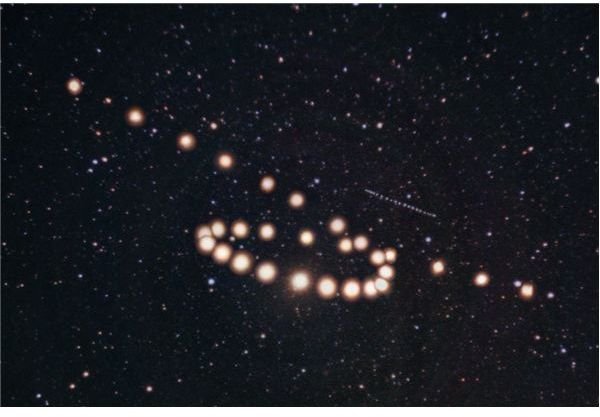
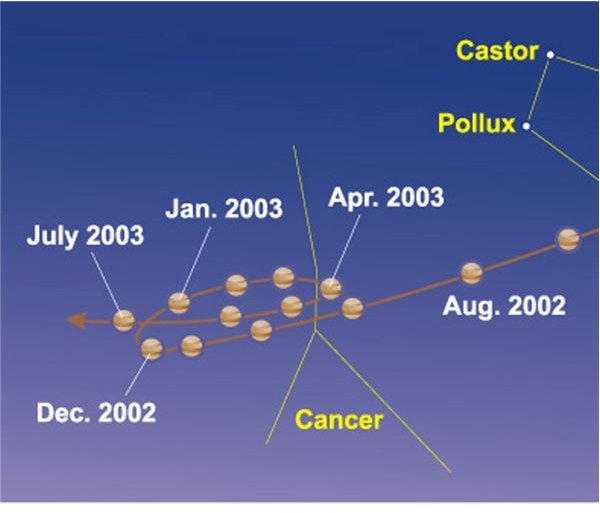
As Earth catches up with a planet in its orbit, the planet appears to halt its journey to the east and appears then to rotate to the west (see the images, below). Then as Earth continues to move—past the planet—the west-to-east motion appears to revert to the normal east-to-west motion. This is particularly apparent with planets beyond earth, as earth moves faster in its orbit than they do**.**
Mercury and Venus undergo retrograde motion but not as frequently. The planets further from the Sun display retrograde motion more often. For instance, Mars demonstrates retrograde motion for a period of 72 days every 25.6 months and Jupiter for 121 days every 13.1 months.
Retrograde Motion Examples
This first image below is that of a time lapse composite photo of Mars illustrating its apparent retrograde motion.
The second photo, below, demonstrates Jupiter’s apparent meanderings from 2002 through 2003.
There is not a single planet in the solar system that displays true retrograde orbital motion, yet some of the outer moons of Jupiter and Saturn do exhibit retrograde motion. These are thought to be captured asteroids. Once a small celestial body is captured by a giant planet it will, generally, establish retrograde orbit.
Triton, Neptune’s largest moon, orbits retrograde. It may also be a captured body having come from the Kuiper belt, a region of icy asteroids and rocks similar to the asteroid belt but on the outskirts of the solar system.
Image Credits
University of Edinburgh Royal Observatory: Mars Composite
University of Massachusetts: Jupiter Retrograde motion