The Geminid meteor shower is so named because its trail of meteors is traced back to the region of the constellation Gemini. It produces the brightest meteors of any shower. The spectacular event is expected on the 13th midnight and early morning on 14th December this year!
In the past, meteor showers were revered to be signs of good or bad omens by either happy or angry gods. One event that had ancient astrologers amazed and continues to fascinate is the annual Geminid meteor shower.
History
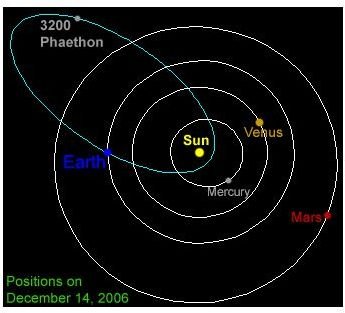
Whenever planet earth enters the tail of an extinct asteroid called the 3200 Phaeton, the earth experiences a shower of meteors across the sky. This two-week event occurs annually and is considered one of the best meteor showers of the year. Geminid shooting stars are considered to be unique as they are caused by an asteroid, the 3200 Phaeton, and not a comet. There have been rumblings that the 3200 Phaeton could have originally been a comet but there is no research to prove that theory yet. As such, when Phaeton was really young, it was a comet but it burned out and was caught in the orbit of Saturn and now it swings by the earth nearly every year leaving a tail of dirt and meteor showers.
{Image credit: Asteroid 3200 Phaethon Orbit: Courtesy: Randy Russell Source : https://www.windows.ucar.edu/tour/link=/asteroids/asteroid _3200_phaethon.html&edu=elem}
Annual Appearances

Astrologers noted the Geminid meteor shower for the first time in 1882. However, the parent asteroid 3200 Phaethon was discovered in 1983, when astronomers were actually looking for the parent comet. Very soon it was realized the its orbit is the same as that of the Geminid meteoroid stream.
The appearance of the Geminid meteor shower is as regular as clockwork, putting in an annual appearance in the night sky every year in the month of December. The showers start from December 7 and then increase in duration and intensity.
December 1998 was a very good year for watching Geminid showers. The peak was observed on December 13th and produced about one shooting star every 30 seconds.
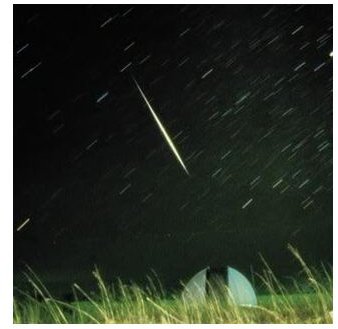
In 2004, the peak of the Geminid meteor shower was visible on the evening of December 13th and lasted till early morning of the 14th. Due to its broader peak and clear sky, the Americans had a spectacular show!
In 2008, the Gemind meteor shower peak event occurred on the full moon day, which was the major interference in watching it. The peak time was 6 p.m EST on December 13th.
This year the viewing is expected to be particularly good, due to it falling on a new moon.
{Above left: Gemini Meteor shower: Image credit: https://www.wired.com/images _blogs/photos/uncategorized/2007/12/13/geminid_meteor_shower_2_2.jpg}
{Image credit: Right:Geminid Meteor shower 12th December 2008, Courtsey; Linda Haywood: https://www.24hourtrading.co.uk/blog/geminids-meteor-shower-on-friday-12th-december-2008-1258/}
Best Way to View the Shower
The Geminid meteor shower can appear in any part of the sky. It appears appear every year between December 6th and 19th.The peak of the shower varies. In 2012 expect the peak of the shower to be between December 13th and 14th.
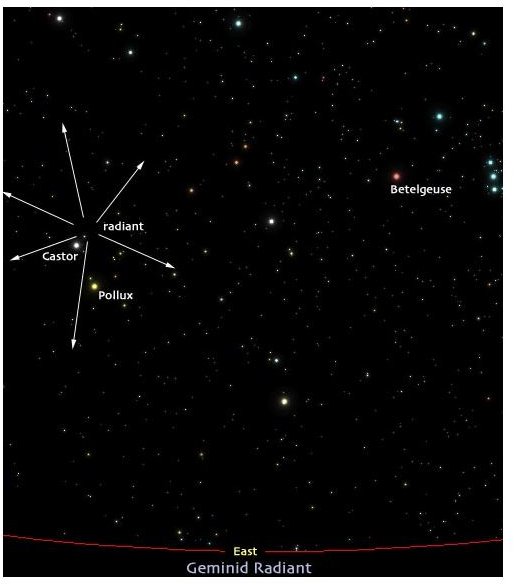
For the best view face east and look between one half to one third of the way up in the sky.
The Geminid meteor showers are clearly noticed after the moon sets because the radiant point of the meteor shower passes almost overhead. The higher the radiant of the shower, the greater the number of meteors are visible in the sky.
The best time is to watch this year will be between 9 pm on the 13th to 4am on the 14th.
For clear visibility a dark and clear sky with no clouds is most favorable. A dark sky is one approximately 40 Km away from any metropolitan city.
You will not require any optical aid like a telescope or binoculars to watch a Geminid meteor shower, although they may be helpful if the night is not very clear.
{Above: Gemini Meteor shower Location : Image credit : Linda Haywood: https://www.24hourtrading.co.uk/blog/geminids-meteor-shower-on-friday-12th-december-2008-1258/}
Interesting Facts
The mythology behind the constellation Gemini comes from the ancient Romans. It relates to the two brothers Castor and Polydeuces who accompanied the leader of the Argonauts (Jason) on a voyage to recover a Golden Fleece.The two brothers were born in an egg and their parents were Jupiter and Leda.
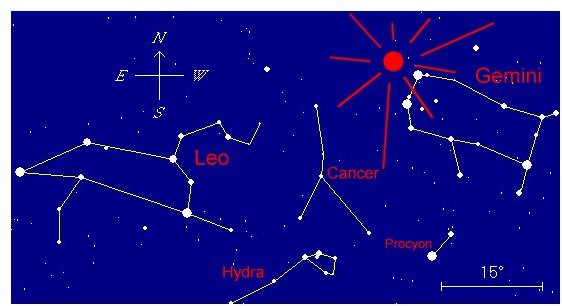
1. The Name: If one traces all the meteor trails of Geminid backwards, It is observed that they all meet within the boundaries of the constellation Gemini. This is why they are called the Geminid meteor shower. This meeting point is termed the “radiant”. The radiant of the Geminid meteor shower is approximately 30 degrees northwest of Castor, which is the first magnitude star and is also known as Alpha [α] Geminorum.
2. Parent Asteroid: The parent asteroid that causes the Geminid meteor shower is a dormant comet. This is very unique as the dormant comet has an ice core and is influenced by another comet called the Elst-Pizarro.
3. Origin of the Geminid Shower: The actual shower seems to come from near the constellation of Gemini because of the earth passing through the tail of a dead comet or asteroid called the 3200 PHAETON. The Earth moves very fast through the tail of this dead comet creating very weird activity and appearance from the meteors. Late stragglers are common and they appear the prettiest in luminosity.
4. Peculiarities of the Meteoroids: The stones from the shower have several peculiarities. For example, by investigating the fireballs, researchers have noted that the density of the Geminid meteoroids is a little lower than normal. They are about 1 and 2 gm/cc lighter than other normal fireballs which average about 3 gm/cc. This is totally different from

other shooting stars.
5. The Event: The shower starts as a simple slow cascade of falling stars and then the shower peaks in a day or two. After a period, the actual trail of the falling meteors may be seen as a luminous trail of colors. Most annual appearances of the shower are simple with only about ten shooting stars seen in the night sky. The stars will usually be a bright yellow with long, glimmering tails.
{Image credit : Above left: Region of appearance of Geminid Meteor Shower in sky (The red dot marks the radiant point which is the origin): Courtesy NASA; https://science.nasa.gov/images/geminidsradiant.gif}
{Image credit : Right: A Fire ball of Geminid Shower: Courtesy: Rick Schmidt:https://www.astronomy.com/asy/objects/images/geminid_trail_1204_500.jpg}