How the Moon and Other Factors Have Affected the Length of Earth's Day
What is the Current Length of a Day?
If the length of Earth’s day is determined using the Sun as reference, that day is called a solar day, and is 24 hours in length.1 If the length of a Earth’s day is determined using the stars as a reference, however, that day is called a sidereal day, and is 23 hours, 56 minutes and 4.09 seconds in length. The solar day is longer, since Earth advances along its orbit approximately one degree per day. This span of time is subject to change—sometimes without notice. For instance, the 11 March 2011 earthquake in Japan has shortened the length of the day by 1.6 microseconds, according to geophysicist Richard Gross. This is because a redistribution of Earth’s mass has occurred due to slippage. In addition, the length of the day varies—speeding up and slowing down—as much as 1,000 microseconds throughout the year because of seasonal changes in the jet stream.
The History of Earth’s Day Length
Scientists speculate the length of Earth’s day has increased since the planet’s origin—perhaps some 4.5 billion years ago. They believe, based on computer simulations, that the length of primordial Earth’s day was approximately six hours. More recently, perhaps 620 million years ago, scientists believe the length of a day had increased to 21.9 hours, based on alternating sandstone layers called “tidal rhythmites.” The nature of the rhythmite layers and their thickness suggest interactions between Earth and Moon.
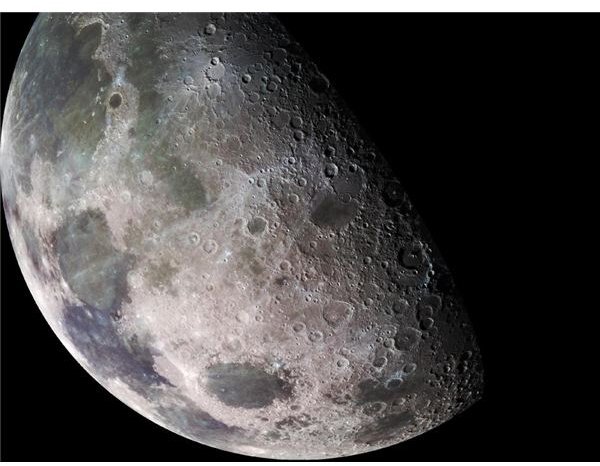
The Moon
Credit: NASA/JPL/USGS
What Causes the Continuous 1.7 Millisecond Change?
The lengthening of Earth’s day by 1.7 milliseconds each century is considered by scientists to be due to frictional slowing of the planet by the tides, caused by gravitational interaction with the Moon. It is theorized the Moon was once closer to Earth. As the Moon creeps further away at the rate of about two inches per year; it carries energy away with it. This loss of energy manifests itself by the slowing of the planet.
1 The length of a solar earth day actually is not 86,400 seconds exactly. In fact, it is 86,400.2 seconds in length. This error is adjusted as needed by the addition of a leap second.
References and Resources
CBS News Tech: Earth’s day length shortened by Japan earthquake
Cornell University – Astronomy: Sidereal Time
Mantle Plumes: Tidal Rhythmites and Their Implications