Continuing and diverging from what was mentioned in Part 1 into more of the specific uses and intricacies of time, we here survey notions such as biological time, quantum time, relativistic time, and provide some more information relating to the concept of time.
Introduction
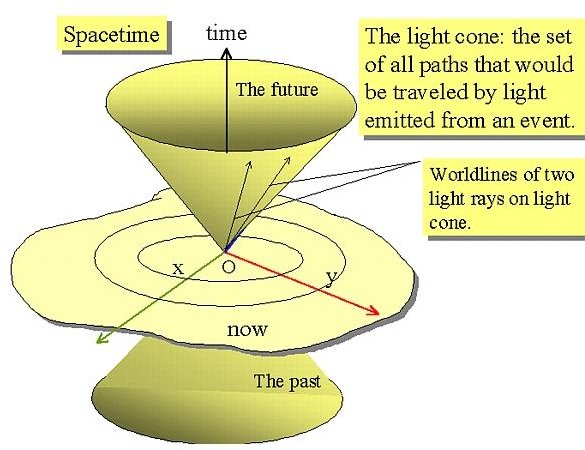
Time can quickly regress to a very meaningless abstraction when you start thinking about it without staying within a context or schema…as can many things I suppose; time, however, seems to be by nature at once a very abstract concept, and a very nebulous, intuitive and fundamental part of existence. The irreversibility of our actions, accepted ideas of cause and effect, and activity in general seems to indicate some sort of “movement” of space; time itself does not necessarily “pass,” or “move.” Time can make explicit the symbolic nature of language, explicit because we see how crude the symbol is. Besides being part of the fabric of space-time, time can also be said to be a tool, which allows us to measure and locate; which, doesn’t define the term as much as just replace it with another term. As to what exactly time is as part of space-time, that is ubiquitous to say the least.
Time can be said to encompass three different concepts: duration, simultaneity and succession.
Time: Circular vs. Linear
Time in general has been thought of generally as functioning along one of two paths: a linear one or a circular one. Although some postmodern thought has of course abolished the binary and integrated the two systems, and indeed in the industrialized societies time can be felt as both linear - a lifetime, and as circular - workweeks, months, years, which all construct a periodic and fluid forward motion, correlating to the linear birth, maturity and deterioration of our bodies. Even modern cosmology is torn on time being linear or circular, with many arguing that the big bang started time and that from there time continues ever forward as space expands, which some think may keep on expanding forever. Others argue that the big bang was an event in some larger cycle, a recycling or expanding and eventual collapsing of the universe in a “big crunch.”
Biological Time
Biological time is generally thought to be some sort of internal awareness of time passing in plants and animals that is a type of innateness, or an unconscious awareness. It can be referred to as photoperiodism, a term which originated while studying plants, but has since grown to include animal behavior. Evidence cited for the existence of biological “clocks” would include the ability of some humans to wake up without alarm clocks at certain times each day, and that certain other types of animals appear through experiment to be able to measure time, such as in migration patterns of certain birds, or in certain behaviors of bees, such as the “dance” they perform upon returning to the hive after discovering the location of flowers. This “dance” involves movements that appear to indicate the amount of time needed to travel to the food, and the position of the food relative to the position of the Sun.
Biological time seems to be dependent upon observations from the natural world, and so be something that is learned. Time is kept by animals and/or plants observing changes in location of the Sun, the starry sky at night, the seasonal changes.
Relativistic Time
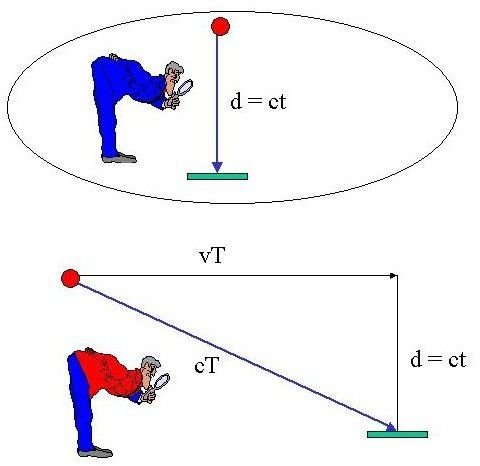
Relativistic time essentially describes time as part of the space-time fabric, something that is determined by the events of space-time, not visa versa, and requires time to be defined when put in relation to an observer or other event. Time in this model is a measurement of at least two simultaneous events. As Einstein put it, paraphrased: In relativistic time what we see is multiple events with different time epochs all occurring relative to the location and speed of some observer. So, in general: Time it is generally thought to be relative to place, speed, and curvature of space. One consequence is that time has been measured to function slower the closer to the light speed one is moving, relative to an observer moving much slower. Also a consequence, no material can travel faster than the velocity of light.
One apparent oddness that occurs due to time being relative, is the phenomenon, “time dilation.” This can best be explained by
referring right to observed data: Mu-mesons, particles produced in cosmic ray showers, exist on average for 2 microseconds, relative to an observer traveling with them. These particles exist roughly 10 kilometers above the surface of the Earth, and so Mu-mesons that have been observed in experiment on the surface of the Earth must have travelled the 10 kilometers; however, they only exist for 2 microseconds and in that duration of time they could only travel less than a kilometer even at the speed of light, however, also a rule in relativity, all material particles travel at less than the speed of light; how could they travel the 10 kilometers? It turns out that with their increased speed their clocks have “slowed down,” significantly, relative to us observers moving relatively astonishingly slowly. Thus no laws of relativity were broken.
Relativistic time is contrasted against the Newtonian theory of an absolute time, a time that carries on at the same rate consistently everywhere in the universe regardless of any events that may be taking place or the speed of those events. Newtonian time is rigidly uniform and linear. Currently, however, most experiment has indicated that time is indeed relative to the simultaneous events that are measuring it.
Quantum Time
Quantum time is a measurement of the time that it takes for light to travel one Plank unit, which is thought to be by some the smallest unit of measurement possible where space-time and gravity have any validity as classically understood; the time it takes for light in a vacuum to travel 1 Planck unit is also called Planck time.
Quantum time behaves contrary to our everyday sensory experience of time, such as days passing and events seeming to be irreversible. In quantum time it can be difficult to properly sequence events, it can be hard to distinguish which events occurred before others. All of this is possible because in quantum time time is broken down into units, Plank units, chronon, and so we get small blocks of time in a sequence with reference to some experiences; further, all observations of quantum time are statistical in nature, due to the fact that at this level of space-time everything appears to have a certain amount of uncertainty to the measurements, due to quantum fluctuations.
So Is Time Travel Possible?
As far as we know thus far, in fact, not in theory, time travel is not possible. Observations of antiparticles have shown that as soon as they are created they move in the normal direction of time occurring, which agrees with the one directional “flow” of time. It seems that as far as we can understand and test right now space is the region we can move around in, and time is relative but binding, inescapable, a medium allowing causality. Wormholes are in theory the most promising hope for time travel, however they are by nature unstable, and would crush themselves the instant they formed (See my article on worm holes for more information: https://www.brighthub.com/science/space/articles/31054.aspx ).
Is There Anywhere in the Universe Where Time Doesn’t Exist?
If we assume that time does exist, letting our experience overrule certain exclusively logical paradoxes of Zeno and Parmenides, the answer to this, for some, is yes. There are only two known places where time does not exist or exert influence in this universe, and the first is a bit squeamish:
-
The unconscious mind of humans, so some psychologists would argue. That is one reason that some adults keep returning to neurotic behaviors they learned as coping mechanisms as children; certain significant impressions and traumas of childhood are timeless, just as vivid after 50 years as when they occurred.
-
In the “realm” of physical laws, which may appear to change because observers may misunderstand them; however, our change in understanding this is not a change in the factual, everyday operation of the laws, which have remained the same since the big bang. Thus gravity remains a constant, and particle physicists are able to recreate conditions similar to those just after the big bang with particle collisions. However, this idea holds only for the known and observable universe, and even saying this sounds like some idea ripe for destruction.
Advertisement
Image Credits
1. Space-time and Time Dilation: https://www.physics.fsu.edu/users/ProsperH/AST3033/relativity.htm