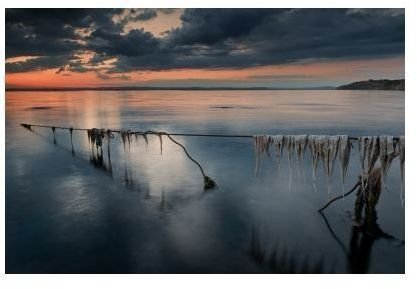
Did you know that there are 4 different types of twilight in astronomy? And, that the length of twilight changes depending on your latitude and time of year, among other factors? If not, then read on as we shed some light on just what twilight is!
What is Twilight
The Sun is the only source of light on Earth. But there is light even when the Sun is not in the sky. This is called Actual Twilight. This beautiful phenomenon is due to the presence of the atmosphere. As we all know, it is not the Sun which is rising or setting, but it is the rotation of Earth around its axis. So there is sunlight in the upper atmosphere after the Sun sets, and the twilight is due to the scattering of light by this upper atmosphere. Various atmospheric and terrestrial factors affect the length of twilight. The presence of clouds, dust and the level of humidity are the primary atmospheric conditions which shorten or lengthen twilight. In addition to this, the local seasons also affect the length of twilight.
Different Types of Twilight
There are three types of twilight, namely: Astronomical Twilight, Civil Twilight and Nautical Twilight. They are categorized on the basis of the solar depression angle. This is the angle which forms between the sea level horizon and the center of the Earth and the center of the solar disc.
Civil twilight occurs when solar zenith angle is 96° or solar elevation angle is -6°. That is the time in the morning or evening in which the center of the solar disc is 6° below the horizon. Civil twilight is appropriate to watch the brightest stars, provided the sky is clear and a well defined horizon is one of its characteristics. Usually artificial light is required to carry out outdoor activities in the time before civil twilight in morning and after civil twilight in the evening.
As soon as solar depression angle is more than 6° nautical twilight starts. The presence of light when the Sun is positioned at an angle, which is between 6° and 12° below the horizon, is called nautical twilight. It is signified by a solar zenith angle of 102° or a solar elevation angle of -12°. In the absence of artificial light it is possible to see shadows of objects on the ground, but it requires proper lighting to identify the object. Also, it is very difficult to identify the horizon as it is blurred. It lasts till the solar depression angel reaches 12°, now astronomical twilight starts.
At the time of sunrise or sunset, when the position of the Sun is at an angle between 12° and 18° below the horizon, astronomical twilight occurs. Alternatively, astronomical twilight is the phenomenon which is experienced when solar zenith angle is at 108° or solar elevation angle is at -18°. Even though the sky is dark during this time, it is difficult to identify galaxies and dimmer stars. But, once astronomical twilight is over, the sky is pitch dark and one can study all stellar objects within view. Astronomers consider this time as the most beneficial to study astronomical objects as the scattering of light by the upper atmosphere is at a bare minimum.
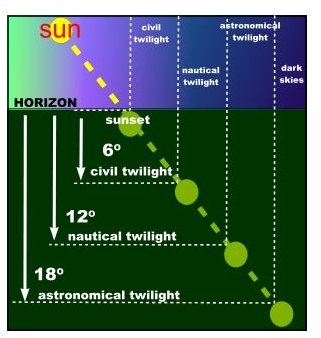
This figure shows how Civil Twilight, Nautical Twilight and Astronomical Twilight are measured. (Image courtesy of the Canadian Space Agency.)
Astronomical Importance of Twilight
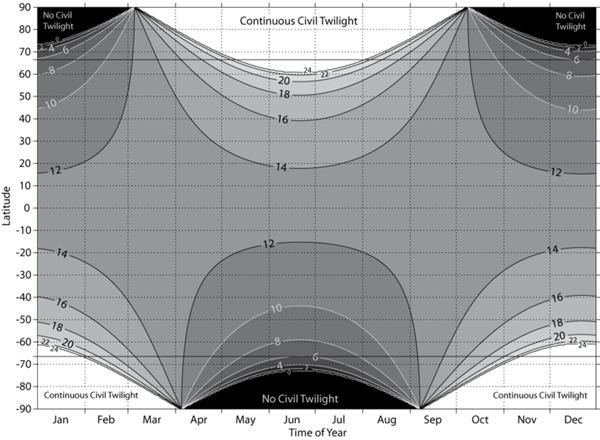
This diagram shows the variation in the duration of twilight with latitude and seasons.
This division is significant in astronomical studies. Astronomers use the nautical twilight to focus telescopes so that once the astronomical twilight is over they can engage in star watching. The duration of twilight depends mainly on the latitude of the observer and on the season . Civil twilight is absolutely absent on the poles for a month before and after the winter solstice. Whereas in the polar fall and spring the duration of twilight literally lasts for two weeks. Likewise, duration of civil twilight varies at the equator in each season. From the diagram above it can be clearly seen that there is no civil twilight at 90° latitude on certain months. The diagram clearly shows the variation of twilight with latitude and seasons.
sources
https://en.wikipedia.org/wiki/Twilight
https://aa.usno.navy.mil/faq/docs/RST _defs.php
https://individual.utoronto.ca/kalendis/twilight/index.htm
images
https://www.freedigitalphotos.net/images/Landscapes_g114-The_Light_Of_The_Twilight_p7811.html
https://www.asc-csa.gc.ca/eng/educators/resources/stars/details1.asp