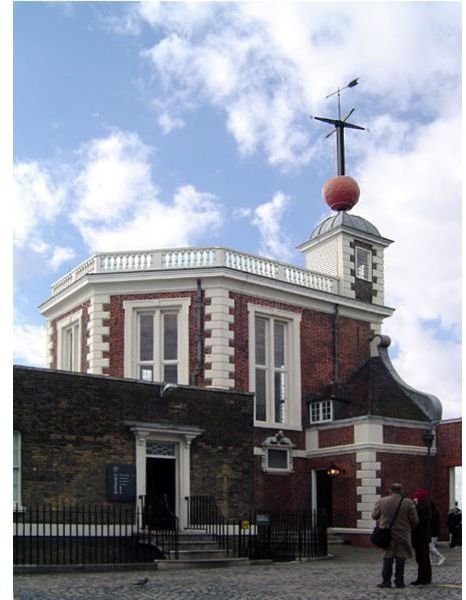
The Greenwich Royal Observatory, which founded in 1675 is the site of the Prime Meridian, Universal Time, and a 28-inch refracting telescope. Read about the rich history of this observatory.
History
The Greenwich Royal Observatory, or The Royal Observatory, Greenwich as it is currently known was founded in 1675 under King Charles II. Until its official closing as a scientific institute in 1998, it was the oldest in Great Britain still in operation.
It was Sir Jonas Moore, Surveyor General for King Charles II, who first proposed the building of the observatory and it furnished the buildings with equipment and instruments with his own money. The final site was on the foundation of the old Duke Humphrey Tower, not the most ideal spot, being aligned 13 degrees from true North, but all that could be afforded on the £500 budget.
John Flamsteed was the first person to serve as director of the Greenwich Royal Observatory and first to hold the title of Astronomer Royal, which came with the directorship. Flamsteed immediately went to work on his new stellar tables and charts.
The Royal Greenwich Observatory was also a time-keeper. It housed two of the most accurate clocks of the time, having a margin of error of +/- 7 seconds per day. Since 1833 a Time Ball on top of the Octagonal Room of the observatory rises halfway up the mast at 12:55, fully at 12:58, and falls at 13:00 hours every day and provided a central time for ships on the Thames to set their clocks by. Later, a telegraph cable would link this time ball to a sister on the southeast coast that would be used by ships in the English Channel. In 1928, Greenwich Time was chosen as the base of world time and given the name Universal Time.
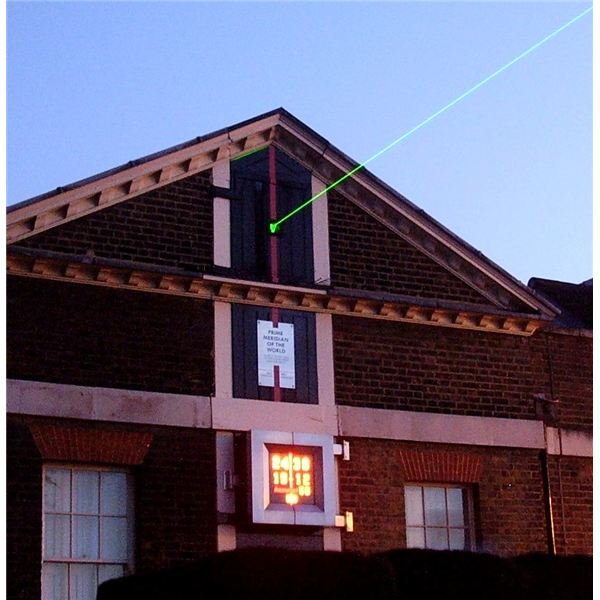
In 1884, The Royal Greenwich Observatory was adopted as the site of 0 degrees for longitudinal measurement – the Prime Meridian, which had been established locally years before in 1851. The Prime Meridian was originally marked through the courtyard grounds with a brass strip, which since has been replaced with stainless steel and since 1999 there is a large green laser pointing north over London.
Telescope
For stargazing and astronomical study, the Royal Greenwich observatory has housed a 28-inch Grubb Refracting Telescope since 1893. It is the largest of its kind in the United Kingdom and seventh largest in the world. It had been in continuous use until retired in the 1960s and several major observations and advancements were made with it in the study of double star systems .
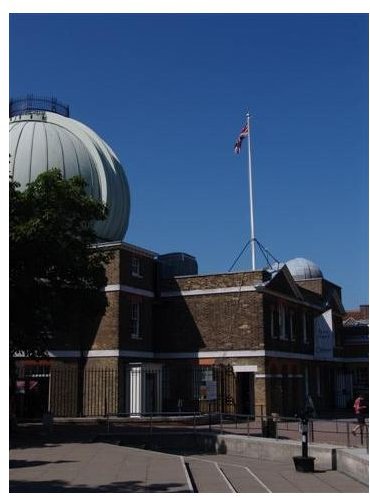
The dome that houses the telescope is known by the nickname, The Onion Dome, for its resemblance to a Spanish onion. The original Onion Dome was built of an iron frame and papier mache but it was destroyed by a German air raid in WWII. The new dome is close replica made of fiberglass.
The mount for the 28-inch telescope was originally moved by a clock drive powered by falling water which matched exactly the rotation of the Earth and made long observations easier, except for those times in winter when it froze up. In the early 1900s an electric drive was installed to replace it.
The telescope tube is an astounding 28 feet long. It is unique in that the ends of the tube are round, but it is rectangular in the center. It was made this way to accommodate the housing which was really meant for a smaller sized telescope.
Today
Since its closing for scientific purposes in 1998, RGO has become a museum, planetarium , and learning center. It hosts a variety of tours where people come to get their picture taken straddling the two hemispheres and to catch one of the many shows, events, or tributes to world space study. Scheduled viewings take place with the telescope and the new additions of its computer-aided guidance system and CCD camera , but tickets go quickly.
The National Maritime Museum has been on premises for since 1934 and it houses the world’s largest collection of sea-voyaging models and artifacts.
Resources
https://www.nmm.ac.uk/places/royal-observatory/
https://www.gmt2000.co.uk/meridian/place/plco0a1.htm
https://www.britannica.com/EBchecked/topic/511416/Royal-Greenwich-Observatory