When is the Next Lunar Eclipse - Partial Lunar Eclipse of April 25, 2013
A lunar eclipse is different from a solar eclipse in the relative positions of the three celestial bodies: namely the earth, moon and the sun. Whereas a solar eclipse is caused by the interruption of the sun’s view from the earth, a lunar eclipse is caused when the earth moves between the sun and moon. When this happens the light of the sun is either fully or partially blocked from illuminating the moon. What we are seeing is a celestial game of light and shadows since the earth and moon do not generate light but reflect the suns rays.
Umbra & Penumbra
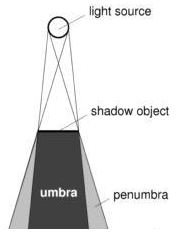
Before you can understand the concept of a lunar eclipse, let me explain the two terms: umbra and penumbra. These refer to the shadows produced by celestial bodies when the source of light is another celestial body and is not concentrated at a point. This leads to the shadow of the intervening body to be as shown in figure 1 to the right. The dark-colored region is the umbra while the other is penumbra. There is another region called antumbra but we will not discuss here for sake of simplicity.
The Lunar Eclipse
Now look at the above diagram again and imagine that the light source is the sun and the shadow object is the earth. If the moon lies behind the earth on or near an imaginary line connecting the sun and earth, it will be in the region of umbra or penumbra shadow. Depending on one’s location on earth, the lunar eclipse could either be a partial eclipse, total eclipse or penumbral eclipse. It must be remembered that from the standpoint of an average person it is only the first two which are visible, the third should be left for the astronomers to gaze at, because the shadow of the earth in the penumbral region is not strong enough to cause a change in the illumination of the moon, which is easily visible to the naked eye.
Areas of Eclipse
After reading about lunar eclipses you might be wondering when the next eclipse is? The next partial lunar eclipse occurs on April 25, 2013. If you want a detailed list of the dates of lunar eclipses, just click here.
The eclipse will be visible in most of Aftica, Europe, Asia and Australia. If you are lucky enough to be in one of the viewing locations try viewing the eclipse with a pair of binoculars. This makes for a great view as you can follow Earth’s shadow as it moves across the lunar surface.
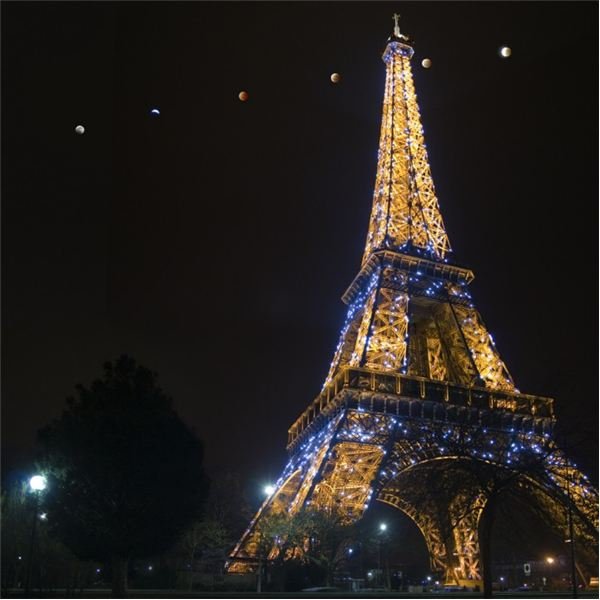
The picture shows the time lapse photography of a lunar eclipse which has already occurred in the past. That should give you a good idea of how a lunar eclipse looks over a period of time.
References
- Eclipses During 2012: http://eclipse.gsfc.nasa.gov/OH/OH2012.html#LE2012Nov28N
- Photo: Lunar Eclipse in the Background of Eiffel Tower
- Penumbral Eclipse of Nov 28, 2012: http://eclipse.gsfc.nasa.gov/LEplot/LEplot2001/LE2012Nov28N.pdf