Cepheid Variable Stars and Their Importance in Measuring the Universe
What Are Cepheid Variables?
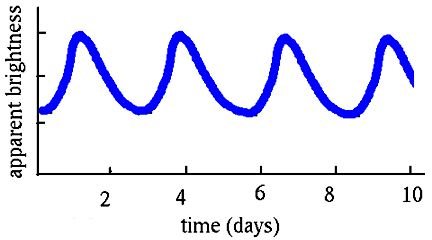
Cepheid variables are a type of variable stars, that is, a type of star that changes in brightness over time. For Cepheids, this variability may happen over a period of time from one to fifty days, the brightness often doubling over the course of each cycle.
This variability is caused, simply put, by a cycle of ionization. As hydrogen and helium ionizes, the star contracts. However, the lost gravitational potential energy is then translated into more heat, which leads to deionization and expansion. With expansion, the star cools and begins to ionize again - and the cycle continues on.
The change in brightness is due to changes in opacity: during that ionized state, the outer layers of the star are more opaque, absorbing more of the emitted light and so appearing as less bright to outside observers. Conversely, in the deionized state, the outer layers of the star are less opaque, letting more of the light escape and so appears brighter to the rest of the universe.
The cycles of Cepheids may even change over long periods of time. Think of it like any other oscillatory motion: once within that cycle of ionization and deionization, this action will not stop until acted upon by other forces, such as the inevitable change of hydrogen and helium changing into heavier elements. For Cepheids, typically this is an excruciatingly slow process for humans to observe, changing over generations—expanses of time for which we do not have truly reliable data to test any theoretical model regarding changes in period of variability. It is theorized, however, that most main sequence stars go through a span of variability during their lifetimes.
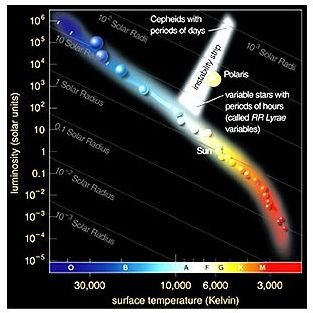
Typically, Cepheid variables are population I giant yellow stars. Because they are population I stars, they are sometimes referred to as “type I” or “classical” Cepheids, to differentiate them from a similar type of variable stars, W Virginis, which are population II and so sometimes referred to as “type II Cepheids”. It’s often quite tricky to differentiate between W Virginis and Cepheid variable stars, because their light curves are somewhat similar. Both of these types of variable stars occupy a nearly-vertical strip on the HR diagram, known as the “instability strip”, along with many other types of variable stars, such as RR Lyrae, ZZ Ceti, RV Tauri and more.
Cepheid Light Curve and HR Diagram
Why Are They So Important?
Other than just being conceptually cool, the incredible usefulness of Cepheid variables to astronomers might not be immediately apparent. Consider the correlation between absolute luminosity and the period of the variability. This means that, after observing a given Cepheid variable for a while, one can acquire the period and thus calculate the absolute luminosity. This can then be used to calculate the distance using the distance modulus.
The distances calculated using this process are some of the most definitive available to astronomers. Due to the relatively high luminosity of Cepheid variables, they are visible even in extremely distant galaxies, allowing astronomers to calculate accurate distances where other methods often fail them. A great example of Cepheid variable star astronomy at work is at the beginnings of modern cosmology, when Edwin Hubble proved using Cepheid variable distances that the Andromeda Galaxy was not in fact within our own Milky Way galaxy.
Of course, plenty of precautions need to be taken when using Cepheid variables as “standard candles” or “cosmic yardsticks”, as they are sometimes referred to. Factors such as metallicity need to be accounted for, which in recent years has led to recalibration of the original correlation established by Henrietta Swann Levitt at the turn of the 19th century, leading to even more accurate use of Cepheid variable stars.
For more information on variable stars in general or in particular, as well as resources and tutorials for observing them for yourself, I would highly recommend the website of the AAVSO—American Association of Variable Star Observers. Available at their website are many excellent articles spotlighting particular Cepheid variables, for instance this one on Delta Cep, the first Cepheid variable star to be recognized as such.