Learn some interesting facts about the Hercules constellation, including who discovered the Hercules constellation, brightest star and more.
The Hero in the Sky
- Symbolism: Heracles (Greek) or Hercules (Roman mythological hero adapted from the Greek Heracles)
2. Right ascension: 17 hour
3. Declination: +30 degrees
- Latitudes visible at: between +90 degrees and -50 degrees
5. The best time to view: During the month of July at 21:00 (9:00 PM)
6. Area of sky: 1225 square degrees
- Nearest star: GJ 661 (20.9 light years away)
8. Brightest star: Beta herculis (2.8 visual magnitude)
9. Constellations bordering Hercules: Aquila, Bootes, Corona Borealis, Draco, Lyra, Ophiuchus, Serpens Caput, Sagitta, Vulpecula
10. Stars in the constellation: Mu Herculis, Alpha Herculis (Ras Algethi), beta Herculis, Pi Herculis, Zeta Herculis, Kappa Herculis, Rho Herculis, S Herculis
11. Other objects in the constellation: M13 (NGC 6205), M92 (NGC 6341),
12: Meteor showers: Tau Herculids. It occurs from May 19- June 19.
13. Mythology: The Hercules constellation is identified with Hercules/Heracles (Greeks), son of Alcmene and Zeus. It bears the Roman name ‘Hercules’ of the Greek Heracles. Hercules was known for his heroisms and fearlessness. The legendary “Twelve Labors” or tasks assigned to Hercules by King Euristeus are always remembered as a great mythical story. Hercules built a funeral pile on Mount Eta, thus destroying his mortal body. His soul joined with other gods and Zeus put Hercules’ constellation in the sky.
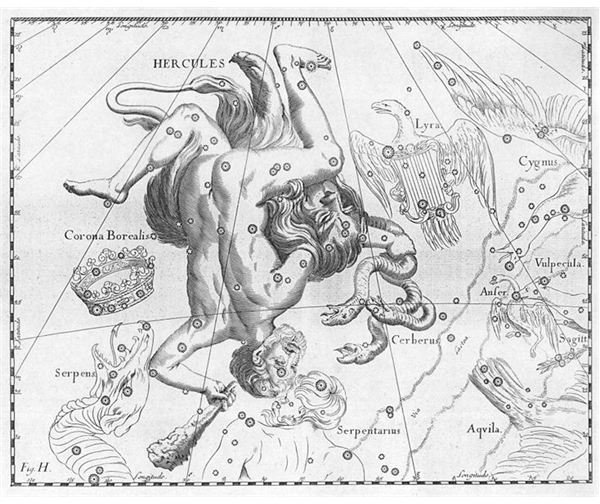
- Who Discovered the Constellation Hercules? Hercules was indexed by Ptolemy as one of the 48 constellation in his Almageste. The constellation was also known as the Greek Engonasin in the Rudolphine Tables, which means “the kneeler.”
[Image Courtesy: Johannes Hevelius 1690 https://commons.wikimedia.org/wiki/File:Hercules _Hevelius.jpg]
Hercules Constellation Image
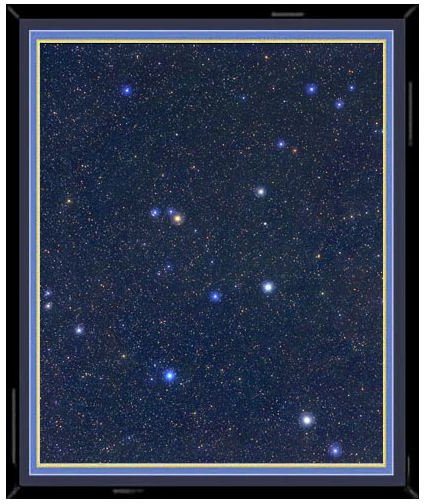
[This photo of the constellation Hercules shows, enlarged in their true color, the main “naked eye” stars that make up the shape of the constellation. Image courtesy of https://www.scienceandart.com ]
Hercules Constellation Facts: Did You Know?
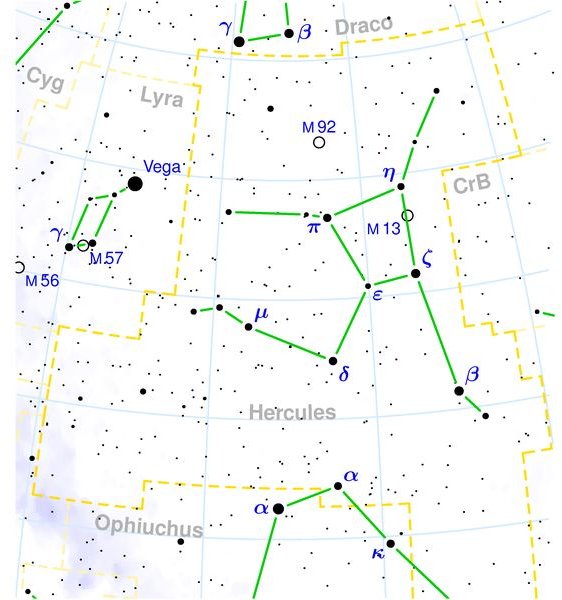
Hercules is the fifth largest constellations amongst the 88 modern constellations.
• The Alpha Herculis star in the Hercules constellation is believed to be as large as 400 solar diameters.
• The constellation Hercules has several binary stars (double stars) with contrasting colors. These include Zeta Herculis, Kappa Herculis, 95 Herculis 99 Herculis, 100 Herculis and Struve 2319.
• The deep sky object M13 (NGC 6205) is an amazing globular cluster. It is sometimes referred to as “The Hercules Cluster" and is known to be the best in the northern hemisphere. It is very old, approximately 10 billion years.
• Seven stars (14 Herculis, HD 154345, HD 149026, HD 147506, HD 164922, HD 155358, and GSC 03089-00929) are orbited by extrasolar planets. These stars were discovered in 1996 and 2005-2007 (one in 2005, two stars in 2006 and three in 2007).
• The HD 154345 is orbited by the HD 154345 b. It takes 10900 days to orbit.
• The Tau Herculids meteor shower was first discovered in May 1930 by the Kwasan Observatory in Kyoto, Japan.
• In 1974 Dr. Frank Drake and Dr. Carl Sagan created the ‘Arecibo Message,’ which was made up of 1,679 binary digits. The ‘Arecibo Message’ was transmitted towards the M13 (NGC 6205) in the Hercules constellation at a frequency of 2380 MHz. It will take an estimated 25,000 years to be picked up and, if someone responds to it, it will take another 25,000 years for the message to reach Earth.
[Image Credit: Top Left: Torsten Bronger https://en.wikipedia.org/wiki/File:Hercules _constellation_map.png]
References
- “Hercules Constellation.” Absolute Astronomy, http://www.absoluteastronomy.com/topics/Hercules _(constellation)
- “Constellations: Hercules The Strongman.” BBC, http://www.bbc.co.uk/dna/h2g2/A29778916
- “Hercules.” Dibon Smith, http://www.dibonsmith.com/her _con.htm
- “Tau Herculids.” http://meteorshowersonline.com/showers/tau _herculids.html
- Masi, Gianluca. “Constellation Mythology: Hercules”, http://www.bellatrixobservatory.org/herc.html
- “Hercules Constellation.” http://en.wikipedia.org/wiki/Hercules _constellation