The Creation of the Subatomic Particle Menagerie
The Creation of Matter
At the moment of the Big Bang, there was nothing. Energy didn’t exist, matter didn’t exist, space didn’t exist. Even time did not exist. Even for several microseconds afterwards, this situation continued. But by 10-43 second, the young and tiny universe had reached a point at which time began to flow. This is known as Planck time, after German physicist Max Planck.
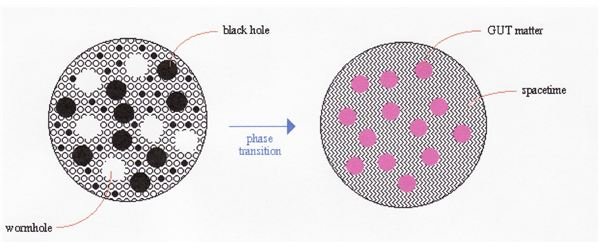
At this point, the young Universe has a mass of 1093 grams/cm and is under such pressure and density that spacetime is folded into a ‘foam’ of quantum black holes and wormholes. While spacetime has come into existence, the nature of this early Universe makes it impossible for matter to form. Its temperature is too high.
Eventually, the temperature drops to a point at which the quantum black holes begin to form a type of matter, know as Grand Unified Theory, or GUT, matter. This is matter in which all forces—the weak force, the strong force, electromagnetic and gravity—are combined into a single force called supergravity. GUT matter contains the progenitors of what will become the subatomic menagerie.
At 10-6 second after the Big Bang, the temperature of the universe cooled to the point that GUT matter can begin to give rise to elementary subatomic particles. Photons are created and there is light in the universe.
Shortly thereafter, Quark matter is created. Quarks are the constituents of the heavier elements of atoms, called collectively hadrons. The most well-known of these are the baryons—the proton and neutron. Then Lepton matter is created. Leptons are basic elementary particles—the electron, the positron, the neutrino and the anti-neutrino. Both Quarks and Leptons were created as sextets—there are six kinds of each.
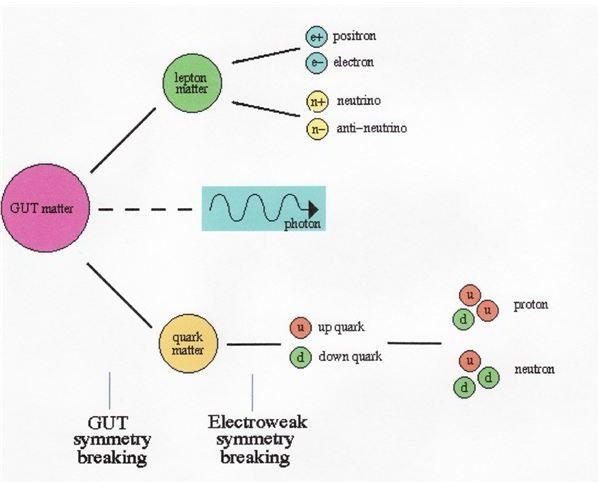
During this formative stage, supergravity splits into the four separate forces. We discuss the particles and forces below.
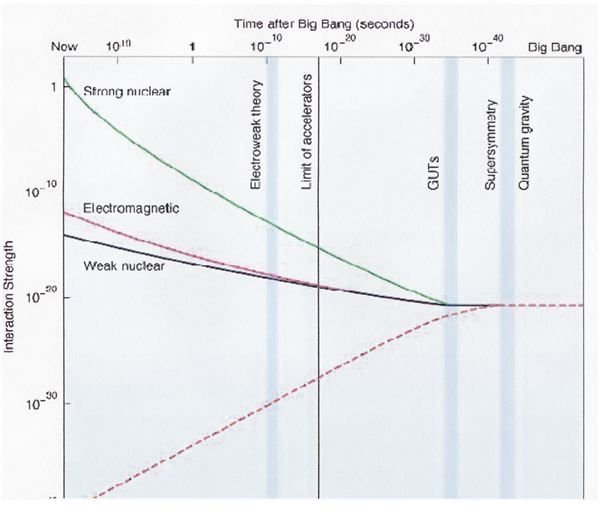
By the time the Universe was one second old, matter as we know it—at the subatomic level–had been created.
Quarks
Quarks are perhaps the weirdest of the subatomic menagerie. They even have weird names. There is the top quark, the bottom quark, the strange quark, the up quark, the down quark, and the charm quark.
And quarks even have color!
Of course, it isn’t color as we think of it. It is actually the force that binds quarks together, but subatomic physicists call it ‘color charge’ to differentiate it from the type of charge an electron has. We will discuss this force later.
Quarks are the basic building blocks of the parts of the atomic nucleus—the proton and the neutron—as well as other subatomic particles. Quarks have a unique aspect. They cannot exist alone. (Although Fermilab recently announced it had produced a lone top quark!) Quarks combine to form baryons or mesons. They must either combine in pairs or in threes. Baryons consist of three quarks. A proton comprises two up quarks and one down quark. A neutron is two down quarks and one up quark.
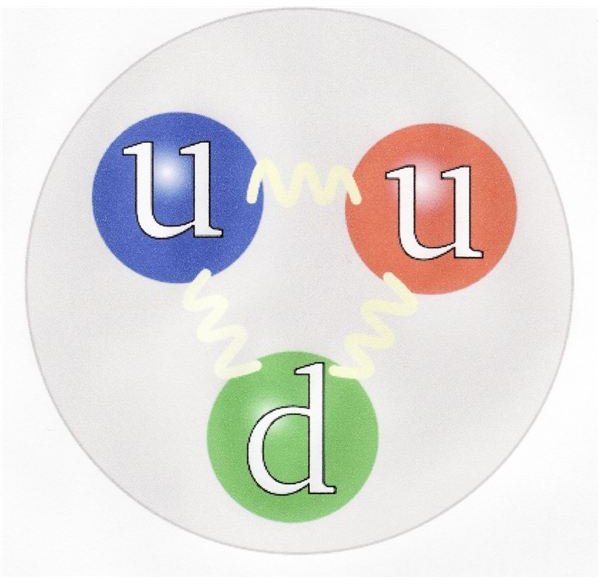
The factor that distinguishes one quark from the other is its electrical charge. The up, charm and top quarks have a charge of +2/3. (A charge of 1 is the charge of an electron) The down, strange and bottom quarks have a charge of -1/3. Note that quarks are the only particles that have fractional charges.
The mesons are themselves unique in that they are the only form of matter in which normal matter and antimatter exists together. Naturally, their lifetime is short, as the two forms annihilate each other almost as soon as they come into contact. A pion—pi meson–for example, is a quark and an anti-quark. There are three pions. One comprises an up quark and a down anti quark. Another is made up of a down anti-quark, a down quark, an up quark and an up anti quark. The third is the reverse of the first—a down quark and an up anti quark. The mean life time of all pions is 2.6x10⁻⁸ seconds.
Longer lived mesons are the Kaons. The longest lived of these four mesons is the KL particle, with a life time of 5.8x10⁻⁸ second. When it was discovered, this combination of normal matter and antimatter with a relatively long lifetime was called strange. That name was given to one of the quarks that composed it, along with either an up or down quark, and related anti-quarks.
We haven’t mentioned the charm quark. It is found only in a group of baryons and mesons that are also short-lived, because it, too, likes to hook up with an anti-quark. The charmed particles include four D mesons and 23 charmed baryons.
Colored Glue
We noted that quarks liked company. The reason they hang together is the particle that carries the strong force. It is called a gluon. Gluons bind quarks together with the strong force, which physicists have named color charge. This area of physics is called quantum chromodynamics.
Quarks do not exist without gluons, and it is the gluons that give them their ’color.’ Physicists visualize the color charge as actual colors—red, green and blue. In hadrons, the colors always mix to form a zero charge—in other words, white.
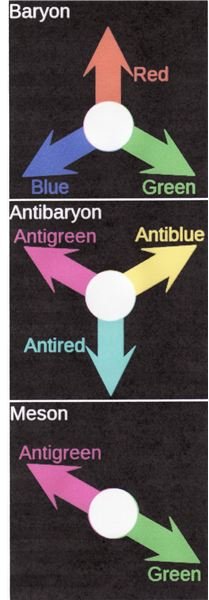
The strong force is so strong that when a quark moves further away from its neighbors, more gluons are produced, making the binding force even stronger. That is the reason quarks cannot exist singly. The strong force always pulls them back together.
Leptons
Leptons are the other fundamental particles. There are six;
Electron
Muon
Tau lepton
…and neutrinos associated with each of these. We will discuss neutrinos below. Notice in the table the type of lepton are called ‘flavors.’ That is just a term physicists use to specify types.
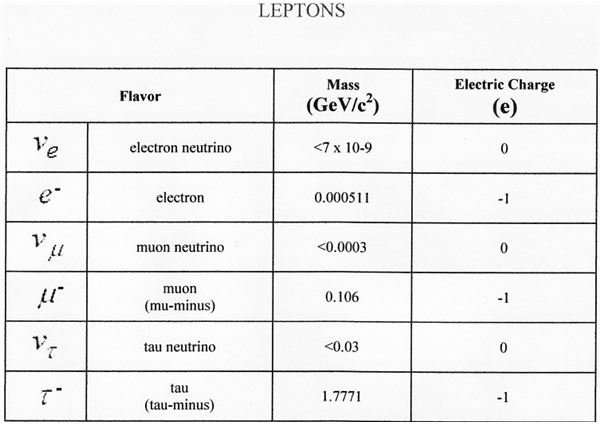
.
Unlike protons and neutrons, which are made up of quarks, these fundamental particles have, as far as we can tell now, no basic structure. In fact, to call them particles may be a misnomer. Accelerator experiments indicate they have no ‘size.’ Some theories cast them as wave fronts.
At any rate, only four of the leptons are stable. The electron, of course, and its associated neutrino are.. Also stable are the muon and tau neutrinos. The muon and tau lepton are not. The muon has a life of only 2.2 microseconds. It is created usually in the upper atmosphere by cosmic rays which create pions, which then decay into muons.
The neutrinos associated with the basic particles are unique. They have no charge and they travel near the speed of light. It originally was thought they had no mass, but recent experiments and observations indicate they do have some, albeit very low, mass.
Neutrinos are created in stars, in supernova explosions, and in radioactive decay here on Earth.
The Standard Model
The particles we’ve talked about collectively are called fermions (after Enrico Fermi, the physicist whose team initiated the first controlled chain reaction in the Manhattan Project) in what is termed the Standard Model of subatomic physics.In addition to the particles we’ve discussed, it also includes the force mediating particles.
We’ve talked about the gluons which mediate the strong force. The electromagnetic force is mediated by photons.
The weak force is similar to the electromagnetic force, and in fact the two have been unified into the electroweak force. The difference in the two is seen only by distance. At about 10-18 meters the two are the same. At 3x10-17 meters the weak force is only 1/10,000th that of the electromagnetic.
The weak force particles are produced when a more massive particle decays into a lighter particle. Weak force particles are called gauge bosons. There are three-the W+, W- and Z. The two Ws carry a charge of + 1, respectively. The Z boson is neutral, and is the more massive of the three.
The Standard Model predicts a fourth gauge boson—the Higgs boson. This should be massive, and in the Model generates the mass of leptons and quarks.
But we have not observed the Higgs boson yet. The Large Hadron Collider at CERN, just beginning operation, is designed specifically to create Higgs bosons.
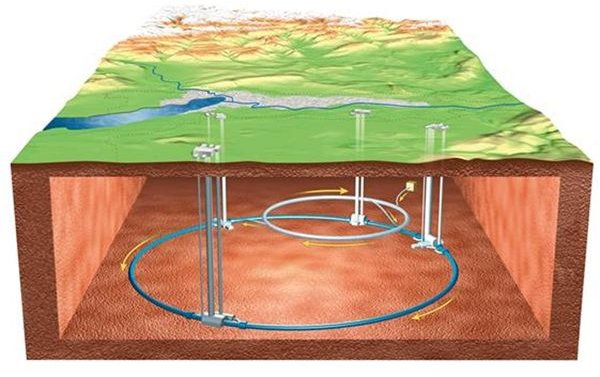
Still, the Standard Model leaves questions unanswered.
- Why can it not explain gravity?
- Why is there almost no antimatter in the Universe?
- Why can it not predict a particle’s mass?
- What is “dark matter.”
- Why does it say neutrinos can have no mass when they observably do?
Perhaps finding the Higgs boson will answer some of those questions.
Credits
Foam to GUT matter, evolution of forces: University of Maryland https://www.astro.umd.edu/~immler/Lecture_21.pdf
Evolution of matter: University of Oregon https://abyss.uoregon.edu/~js/21st_century_science/lectures/lec26.html
How quarks make protons, Colored glue:https://en.wikipedia.org/wiki/Quarks
Organization of fermions:https://en.wikipedia.org/wiki/Standard_Model
The Large Hadron Collider: CERN https://multimedia-gallery.web.cern.ch/multimedia-gallery/PhotoGallery.aspx?searchTerm=internalnote:'Views*’&page=1
References
- University of Oregon http://abyss.uoregon.edu/~js/21st_century_science/lectures/lec26.html
- Foam to GUT matter, evolution of forces: University of Maryland http://www.astro.umd.edu/~immler/Lecture_21.pdf