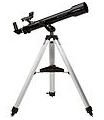
What is the best beginner telescope available to amateur astronomers? Learn your options and how to choose the best telescope to observe the wonders of the night sky.
The Wonderful World of Telescopes
If you are new to the world of telescopes you are probably wondering which is the best beginner telescope and how you should make your decision. Whether you are looking to take advantage of an after the holiday sale, or maybe cash in a gift card on a new telescope you may need help making your decision.
There is an assortment of telescope technology available for you to choose from: Refractors, Reflectors, Dobsonians, Cassegrains and Catadioptrics, and don’t forget the computerized models to complicate your decision. Cost is an issue to be considered as are ease of use, maintenance, storage and portability. Are you interested in astrophotography or just want to take a look at whatever is up in the sky tonight? These and other factors will come to bear as you make your final decision in buying a telescope—but first, let’s find out what the different technology is all about.
Refractors
Refractors: The classical telescope that probably comes to mind when one thinks of a telescope. When you think about the history of telescopes you may invision images of Galileo
peering through his telescope, or the ever-present pirate on the high seas looking through his “spy glass” for unsuspecting victims. These telescopes were nothing more than a tube with lenses in it to focus and magnify the image that was being viewed. These are refracting telescopes. The light that is coming from the object you are viewing passes trough a lens at the end of the telescope, the objective lens, which bends, or refracts the light to a point and then through a lens in the eyepiece to magnify the image.
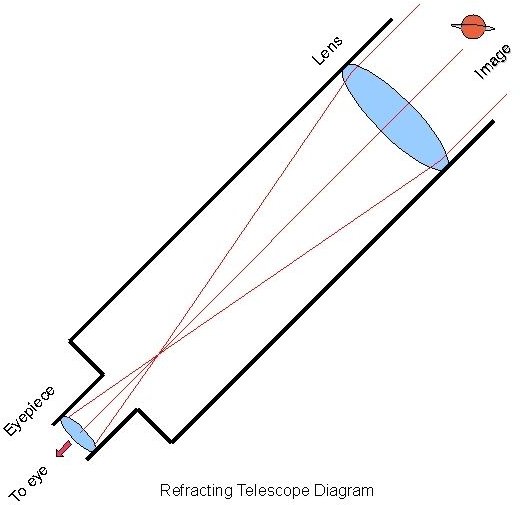
Today’s modern refracting telescopes don’t suffer from the problems that plagued the early astronomers, with poorly ground lenses and inferior glass providing anything but a sharp, clear image. Refracting telescopes manufactured today tend to be very rugged and maintenance free due to the fact that the optical tube is closed with lenses on either end, there is no chance of dust accumulating on the optics. Because the lenses are fixed, one does not have periodic adjustments to make to fine-tune the optics as is required with a reflecting telescope. This convenience comes at a price and refractors tend to be expensive and the price increases dramatically as your objective lens size increases, as does the length of the optical tube. Refracting telescopes, and other small telescopes , provide very high contrast, small field of view and are the telescope of choice for planetary viewing and photography. Refractors work well with electric drive systems and the computerized locate and track systems available today.
Reflectors
The next most common telescope that might come to mind is the Newtonian reflector. This telescope uses mirrors and lenses to bring the image to the observer. The figures below illustrate the construction of a typical reflecting telescope along with an image of the Cassegrain telescope, which places the eyepiece at the back of the telescope, more like the conventional refractor design.
Newtonian and Cassegrain Reflectors
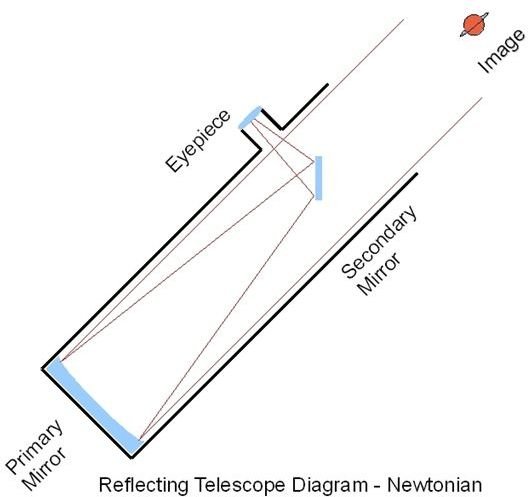
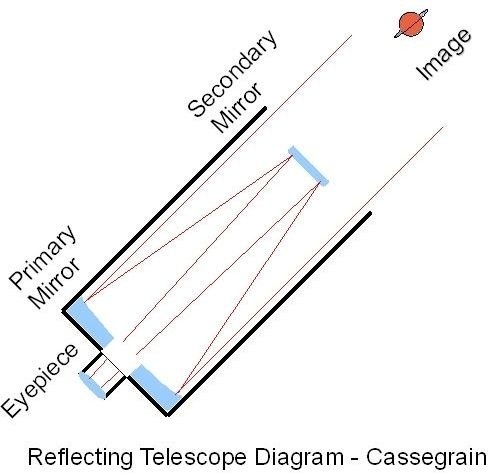
The light from the observed object enters the open end of the optical tube and bounces off a curved mirror at the base of the tube, the primary mirror. The reflected rays then reflect off the secondary mirror and are focused through a lens in the eyepiece. This type of construction allows for a very inexpensive, high quality telescope with a lot of light gathering capability providing very bright, high contrast images. The down side of this construction is that the mirrors may be knocked out of alignment as the telescope is ported from one location to another and may need adjustment. Also, the open tube allows dust to collect on the surface of the mirrors deteriorating the image over time and require careful cleaning.
Reflecting Telescopes
A variant on the classical Newtonian/Cassegrain is the catadioptric or Schmidt/Cassegrain configuration as shown in the figure below.
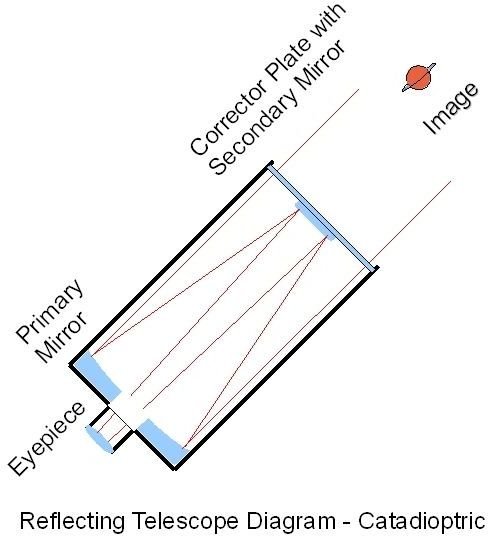
This design provides a closed optical tube by virtue of the corrector plate at the end of the telescope, which is a lens with a mirror at the center. It also reduces the length of the optical tube because the light path is “folded” by bouncing the image off the primary mirror to the secondary mirror and back through the primary mirror to the eyepiece. This compact design has the advantage of providing a much more portable telescope but it comes at a higher cost. The image that you get from this type of optical train may not be as bright as you can get with a more traditional reflector of the same size. Also the large collecting plate at the end of the telescope has a nasty habit of collecting dew on those damp cool nights and requires a heater to prevent the formation of dew.
The Newtonian reflector, either classical or in the catadioptric form, lends itself well to electric drive/computer control, which is essential if you have desires to do astrophotography. The classical reflecting telescope has a great advantage over a refractor or catadioptric for light gathering capability versus cost. If you are willing to do without the computerized control or electric drive there is a variant on the standard Newtonian that does away with the complex mount needed to support the drive mechanism and provides a base that allows simple pointing and viewing of your celestial object of choice. (Tracking an object manually is not difficult, once you get the hang of it.) These are called Dobsonians.
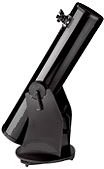
The Dobsonians are very inexpensive compared to the other scopes and provide the most light gathering capability for your cost. Dobsonians with primary mirrors of 8 – 10 inches (20 – 25 cm) are easily transported as the base and optical tube separate and can be loaded into the back of your car. There are computerized versions that will locate objects you choose automatically (commonly known as “GoTo” scopes) once you’ve properly oriented the scope, but they lack the ability to track the object to counteract the earth’s rotation because of the simplified mounting assembly.
Selection Criteria
In all of the above you may have noticed that I didn’t talk about magnification power, which is typically what is promoted for lesser quality telescopes. The critical item in any telescope is it’s light gathering ability, which is directly related to its aperture. In refractors it means the larger the objective lens, or in reflectors, the larger the primary mirror, which allows more light to be collected and focused to your eye, providing a brighter, higher contrast image and this allows the observer to glean more detail about the object they are viewing. The magnification comes through the eyepiece, which can be changed to accommodate what you are looking at and what you want to see. The higher the magnification, the larger the image you will see, but it will be dimmer and not necessarily the sharpest, most detailed image. Higher magnifications also mean you’re you are looking at a smaller piece of the sky, which makes tracking the object more difficult. Any defects in the optical train (and this includes all the jiggles the atmosphere introduces in your image!) will become more evident as you increase the magnification, which causes the image quality to decrease. Low magnification gives you a wider field of view and reduces the tracking issues. Don’t think that lower magnification means boring objects to look at; there are many amazing objects that will astound you, like open clusters, nebula, and the Andromeda Galaxy (M31). Check out the article on “What You Can See with Your New Telescope ” for more information.
So, which one to choose?
Now that you have an idea of what is out there, which one is best for you?
Consider what your experience with astronomy is. If you are just beginning to explore the night sky you can begin very simply with your eyes, and a chart of the night sky. This will allow you to become familiar with the constellations, planets and other objects that are visible to the naked eye. A step above this is practising astronomy with binoculars that will allow you to see much more (typically about 50 times more). If you feel that you are ready to get a telescope and want to get into it gradually then the Dobsonians provide a great choice to get started—low cost and great optics. You will learn the night sky, where and how to find the celestial objects of interest and develop an intuitive feel for navigating the cosmos—something that you won’t get with a computerized telescope or “GoTo” scope.
If you are sure that you want to get into the field of astrophotography or want to hook up your scope to your computer then you will need to get a scope that has an electronic/computerized drive system and you can look at any of the telescopes discussed, it depends on the objects you want to photograph (i.e. planets or deep space objects) and how much you have to spend. These scopes will be heavier because of the substantial mounts needed to stabilize the scope for the long term exposures and therefore will be more expensive and take more time to move and set up.
What ever you decide to buy, make sure that you purchase from a reputable supplier and do some research on what you are buying. Check out online user reviews and the sites for Astronomy and Sky and Telescope magazines for equipment reviews. Do not be swayed by magnification, remember, it is the light gathering ability that will give you a better image – larger mirrors on reflectors and lenses on refractors. With regards to the larger aperture scopes, they will get physically bigger and heavier, so make sure that you are not buying something so big that you don’t want to haul it outside and set it up. Buying the best scope in the world is a waste if you are not inclined to use it. Stay away from the bargain store specials and pay a bit more for quality optics and construction; in the long run you will be much happier with your decision and you can start making plans for your backyard observatory—but that’s another article!