It took one more stumble, but Gemini finally achieved its goals of docking with the Agena and using the stage to maneuver. Along the way three more astronauts took strolls around the Earth.
The Angry Alligator
Once again, the rocket science gods would have their way with the seemingly cursed Atlas Agena. With Gemini IX sitting on the pad, Tom Stafford and Gene Cernan watched the Atlas Agena rise into the clear Florida sky. Two minutes after launch one of the Atlas engines gimbaled hard over, pitching the entire vehicle into a nosedive towards the Atlantic. The Agena separated, but it was too late. It and the Atlas crashed into the waters off Cape Canaveral.
While not elated at the turn of events, NASA this time was ready. It had directed General Dynamics, which built the Atlas, to have one ready for a 14 day turn around in case. No Agena was available, but an unpowered docking collar assembly was. This would be orbited by the Atlas, which alone was capable of putting several hundred pounds in orbit. Years before, an Atlas had put itself into orbit, to the world’s amazement.
So once again, Stafford and Cernan, in IXA now, watched the Atlas head for space. No problems so far this time, and IXA rose from the pad for a rendezvous and docking.
But the ground was receiving some worrisome telemetry. There were indications the shroud had not separated. Were the rocket science gods working their mischief again?
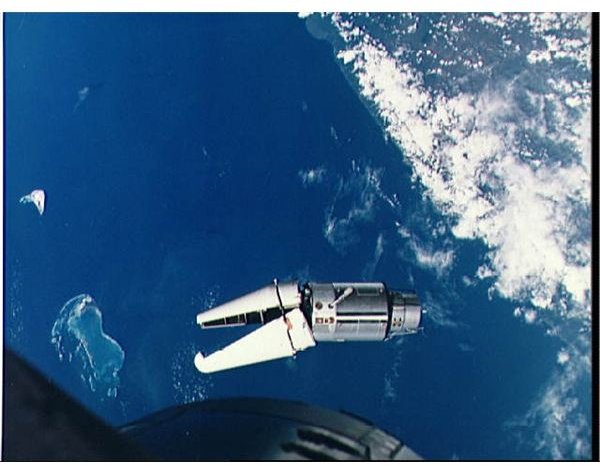
As IXA closed on the target, it was clear they indeed were. The shroud was half open and still attached to the collar.
“It looks like an angry alligator,” Stafford exclaimed.
He told Mission Control he thought he could knock it loose with just a gentle nudge. Control nixed the idea completely however, concerned the shroud might damage the spacecraft.
So the crew went on to a series of complicated rendezvous and stationkeeping procedures. They would move away from the collar in various directions, then return. They did this several times.
After these experiments, Cernan took a stroll in space, using the new Astronaut Maneuvering Unit (AMU) stowed in the equipment section at the rear of the Gemini. He even moved to the ‘angry alligator’ and investigated it.
He found the extra vehicular activity (EVA) exhausting, because any small movement of his body—by Newton’s law of equal and opposite reaction—caused him to move, which he had to correct.
Cernan spent 128 minutes outside the spaceship.
Gemini IXA splashed down 72 hours after launch, only 0.7 kilometers from its predicted impact point. Despite the angry alligator, more rendezvous techniques had been perfected.
Double Rendezvous
For Gemini X, the rocket science gods apparently had grown tired of their game. John Young and Michael Collins approached a good Agena in perfect orbit, having already circularized their orbit. Slowly Collins inched into the docking collar.
“We have a good dock,” he reported to Mission Control.
Now they had a second rendezvous to make. Neil Armstrong’s Gemini VIII Agena, now dead, remained in orbit at just under 400 kilometers. They would use the big engine on their Agena stage to reach it.
An hour after docking, they fired the Agena’s engine and began a trip to a place man had never gone at the time.
To match speeds with the Gemini VIII Agena, they of course had to slow down, due to the vagaries of orbital mechanics . This meant they had to move to a higher orbit. The Agena’s engine fired for 80 seconds. At shutdown, it had put them on a course that would take them to an apogee (high point) 412 miles above the Earth. No man had ever flown that high at the time.
Once they had caught the old Agena, they fired their Agena’s engine again to lower the apogee to near that of the dead vehicle. One more firing circularized their orbit. Later, they undocked from their Agena, and Young used Gemini’s thrusters to move closer to the Gemini VIII Agena. Once they were within three meters, the hatch was opened and Collins began an EVA.
He moved to the VIII Agena and retrieved a micrometeorite experiment package left because of the VIII problems.
Now it was on to greater heights!
The View From 800 Miles
Young and Collins’ record for the highest orbit lasted about two months. Chuck Conrad and Dick Gordon on September 12, 1966 were ready to smash it, along with some other advances.
Their Gemini XI raced after the Agena target vehicle just two seconds after its launch. This was to be a first orbit rendezvous. NASA had already determined that a lunar orbit rendezvous would be a part of the moon landing program, and that would require a first orbit connection at the moon. It had to be perfected now.
Conrad and Gordon made it look easy. By now all the astronauts were well versed in orbital mechanics, and the two pilots made the orbital adjustments quickly, much of them on their own, as they were out of communication range with the ground. Eighty-five minutes after XI’s launch, the spaceship pulled to within 15 meters of the Agena.
Gordon radioed down, “Mr. [Chris] Kraft, would you believe M equals 1? (NASA speak for rendezvous achieved.) Seconds later, they were given the go ahead to dock.
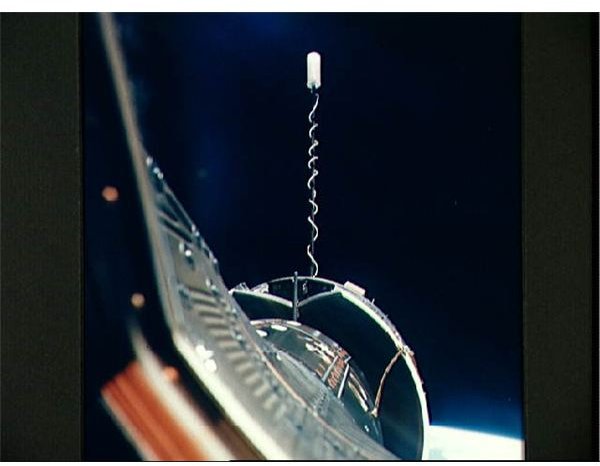
Both pilots then practiced undocking and docking several times. They then fired the Agena’s engine to change the orbital plane.
Then Gordon exited the spacecraft for an EVA. He retrieved a couple of experiments from the Agena, and attached a 30 meter tether to both vehicles for a later experiment in artificial gravity.
After the EVA, and some sleep, the two prepared their big adventure. On the 26th revolution, they fired the Agena’s engine for 26 seconds. They were headed out. As they watched the Earth recede, Conrad radioed down, “the world is round.”
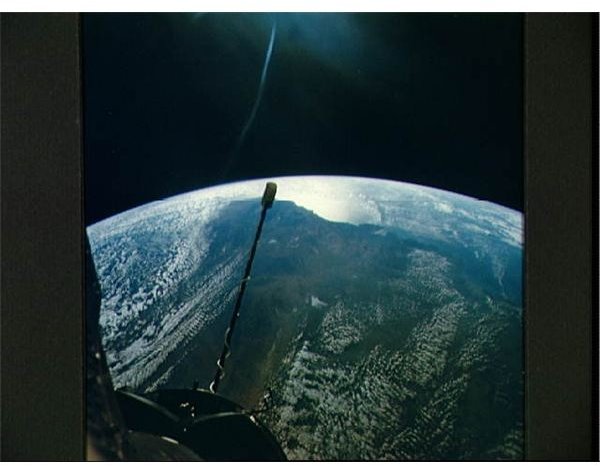
They reached an apogee of 800 miles, and spent two revolutions at that distance. They then fired the Agena’s engine to bring them back down to **189 miles.**The next day, they began the artificial gravity experiment with the tether. Theory said if two objects were connected, with one closer to the Earth than the other, it would produce a ‘gravity gradient’ that would create artificial gravity in the spaceship.
They undocked from the Agena and began to reel out the tether. The tether stuck, so they couldn’t do the gravity gradient experiment. So they attempted to do a spin experiment. In this, they put both craft into a rotation around each other. There were problems but the pilots solved each one in turn. Finally, they had a stable rotation. Although neither could feel any indication of gravity, objects in the cabin did slowly move to the back—now floor—of the cabin.
After releasing the tether, they rendezvoused again with the Agena, stationkeeping for a time.
Then it was time to come home, from the most successful Gemini mission ever.
The Final Mission
Gemini XII did not quite match XI’s successes, but it did achieve some of its own. It had the most successful EVA to date, and it accomplished the gravity gradient experiment. Jim Lovell and Buzz Aldrin successfully docked with their Agena, but the Agena had suffered a decay in chamber pressure and drop in turbine speed. Ground control nixed firing of the big engine for the planned trek to higher altitudes.
Still, there was plenty to do. Aldrin had several EVAs planned. Some were simply standing with the hatch opened. The main one was to see if he could install and remove a movie camera on the Gemini. He did with no problem.
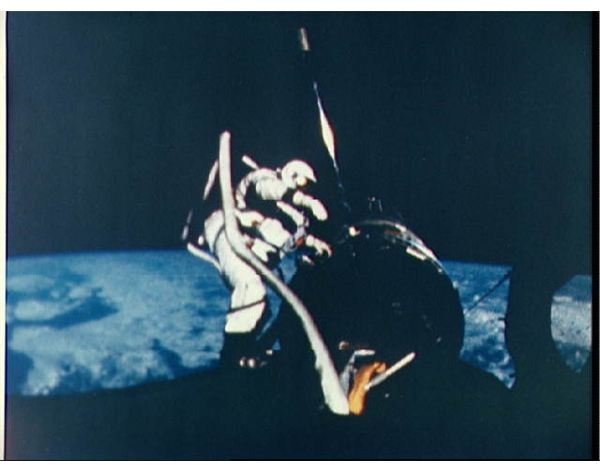
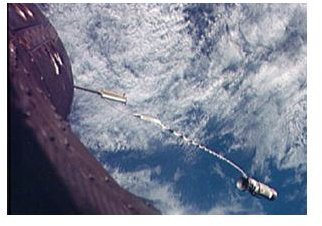
Then he attached the tether to both craft. This time the tether uncoiled from the spacecraft perfectly.
The gravity gradient theory states that if the mass of an orbiting body–even two just connected by a tether–is distributed so that part of it is closer to the Earth than the other, the part closer to the planet will be subject to a greater gravitational pull than that part of the mass further from the Earth. That should not only create a slight artificial gravity, but stabilize the satellite without use of fuel.
It did. Their gravity gradient experiment was a success. The theory was correct.
When XII splashed down, the Gemini program came to an end. It had proven and developed the procedures for rendezvous and docking with another spacecraft, and much more.
Now NASA took aim at the moon.
Credits
All photos: NASA
This post is part of the series: Rendezvous in Space–The Gemini Program
With President John Kennedy’s challenge to land a man on the moon by the end of the decade, NASA had to develop and prove the techniques of rendezvous and docking two spacecraft in orbit. That was Gemini’s mission. Along the way, five astronauts would take a stroll in space.