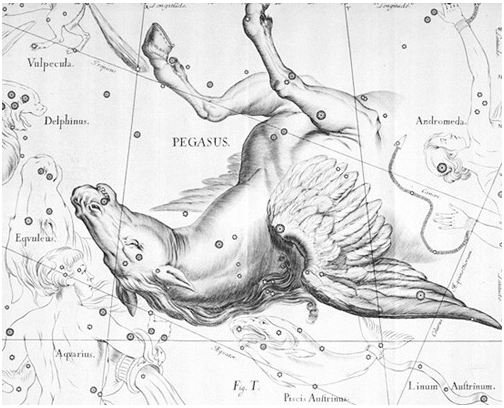
This 7th largest constellation in the sky derives its name from a winged horse in Greek mythology. The articles presents some interesting facts and numbers about the constellation.
Pegasus Constellation
The image presents the mythological illustration of Pegasus, i.e, the winged horse.
Interesting Facts About Constellation Pegasus
1. Symbolism: A winged horse.
2. Right Ascension: 23h.
3. Declination: +20o.
4. Area: 1121 sq. deg.
5. Latitudes visible at: Between +90o and -60o.
6. Time best visible: At 21:00 in October.
7. Rank in constellation size: 7th.
8. Brightest Star: Epsilon Pegasi (Enif) - 2.39m.
9. Nearest Star: Iota Pegasi (38.3 light years).
10. Named Stars: Markab, Scheat, Algenib, Enif, Homam, Matar, Baham, Sadalbari
11. Meteor Showers: Pegasids in July.
12. Deep Sky Objects: M15 globular cluster, NGC 7742 and NGC 7331 galaxies.
13. Mythological significance: In Greek mythology, Pegasus is a winged horse who is the son of Poseidon. Pegasus is thought to be born from Medusa’s severed head when Perseus killed her. It is also believed that Pegasus carried Zeus’ thunderbolts through the sky.
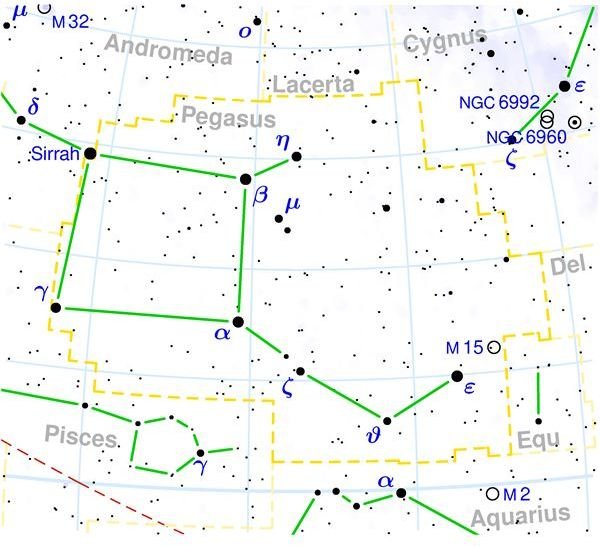
Image: (below) A constellation map of Pegasus.
More Info on the Stars in the Constellation
1. The square of Pegasus: Alpha Peg, beta Peg, gamma Peg along with alpha And form the famous asterism known as the square of Pegasus which is very distinctly visible in the night sky.
2. Exosolar planets: 51 Pegasi is the first Sun-like star known to have a planet orbiting around it. HD209458b, an exosolar planet in this constellation, has shown evidence of atmospheric water vapour on spectroscopic analysis. HR 8799 is the first exosolar planet to be directly imaged.
3. Nearest Supernova: IK Pegasi is believed to be the nearest supernova candidate.
4. Transferred star: A star delta Pegasi, also known as Sirrah, is now officially declared to be in the constellation of Andromeda and is more commonly known as alpha And or Alpheratz.
5. Nebula in cluster: M15, a globular cluster in Pegasus, houses one of the only four planetary nebulae known in a globular cluster. The name of the planetary nebula inside M15 is Pease 1.