Cosmology is the study of origin, current state and future of the universe as a whole. From the Big Bang to the Hubble’s Law, learn the important facts about cosmology in this article.
Images
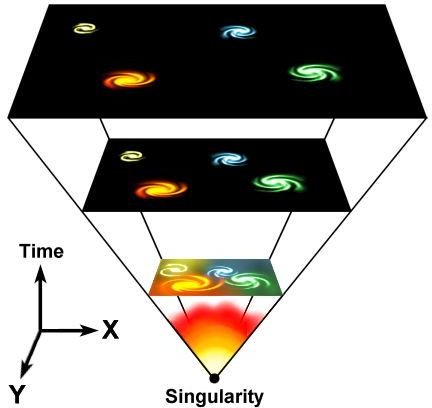
This illustration(to the right) shows abstracted “slices” of space at different points in time. It is simplified as it shows only two of three spatial
dimensions, to allow for the time axis to be displayed conveniently (Courtesy: Wikimedia Commons). This illustration is based on the Big Bang model of the universe.
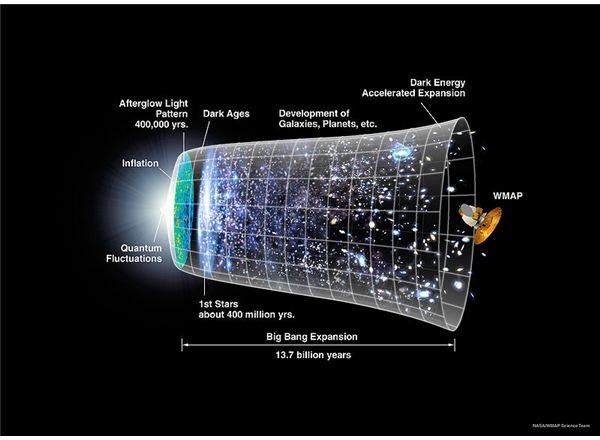
The image(to the left) shows an artist impression of the timeline of our universe starting with a Big Bang and consequently expanding into various small structures. (Courtesy: Wikimedia Commons)
Theories of the Universe
1. Ptolemy (2 century AD) : He gave a geocentric (centered at the Earth) theory of the universe. According to the theory, planets move in small circles called epicycles each having a centre which moves in a larger circle called an eccentric or a defferent.
2. Copernicus (1543) : His theory was the first scientifically based heliocentric (centred at the Sun) theory of the universe. He also explained that the apparent motion of the stars is because of the Earth’s motion.
3. Static Newtonian Universe : This theory states that the universe is infinite (in space and time), static and in steady state. Every particle in the universe attracts every other particle with a gravitational force. The model is unstable.
4. Einstein’s universe : The theory introduces a cosmological constant to stabilize the static non-expanding universe. However, this model of the universe is still unstable.
5. Oscillating universe : The universe, in this theory, is said to be in perpetual oscillation of big bang and big crunch. This model was favoured by Friedmann, a famous Soviet cosmologist who discovered that general relativity supports an expanding universe.
6. Big Bang model : This is the most widely accepted model of the universe. The universe started with a big bang and has since then, continued to expand. Time and space originated at the big bang. The Hubble’s constant quantifies the rate of expansion. There are still many observed facts that cannot be explained by the big bang model.
Fun with numbers
1**. Age of the Universe:** 13.7 billion years.
2. Size of visible universe(radius): 46.5 billion light years.
3. Hubble’s constant: 70.8 +/- 1.6 (Km/s)/Mpc. This means that a galaxy that is 1 Mpc away from us will be moving further away from us at about 70.8 Km/s. A galaxy twice as far will move away at twice the speed.
4. Average density of visible matter in the universe: 10-30 g/cm3.
5. Approximate number of galaxies in the universe: 1011.
6. Approximate number of stars in a galaxy: 1011.
7. Temperature of Cosmic Background Radiation : 2.7 K.
Some Interesting Laws and Theories
1. Hubble’s Law : Empirically derived by famous astronomer Edwin Hubble, this law states that outside the local group, galaxies are moving apart at a velocity proportional to the distance between them.
2. String theory : The basic assumption of this theory is that the building blocks of matter are one-dimensional strings. This theory is still in its developing stages due to its high complexity.