Do stars really move? We look at the night sky and the stars appear fixed in the heavens. But they do move and you can see them move if you know where and how to look. But the most exciting thing about this is that the driving force behind this motion is a black hole at the center of our galaxy!
Stellar Motion
If you watch the night sky for a lifetime you will notice the planets wander among the stars, along with the occasional comet now and then and the Moon going through its monthly cycle; you might even be lucky to see a nova or supernova, but you will never see the
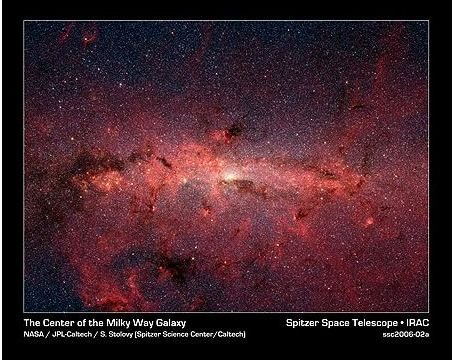
stars move. They are moving, rest assured, but even with the high velocities they are traveling at, the tremendous distance that separates us makes the distance (their proper motion) they would move in a lifetime imperceptible—especially to the naked eye. But, there is a place where moving stars move fast enough so that you would notice their relative motion in a few years and that is at the galactic center of the Milky Way.
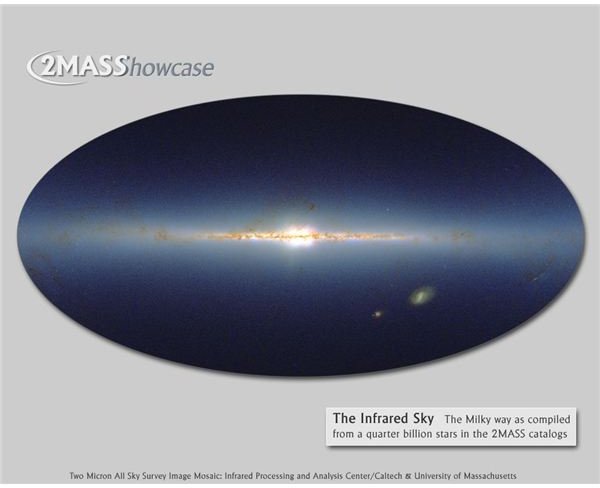
Below, in the infrared image from the Two Micron All Sky Survey, a more encompassing view of the Milky Way Galaxy can be seen, emphasizing the galactic core.
How Do We See the Motion of the Stars?
The galactic center contains a high concentration of stars and a massive black hole. It also is shrouded in dust that obscures our visual observation of the individual stars. We know there is a black hole there by the intense X-ray and radio emissions that are observable in the constellation Sagittarius, which frames our view of the center of the Milky Way galaxy. The object that is specifically associated with the black hole is Sagittarius A*. To pierce the veil of dust that hides the stars at the center we need to look beyond the visual into other parts of the electromagnetic spectrum—the infrared region.
Looking at the longer wavelengths in the infrared region of the spectrum gives us a view of the heat signature of the stars, which passes through the dust while the visual wavelengths are absorbed by the dust. Looking in the right part of the spectrum is not all you need. You will need an optical system that can resolve, or separately image the individual stars at the center and that takes some special technology, namely adaptive optics and speckle imaging.
Both of these tools are used to compensate for the turbulence we have in our atmosphere due to temperature, pressure and moisture changes. The adaptive optics system adjusts the surface of the mirror of the telescope many times a second after measuring the atmospheric distortion and calculating the best mirror shape to compensate for it. The speckle imaging technique takes many short exposure images, on the order of hundreds to thousands of pictures and then uses a computer and a mathematical algorithm to combine the images to provide a much sharper image.
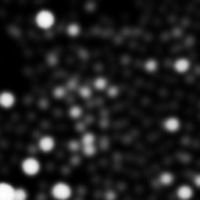
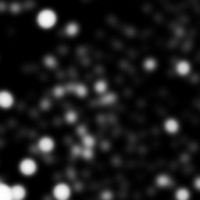
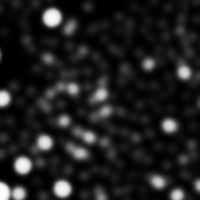
Utilizing these two advances in technology a team of astronomers lead by Dr. Reinhard Genzel at the Max Planck Institute was able to image the stars at the galactic center over a period of six years, from 1994 to 2000. They produced an amazing movie that shows the stars moving in different orbits about a central mass. The gallery below contains three images taken over this time span that clearly show the motion of the stars. Look closely at the stars in the center of the images and you will see that the pattern changes from frame to frame.
Images Showing Stellar Motion at the Galactic Center
Movies of the Stars in Motion
To actually see these stars at the galactic center in motion please view this movie , which covers a period from 1992 to 2002 and shows very clearly the stars moving about a central point marked by the yellow cross—the suspected black hole. (Even more detail can be seen in this movie showing a zoomed-in view of the activity.)
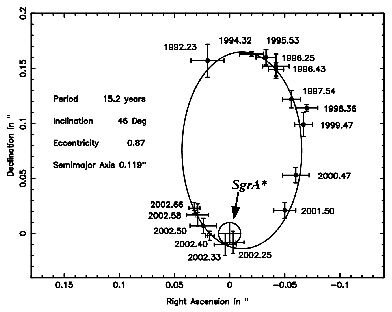
After analysis of the images they were able to produce this simulation the orbits of these stars about an unseen mass. In the figure below you can see a detailed image of the orbit of the star - S2, which moves around Sagittarius A*.
Our Universe is teeming with activity—from the occasional supernova to the more mundane comet streaking through our Solar System to the mysterious dance of stars about a massive black hole at the center of the Milky Way galaxy. We live in a very dynamic cosmos only limited by what we can perceive with our senses, technology and imagination.
For more information on this fascinating place in our galaxy visit the Galactic Center Research site at the Max Planck Institute and be sure to view the slide show that is available and gives more information about this topic.
12/11/2008 Update: The ESO, the European Organisation for Astronomical Research in the Southern Hemisphere, has just released a wonderful video summarizing 16 years of observations of moving stars at the galactic center. There are some nice 3D graphics to illustrate the orbits of the stars about the massive black hole that hides at the core of the Milky Way.
References and Credits
Galactic Center Research: https://www.mpe.mpg.de/ir/GC/index.php?lang=en
Sagittarius: https://www.spitzer.caltech.edu/images/1540-ssc2006-02a-A-Cauldron-of-Stars-at-the-Galaxy-s-Center
Two Micron All Sky Survey: Atlas Image obtained as part of the Two Micron All Sky Survey (2MASS), a joint project of the University of Massachusetts and the Infrared Processing and Analysis Center/California Institute of Technology, funded by the National Aeronautics and Space Administration and the National Science Foundation. https://www.ipac.caltech.edu/2mass/gallery/showcase/allsky_stars/index.html
Images of stellar motion: Courtesy of the Galactic Center Research site at the Max Planck Institute - https://www.mpe.mpg.de/ir/GC/res_mass.php?lang=en
ESO stars at the galactic center: https://www.eso.org/public/news/eso0846/
Orbit of Star S2: Courtesy of the Galactic Center Research site at the Max Planck Institute - https://www.mpe.mpg.de/ir/GC/res_s2orbit.php?lang=en