
Astronomy in Ancient Mesopotamia was as much a mixture of religion and astrology as it was a science, but its methods had a significant influence on later Western astronomers.
Sumerian Astronomy
The region archaeologists call Ancient Mesopotamia encompassed parts of modern-day Iraq, Syria, Turkey and Iran. It is often called the “cradle of civilization”, for it was here that humans built the earliest known cities, invented the wheel and developed the first written language.
Civilization in Mesopotamia began with the Sumerians, who settled there around the 40th century BCE. In addition to writing, the Sumerians devised a counting system that allowed them to express both very large and very small numbers. They also invented algebra and geometry, and it was Sumerian mathematicians who first divided circles into 360 degrees of 60 minutes each.
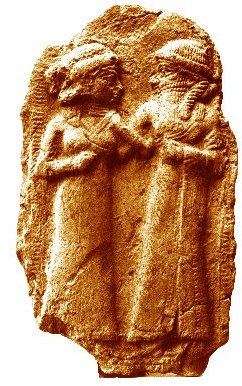
Without the aid of telescopes, Sumerian astronomers followed the movements of the stars, and identified the planets Mercury, Venus, Mars, Jupiter and Saturn. The next planet to be discovered, Uranus, was not observed until well after the invention of the telescope, in 1781. It is thought that the Sumerians worshipped the planets as gods, but unfortunately most of their astronomical archives have been lost. What we do know about Sumerian astronomy was largely deduced from records compiled by the civilization that succeeded Sumer in Ancient Mesopotamia – the Babylonian Empire.
Babylonian Astronomy
The Babylonians adopted a more scientific approach to astronomy than their Sumerian forebears, though religion and astronomy were still intertwined. For example, the Sun, the Moon and the five known planets were closely identified with the principal gods of the Babylonian pantheon – Jupiter with Marduk, Venus with Ishtar and so on. However, rather than simply watching the motions of the heavenly bodies, Babylonian astronomers sought to understand them, to enable predictions of their positions in the future.
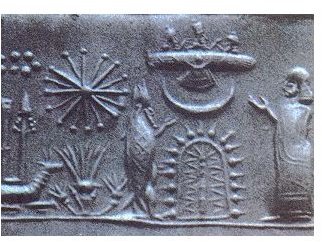
Through painstaking observations, the Babylonians were the first to recognize that astronomical events occur in cycles. This enabled them to develop a calendar, based on both their own findings and an earlier calendar devised by the Sumerians. Knowing the dates of the seasons was of vital importance for agriculture, allowing farmers to plant their crops at optimal times to feed the burgeoning population. Babylonians measured time using sundials and water clocks. Although none of these instruments has survived to the present day, we know of their existence from clay tablets describing the rising and setting of the Sun, Moon and planets.
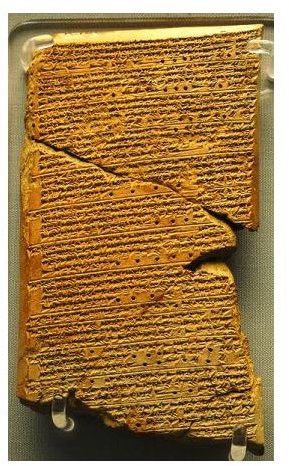
The Enuma Anu Enlil is a series of around 70 tablets recording celestial motions, the phases of the Moon, lunar and solar eclipses, and weather phenomena spanning centuries. It includes the Venus Tablet of Ammisaduqa, which was compiled during the 17th century BCE and details the times of the first and last risings of the planet Venus over two decades. However, much of the content of these tablets is concerned with divination and omens, aiming to interpret the astronomers’ observations in terms of the fortunes of the king and his empire. Astronomy in Babylonian times was very much a branch of astrology.
In the 12th century BCE, Babylonian astronomers began to compile “star catalogs” – lists of the visible stars, grouped into constellations. Many had Sumerian names, demonstrating the continued influence of Sumerian astronomy in Babylon. Some of the constellations identified by the Babylonians – including Taurus, Leo, Scorpio, Capricorn, Gemini and Cancer – are still recognized by astronomers and astrologers today.
The Chaldeans: Babylonian Priest-Astronomers
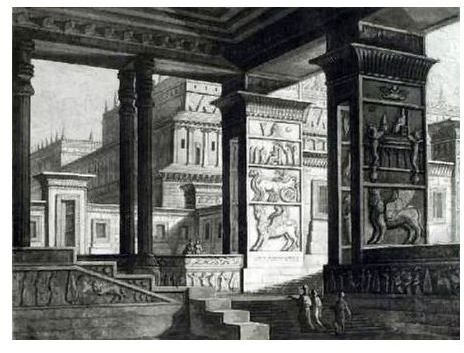
In the later Babylonian Empire, the individuals responsible for studying the skies were known as Chaldeans. Although these priest-astronomers continued to use the old star catalogs to predict celestial phenomena, they also developed mathematical models that allowed them to anticipate astronomical events without consulting the records. This ability to “foretell the future” must have seemed magical to the general population, and the Chaldeans enjoyed positions of great power and respect within the social and religious hierarchy.
Probably the most famous Chaldean was Seleucus of Seleucia, who lived around 200 BCE. Unlike most of his contemporaries, Seleucus believed that the Earth and the other planets revolved around the Sun, as did Copernicus 1700 years later. Seleucus was also the first to suggest that the Earth’s tides are caused by the action of the Moon , and that the height of the tides depends on the Moon’s position relative to the Sun.
The Legacy of the Ancient Mesopotamian’s Study of the Cosmos

With the passage of millennia, the achievements of Sumerian and Babylonian astronomers were largely forgotten until modern times, when their cuneiform records were discovered and deciphered. However, astronomy in Ancient Mesopotamia had a significant influence on subsequent civilizations. After Alexander the Great conquered the region in 331 BCE, Ancient Greek scientists gained access to the Babylonian star catalogues, and absorbed the scientific and mathematical methods of the Chaldeans into their own astronomy. Centuries later, this knowledge passed from the Greeks and Arabs into Western science. Although we no longer worship planets as gods, the Ancient Mesopotamians helped lay the foundation for all of modern Western astronomy.
Image Credits
Map: Teka, https://commons.wikimedia.org/wiki/File:Mesopotamia _geographic.png
Inanna: Tang Lung, https://commons.wikimedia.org/wiki/File:Dumuzi.gif
Cylinder seal: Irony Writ, https://commons.wikimedia.org/wiki/File:Mesopotamian _cylinder_seal_impression.jpg
Venus Tablet: Fæ, https://commons.wikimedia.org/wiki/File:Venus _Tablet_of_Ammisaduqa.jpg
Babylon: Sitris, https://commons.wikimedia.org/wiki/File:BasoliAntonio _StageSet2_Meyerbeer_Semiramide.jpg
Ruins: Library of Congress, https://commons.wikimedia.org/wiki/File:Babylon ,_1932.jpg
References
- “Sumerian/Babylonian Mathematics” http://www.storyofmathematics.com/sumerian.html (Accessed 24-08-11)
- Aaboe, A. “Scientific Astronomy in Antiquity”, Philosophical Transactions of the Royal Society A. 2 May, 1974 http://rsta.royalsocietypublishing.org/content/276/1257/21 (Accessed 24-08-11)
- “Mesopotamian Astronomy” http://www.experiment-resources.com/mesopotamian-astronomy.html (Accessed 24-08-11)
- “Astronomers of Babylon” http://www.mesopotamia.co.uk/astronomer/home _set.html (Accessed 24-08-11)
- Reiner, E and Pingree, D. “Babylonian Planetary Omens, Part One”. Undena Publications, 1975 http://www.caeno.org/ _Eponym/pdf/Reiner_Ammizaduga%20BPO%201975.pdf (Accessed 24-08-11)