People have been trying to understand the beginning of the universe – what it is, why it is – since the earliest days of civilization. Read on to fine ancient cosmology’s various theories on the origin of the universe.
Theories on the Origin of the Universe
While we still don’t have anywhere near all the answers today, we’ve come a long way since the days when the sun, moon and stars were believed to have been vomited by a giant deity (the Bakuba Kingdom of Congo) or the universe was hatched from a black egg (ancient China).
Let’s look at some ancient cosmology from around the world and how different nations once tried to understand the heavens and earth:
North America
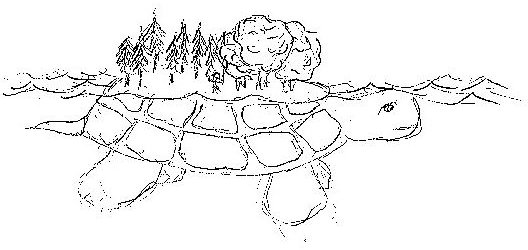
The heavens were around for a lot longer than the Earth, according to a creation myth told by the Iroquois people of North America. One of the heavenly inhabitants, the Great Spirit, punished his daughter for becoming pregnant by throwing her through a hole formed when he ripped up a giant tree. To keep her from perishing, though, he ordered the Great Turtle to dive down into the water, bring up some mud and wait for the daughter to land on its back. When she landed, she gathered up the mud and created the Earth as an island carried on the Great Turtle’s back.
At left: a depiction of the Great Turtle carrying the Earth. (Image credit: Lindsey Murtaugh, “Common Elements in Creation Myths,” https://www.cs.williams.edu/~lindsey/myths/myths _12.html)
Mesoamerica
In the beginning, according to the Aztec creation myth, was a being called Coatlique. After being impregnated by an obsidian knife, she gave birth to the moon goddess (Coyolxanuhqui) and many sons who became the stars. The rest of the cosmos emerged as the result of a brutal conflict between Coatlique, her son Huitzilopochtli (the god of war) and her other children, who were murdered.
South America
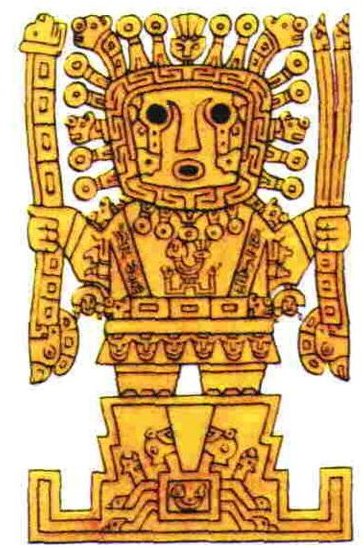
In ancient Inca mythology, the god Viracocha reigned alone in darkness. He then created the sun (the god Inti), moon (the goddess Mama-Quilla), stars (the Inca’s guardians in the heavens) and Earth before creating humans out of stone. The Inca believed the sun god dropped into the ocean at sunset each day, and had to swim underneath the Earth each night before re-emerging at sunrise.
At right: the Inca god Viracocha (Image credit: https://commons.wikimedia.org/wiki/Image:Viracocha.jpg)
Africa
According to the Bakuba (also called Kuba) people of central Africa (Congo), the first being was a white giant named Mbombo, who presided over a dark and watery world. A violent stomach ache caused him to throw up the stars, moon and sun, which dried up the waters to reveal the Earth. A second bout of nausea led to the creation of people, animals, trees and more.
Middle East
The ancient Babylonians’ view of the universe was detailed in the Enuma Elish, a creation myth inscribed on a series of seven clay tablets. In the story, a battle among the gods leads Marduk, the god of spring, to kill Tiamat, goddess of the sea. He splits her body in two, and one half becomes the Earth, the other, the sky. The slain Tiamat’s saliva becomes the rain.
Europe
In ancient Greece, the universe was believed to have started as a dark emptiness in which lived a black-winged bird. After a long time, the egg hatched, and one half of the shell became the sky while the other became the Earth.
The Norse, on the other hand, had a far more complicated explanation for how the universe came to be. An old Norse poem, the Völuspá, describes a cosmos that began with nothing but ice to the north and fire to the south. In the gap between those two regions, the fire melted some of the ice to form a life-creating substance known as Eiter. From the Eiter came a giant, Ymir, and a cow, Auðumbla, who then licked ice to uncover a man known as Búri. One of Búri’s grandsons eventually went on to kill Ymir, using the giant’s body to create the universe: flesh became dirt, bones became mountains, brains became clouds. The sun, moon and stars were then created using sparks from the fiery south.
Asia
The ancient Hindus too envisioned the universe emerging from an egg. In the Brahmanda Purana, a religious text, this cosmic egg gives rise to creation not once but in an eternal cycle of birth, death and rebirth. (It’s interesting to note this tale echoes the modern theory of the oscillatory universe .)
Oceania
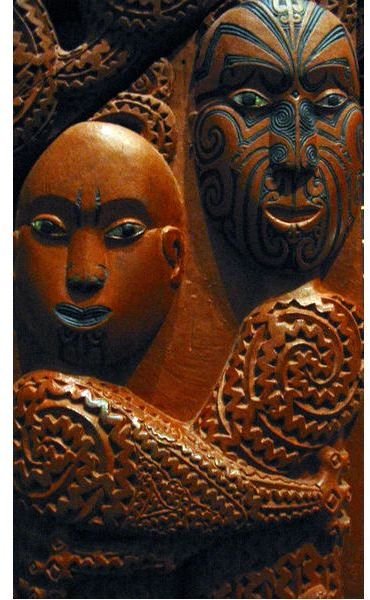
The Maori of New Zealand believed the god Io created the universe out of nothing, bringing forth the Sky Father (Ranginui) and the Earth Mother (Papatuanuku). The two, who remain “cleaved together,” have many children, who eventually decide to separate their parents because they’re blocking out the sun. The son Tanemahuta eventually succeeds in separating his mother and father, causing them to bleed what becomes red clay, or ocher (a vital element in Maori culture).
At left: a sculpture of Ranginui and Paptuanuku. (Image credit: https://commons.wikimedia.org/wiki/Image:WahineTane.jpg)
Resources
“Common Elements in Creation Myths”: https://www.cs.williams.edu/~lindsey/myths/
Links to creation myths from around the world: https://www.magictails.com/creationlinks.html