Neutron stars are strange creatures. One teaspoon weighs a billion tons. Now, the Chandra X-Ray telescope has discovered they are even more weird. It appears that in their center they are liquid. Not a liquid as we know it, but a superfluid—with superconductivity and no viscosity.
Liquid at One Billion Degrees
The interior temperature of a neutron star is about one billion degrees F. So how can a liquid exist at those temperatures? A normal liquid as we know it on Earth—water, oil, etc—can’t. They would not just boil away immediately; they would be torn into their respective atoms.
In a neutron star, the pressures are so great, the subatomic particles of the atoms have been collapsed into each other. The electrons and protons have been squashed together to form neutrons. But under the pressures in a neutron star, the neutrons form a Bose-Einstein condensate—a neutron ‘soup’ that behaves like a liquid, except it has no viscosity , and is superconducting.
Viscosity is the ‘glue’ that makes a liquid hold together. Liquids with a high viscosity are thick and pour slowly, such as ketchup or honey. Water has a relatively low viscosity.
A superconducting material has no resistance. Introduce an electric current into it and the electricity will flow forever.
What is a Superfluid
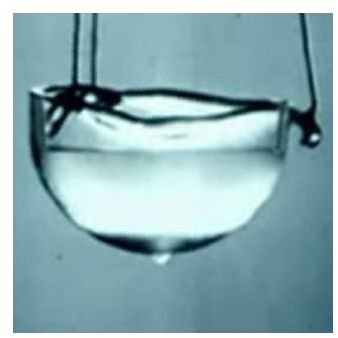
We have produced superfluids on Earth, but not at billions of degrees—rather at temperatures barely above absolute zero. Strange things happen if you cool helium 4 (He4) to just 2 degrees K (-452 degrees F) above absolute zero, the temperature at which all molecular and atomic motion ceases. But not in superfluids. The atoms stop darting around alright, but they sit in place ‘shivering’—vibrating. This causes the unique liquid to do things that seem impossible. If you stir a cup of coffee, after a few minutes the swirling stops. Not superfluid He4. Let it sit for 1000 years and it will still be swirling. That is, if you can keep it in the cup. Because it will climb the sides of the cup, and eventually empty itself out, leaving an empty cup. This is because a superfluid has no viscosity. It will even find quantum cracks in a container and leak out them.
We mentioned the Bose-Einstein condensate (BECs for short) nature of superfluids. This is a quantum state of matter in which atoms merge to create a ‘matter wave.’ It is matter, but it behaves as a wave, just a light behaves as a wave or a particle.
The matter waves physicists have created are about a millimeter in length. To date, they have gone beyond He4 and used sodium, rubidium and other elements. But only atoms with an even number of neutrons protons and electrons can become superfluids. Because this quantum form of matter behaves like a wave, it does some interesting things.
Supernovas in the Lab
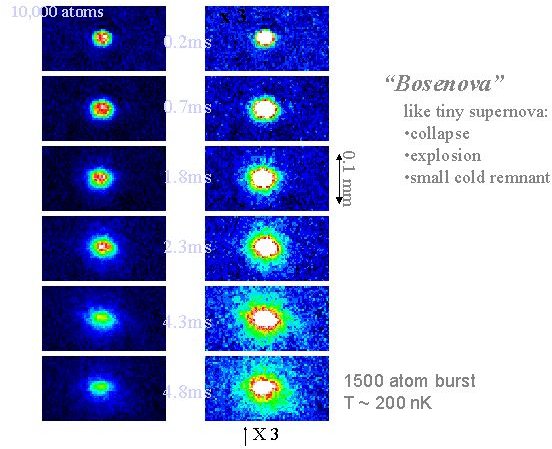
Researchers have created BECs and ‘trapped’ them in magnetic fields. Then by tuning the field, they made the atoms mildly repel each other. The BEC expanded as expected. Then they made it mildly attractive. It began to shrink, as expected, but then it surprised the heck out of them.
Many atoms flew outward in spherical shells. Some spewed out in narrow jets and disappeared completely. Some remained at the center, forming a much smaller core.
If you’re a regular reader of the space channel, you will recognize this as a description of a supernova and the creation of a neutron star. The researchers called it a “bosenova” (bose-a-nova) or “ the puniest explosion ever.”
Supercold Proves Superhot
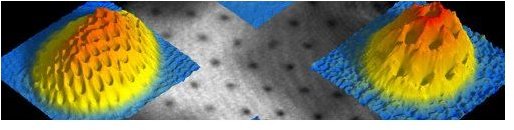
Further experiments with the supercold superfluids opened another look into the innards of a neutron star. Many researchers had seen vortices in superfluids when they were rotated, and astronomers believed firmly the superfluid in neutron stars contained great vortices. You might think of them as superfluid tornadoes.
The reasoning behind this thinking is the fact that many neutron stars are pulsars —stars that emit a beam of radio waves, sometimes light, as regularly as a lighthouse as they spin at incredible rotational speeds. But sometimes a pulsar will begin to run too fast, or too slow. Astronomers believe this is due to the vortices decaying, or forming.
Researchers spun a BEC with a laser, and guess what? Vortices formed just as they believe occur in a neutron star. And as the vortices decayed, the spin rates slowed. Just what astronomers thought happened in neutron stars.
It brings to mind the little rhyme penned by physicist Lewis Richardson in the 1920s.
Big whorls have little whorls
That feed on their velocity,
And little whorls have lesser whorls
And so on to viscosity.
Except in superfluids viscosity disappears.
Sources and Credits
Vortices in neutron stars: NASA https://www.jpl.nasa.gov/releases/2001/whirlpool.html
Superfluid in neutron star: NASA https://www.nasa.gov/mission _pages/chandra/news/casa2011.html
BECs: NASA https://science.nasa.gov/science-news/science-at-nasa/2002/03apr _neutronstars/
Superfluid climbing out of cup: Scientific American https://www.scientificamerican.com/article.cfm?id=superfluid-can-climb-walls
Bosenova: University of Colorado https://spot.colorado.edu/~cwieman/Bosenova.html