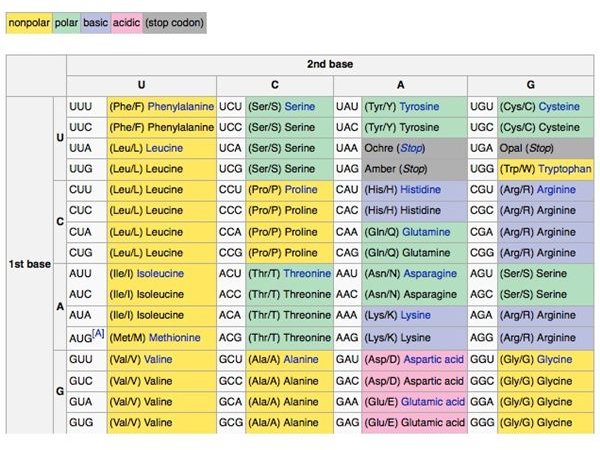
The genetic code is the translation system between the nucleotides of DNA and RNA, and the amino acids that make up proteins.
What is the Genetic Code?
Before we can understand the genetic code, we must first understand some basic genetics.
Genes and proteins are written in different “languages.” Genes are encoded within DNA, which are made of nucleotides, while proteins are constructed out of amino acids. In order for a biological cell to make proteins, the genetic information from DNA has to be translated.
First, the gene encoded in DNA is transcripted into a single strand of mRNA (messenger RNA). This happens inside the cell nucleus in eukaryotes. DNA and mRNA are both sequences of nucleotides. In DNA, the nucleotides are adenine, guanine, cytosine, and thymine. In RNA, the thymine is replaced with uracil, but otherwise the sequences are the same.
The mRNA then moves outside the nucleus to the ribosomes (rRNA), where protein synthesis takes place. Ribosomes move along the mRNA strand, reading it three nucleotides at a time. At each three nucleotides, called a codon, a molecule of tRNA (transfer RNA) binds to them.
There are several dozen different kinds of tRNA. Each can bind to a different codon at one end, and one of twenty amino acids at the other end. The tRNA brings amino acids to the ribosome as the ribosome reads the mRNA, and the amino acids are joined together to make a polypeptide, which later folds into protein.
What is a Codon?
A codon is a triplet of nucleotides. With four nucleotides (adenine, cytosine, guanine, thymine or uracil), there are 64 possible combinations of three-nucleotide sequences. 61 of these code for 20 different amino acids. For example, if the triplet of nucleotides is UUA (uracil-uracil-adenine), the amino acid is leucine.
The other three are called stop codons. These signal to the ribosome that protein synthesis has ended and to let go of the mRNA. There is also a start codon, but it codes for methionine in addition to start. For the entire code, refer to the chart at the left.
Key Features of the Genetic Code
- 61 codons code for 20 amino acids.
- Three codons do not code for any amino acids. They function as stop codons to end protein synthesis. These are UAG, UGA, and UAA.
- Each codon codes for only one amino acid, hence, it is unambiguous and specific.
- Some amino acids are coded for by more than one codon, hence the genetic code is degenerate . Most of this degeneracy involves the third nucleotide of a codon.
- The code is read in mRNA in a continuous fashion. There is no punctuation.
- The AUG codon has a dual function. It codes for methionine (met), and it also acts as a start (or initiator) codon to start protein synthesis.
The genetic code is universal ….
…. well almost. In general, the same codons are assigned to the same amino acids with the same stop and start codons in almost every living organism on Earth. Minor variations exist, for example among certain mitochondria which keep their own set of genetic material separate from the main genome, among some fungal species, and among some bacteria and archaea. Even so, the differences are minor compared to the huge number of possible genetic codes that could pair amino acids to specific codons.
References and Credit
Griffiths, Anthony J.F., Jeffrey H. Miller, David T. Suzuki, Richard C. Lewontin, and William M. Gelbart. 1993. An Introduction to Genetic Analysis 5th ed. W.H. Freeman and Company.
Genetic code table from Wikipedia .