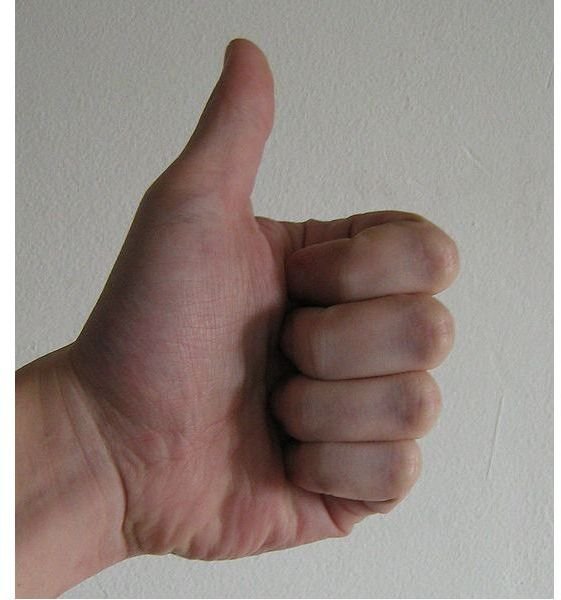
A landmark study is shedding light on an important aspect of our genetic and physical evolution. Scientists have discovered that a region of DNA once dismissed as junk may have contributed to the development of opposable thumbs and our ability to walk on two legs.
Human evolution
What is it that separates us from the animals, or should that be other animals? Our opposable thumbs that allow us to grip and manipulate tools and objects, as well as our upright walking gait were certainly pivotal moments in our evolution that helped to mark us out from the rest of creation. A new paper throws up some interesting clues on how this may have came about and goes some way to explain why humans have opposable thumbs.
HACSN1
In this latest genetic research to try and understand human evolution, scientists poured over large regions of junk DNA , that is, non-coding regions. Once dismissed as molecular garbage these sections have been shown to have a regulatory role in being able to turn genes on or off.
In this study, scientists isolated a region known as HACSN1 that may have led to opposable thumbs and switched on genes in the foot and ankle that enabled humans to walk upright. It could have done this by switching on hox genes for example, the pattern forming genes in most organisms. If this is so it suddenly promotes junk DNA to being a significant driver of evolutionary change.
The HACSN1 section of DNA was shown to be highly conserved and hardly changed throughout the evolution of backboned creatures. It suggests that it may have an evolutionary important role because it hasn’t been selected against.
Why Do Humans Have Opposable Thumbs?
Researchers came to their conclusions after injecting human HACSN1 into 11-day old mouse embryos. It appeared to activate genes in the proto wrist and thumb, whilst the chimpanzee version only switched on genes in the developing shoulder.
Scientists involved in the research, which was published in the journal Science are keen to point out that they are not rushing to too many definitive conclusions just yet. They say their results are preliminary and in any case many genes will probably be involved in the development of a complex structure like a hand.
In an interview with Science Daily Dr Shyam Prabhaker, first author of the paper and Senior Research Scientist at the Genome Institute of Singapore (GIS) said, “This is just the first step - we need to characterise HACSN1 in more detail, and also test the hundreds of other HACSN’s we have identified in the genome to figure out what role, if any, they play in making us human.”
Junk DNA
The research is valuable for many different reasons. It adds to an ever increasing body of knowledge that is finding utility for junk DNA. It now appears they play important roles in regulating and switching some genes on or off.
The new study may also help us to understand more about what makes us different from other primates, as well as giving us a better picture of what’s going on in our bodies at the molecular level.