Find out in this article how a mutation in the MTHFR gene can cause pregnancy complications and congenital birth defects.
MTHFR and Folate Deficiency
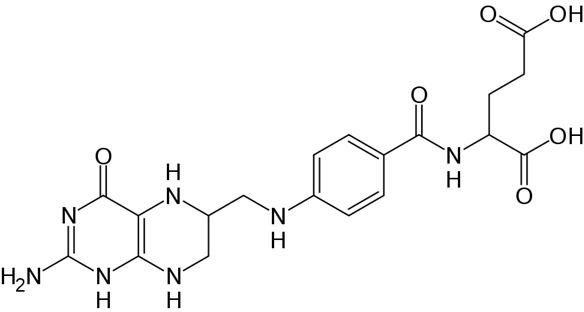
MTHFR is the gene that provides the complete instruction for the biosynthesis of the metabolically important enzyme called methylenetetrahydrofolate reductase. This body enzyme catalyzes the conversion of folic acid into its biologically active form which is tetrahydrofolate (THF). An MTHFR gene mutation impairs the efficiency of the enzyme to produce enough tetrahydrofolate that the body needs. When the body is deficient in tetrahydrofolate as a result of an MTHFR mutation, serious diseases will develop.
Methyltetrahydrofolate (CH3-THF) is an important derivative of tetrahydrofolate. It donates carbon (from CH3) during the assembly of nucleotides such as 2′-deoxythymidine-5′-phosphate (dTMP) and 2′-deoxyuridine-5′-phosphate (dUMP). These nucleotides are utilized by dividing cells for DNA synthesis. Hence, CH3-THF deficiency disrupts DNA synthesis and cell division.
CH3-THF is also important in genetic regulation. It is involved in gene silencing by attaching its methyl group to the DNA . If a gene is not properly regulated due to CH3-THF deficiency, diseases like cancer could develop in an individual.
CH3-THF is needed in the production of essential amino acids in the body. For example, MTHF donates its methyl group to the amino acid homocysteine to convert it to methionine. The reaction is very important because the build up of homocysteine in the blood plasma due to CH3-THF deficiency can lead to homocysteinuria, a metabolic disorder.
MTHFR Mutation
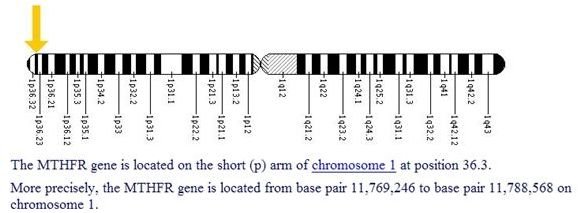
Two common types of mutation can occur to the MTHFR gene located at chromosome 1. The first mutation is written as MTHFR C677T wherein the nucleotide thymine replaces nucleotide cytosine at position 677 of the MTHFR gene. The protein product (enzyme) of the MTHFR C677T has valine instead of alanine.
The second mutation is written as MTHFR A1298C wherein nucleotide cytosine replaces nucleotide adenine at position 1298 of the MTHFR gene. The protein produced by this mutation has alanine instead of valine at position 1298 of the protein sequence. Besides these 2 mutations, at least 24 MTHFR gene mutations have already been identified in humans.
MTHFR mutations can completely inactivate the enzyme, but there are times when the defective enzyme can still function, albeit less efficiently than normal. The defective enzymes may not catch up with the body’s demand for tetrahydrofolate needed for DNA synthesis during rapid cell division.
MTHFR Mutation Inheritance
The mutated MTHFR gene can be inherited by a child from both of his parents. A child is said to be heterozygous with MTHFR mutation if he receives one copy of the mutated gene and another copy of the normal gene from his parents. If the child receives two copies of the mutated gene, he is homozygous to MTHFR mutation. The heterozygous child will not develop diseases associated with the mutations since the normal gene masks the expression of the mutated gene. However, the homozygous child is at greater risk of developing diseases because the mutated gene is expressed.
It is estimated that only 12% of the general population is homozygous to MTHFR mutation. Forty-four percent is heterozygous while the remaining forty-four percent has normal copies of the MTHFR gene.
Pregnancy Complication and Birth Defect Associated to MTHFR Mutation
MTHFR mutation is associated with miscarriage. A group of medical researchers theorized that the increase in homocysteine level (homocysteinuria) in the blood can cause miscarriage because it can trigger the formation of tiny blood clots that obstruct the flow of oxygen and nutrients to the placenta. The baby eventually dies if he or she is not receiving any nutrients or oxygen from the mother.
The common birth defect associated with MTHFR mutation is the neural tube defect that causes the malformation of the spine (spina bifida), skull, and the brain (anencephaly). The connection between neural tube defect and MTHFR mutation is not yet clear but researchers say that the normal development of the neural tube is associated with proper DNA methylation of an insulin-like growth factor. As mentioned above, CH3-THF is involved in DNA methylation. Thus, THF deficiency can cause neural tube defect.
Babies with MTHFR mutation are also born small and with low birth weight. This condition is the result of intrauterine birth restriction due to THF deficiency.
Anemia has also been diagnosed on babies with MTHFR mutation. This is the result of impairment of hematopoiesis or the production of red blood cells. Stem cells of red blood cells cannot divide properly if there is not an adequate amount of THF.
References
MTHFR. Genetics Home Reference. National Institute of Health Website
MTHFR Gene Mutation and Pregnancy Complications
MTHFR gene Location Image