Genes that code for proteins aren’t the only kind of gene. There are thousands that code for microRNA, which are fundamental to gene regulation and cell health.
The Central Dogma of Molecular Biology: What Causes Gene Expression?
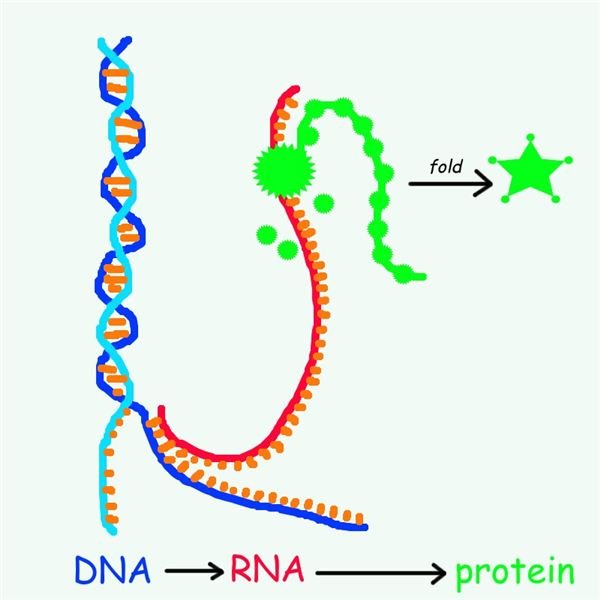
Since 1958, the central dogma of molecular biology has been: “DNA makes RNA; RNA makes proteins.” DNA (deoxyribonucleic acid) and RNA (ribonucleic acid) are made of long chains of nucleotides . Segments of DNA are transcribed into segments of RNA called messenger RNA (or mRNA). The mRNA is then translated into a chain of amino acids called a polypeptide, which is then folded into a three-dimensional structure, sometimes with other polypeptides, to make a protein. (Hemoglobin, the protein in red blood cells that carries oxygen molecules, has four of the same polypeptide folded together.) A gene, as defined by the central dogma, is a segment of DNA that codes for a protein. Each gene codes for one protein, and each protein is coded for by one gene. A gene whose protein is produced is a gene that has been expressed.
Gene Expression According to the Central Dogma
Proteins carry out the bulk of functions involved in running a living organism. Proteins control which other proteins are produced by causing or blocking transcription of their genes from DNA, or translation from mRNA. More copies of a protein can be produced faster if multiple copies of its mRNA are made. Different mRNA molecules also have different shelf lives - a few seconds to several days.
Often, opposing groups of proteins work in concert to determine the exact types and amounts of other proteins produced at any given time. The role of RNA in gene expression, meanwhile, is seen simply as an intermediary between DNA and protein synthesis .
A New Class of Gene
Or so the understanding went until 2001 when the term “microRNA” was introduced into the scientific literature. It turns out that genes that code for proteins aren’t the only kind of gene.
Only about 2% of the human genome actually codes for proteins. Some of the other parts are important for things like regulating gene expression, or chromosome structure, but about 90% of it was formerly dismissed as “junk DNA” - obsolete genes, ancient inactive viruses, transposons and introns, and other portions with no apparent purpose. Some of it, however, turns out to code for microRNA.
MicroRNA (micro RNA, miRNA)
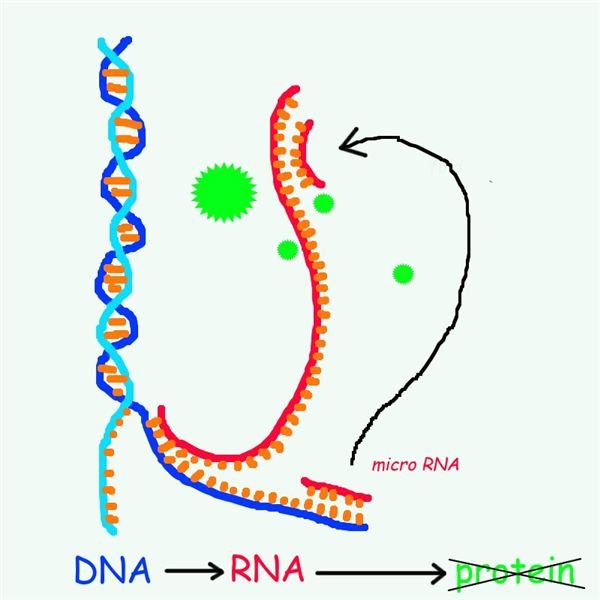
MicroRNA (or micro RNA, or miRNA) are segments of RNA that are transcribed from DNA in a way similar to messenger RNA. Some are found within introns (segments of mRNA that are removed after transcription, before translation). The key difference is their length - much shorter at only 21-23 nucleotides long, as opposed to about 2,000 for a typical mRNA - and they are not translated into proteins. Instead, they provide a mirror image match to portions of one or more mRNA molecules (that is, are complementary to them), with which they can pair-bind, thereby shutting down polypeptide translation and blocking production of the protein. In many cases, pair-binding also marks the mRNA for destruction.
In short, instead of producing a protein to oppose its matching mRNA’s protein, microRNA blocks mRNA directly, which removes a layer of complexity and allows for more precise timing in controlling gene expression .
The first microRNA was discovered in 1993, but their full significance wasn’t apparent until 2000, when a second one was found to be widespread throughout the animal kingdom. Thousands are now known, and they are involved in regulating gene expression in all aspects of running a living organism. Proteins still turn genes on and off, but microRNAs control how many proteins are made. Turning on a gene for one protein might also turn on a gene for a microRNA that stops production of a second protein. Moreover, many diseases have distinct patterns of microRNA gene expression. This makes them excellent for diagnosis, for future development of drugs that target them, and maybe even as future drugs themselves.
Resources and Images
Whitehead Institute for Biomedical Research - MicroRNA
Gene expression diagrams made by article author