Plant Genetics: An Introduction to the Life Cycle of Plants - Alternation of Generations
What is Alternation of Generations?
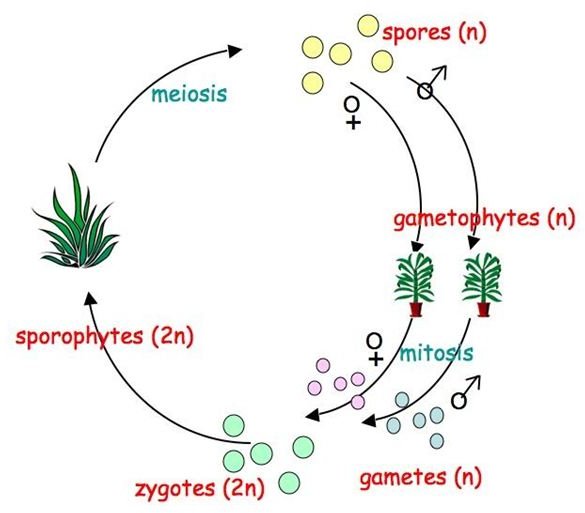
The life cycle of every plant in the plant kingdom includes what’s known as “alternation of generations.” This means that genetically, each species has two forms - a gametophyte and a sporophyte - which alternate with each other. Gametophytes produce sporophytes, and sporophytes produce gametophytes.
Gametophytes are haploid, which means they have one full set of chromosomes. They produce gametes through mitosis. Gametes are either male or female, and gametophytes may produce only male, only female, or both. Male and female gametes unite to form zygotes, which are diploid, or have two full sets of chromosomes. The zygotes become diploid sporophytes, which produce spores through meiosis that are haploid. The haploid spores then become more gametophytes.
In some species of plants, the two forms are separate, free-living and independent of each other. Some are isomorphic, or with forms that are indistinguishable from each other. Examples of species with isomorphic alternation of generations can be found among green algae. Other species, most notably ferns, have heteromorphic alternation of generations. In some cases the two forms are so completely different in appearance and ecological niches that past botanists sometimes mistakenly classified them as separate species.
Heteromorphic Alternation of Generations to the Extreme
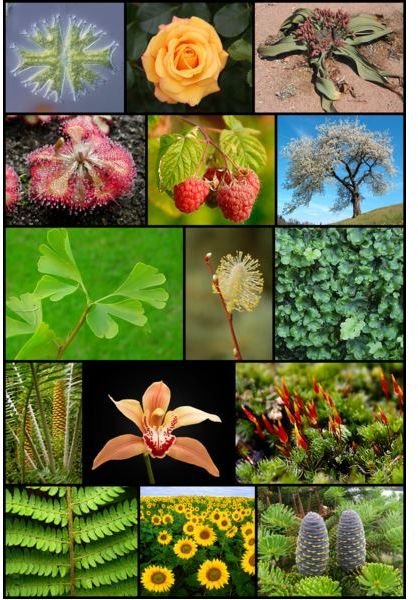
Then there are other plant species where one form encompasses most of the life cycle while the other is limited to a purely reproductive role and is often dependent on the first. This is a more extreme form of heteromorphic alternation of generations. For bryophytes (mosses, liverworts, hornworts) and some species of green algae, the gametophyte is the main form, while among vascular plants (ferns, seed plants) the sporophyte dominates. In the case of the seed plants - gymnosperms (cycads, pines) and angiosperms (flowering plants) - the female gametophytes are found only within ovules (which develop into seeds when fertilized), and the male gametophytes are individual grains of pollen.
It’s Not Only Plants …
Plants are not the only organisms that undergo alternation of generations for their life cycles. Fungi and some protists (slime molds, foraminifera, most algae) have similar life cycle genetics to plants. In most cases, the haploid forms dominate.
Resource and Image Credits
Bold, Harold C., Alexopoulos, Constantine J., and Theodore Delevoryas. Morphology of Plants and Fungi, 5th ed. Harper Collins. 1987.
Composite plant life picture by Ryan Kitko, used under CC-A-SA 3.0 license
Alternation of generations diagram by article author