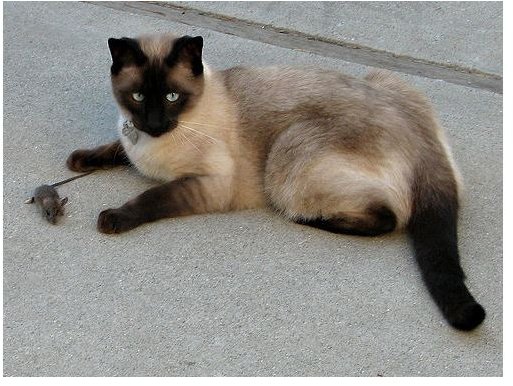
Siamese cats have a unique coat pattern. The gradual shading of the extremities is caused by a recessive gene with temperature-sensitive expression. The resulting pattern is essentially a heat-map of the cat’s body.
Siamese Cats Are Albinos
Siamese cats are renowned for their peculiar coat pattern. A cream or white underbelly shades gradually to a medium color on the back, while the ears, face, legs, and tail are very dark. This pattern is called “pointed” or “colorpoints,” and it affects not only the coat, but also the eyes, which are always blue.
Pointed cats are partial albinos. Albinism is a mutation in the TYR gene , responsible for the enzyme tyrosinase. Tyrosinase, in turn, is necessary for the production of melanin, or dark pigmentation. Albinism is not a black or white trait; it has shades of gray—literally. In cats, various mutated alleles in TYR can result in phenotypes with different degrees of pigmentation. Each of these phenotypes falls in a specific place in an allelic series with a hierarchical inheritance pattern from dominant to recessive —in other words, some of these traits are dominant over others. The Siamese phenotype falls in the middle of the series, recessive to normal coloration but dominant over a completely white coat.
Above right: Siamese cat with prey . Photo by “emdot.” (CC) Some rights reserved.
Body Temperature and Coloration
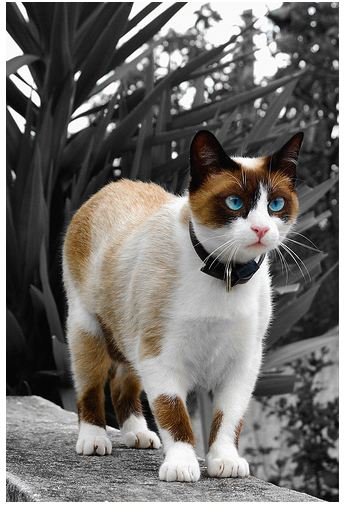
The albino mutation in Siamese cats results in a defective form of tyrosinase which does not function at normal body temperature. Therefore, dark coloration can only appear in parts of the body that are cooler than the core body temperature. The extremities are always the coolest parts of the body. The face is also cooler because of air passing through the sinuses. The back is warmer than the extremities, being closer to the body core, but it is also exposed. The result is a medium degree of tyrosinase function, resulting in a medium degree of shading
Left: The Siamese colorpoint mutation can be combined with other coat color mutations. This cat has both colorpoints and leucism (white patches). Image by Feliciano Guimarães. (CC) Some rights reserved.
Siamese Cat Coat Genetics
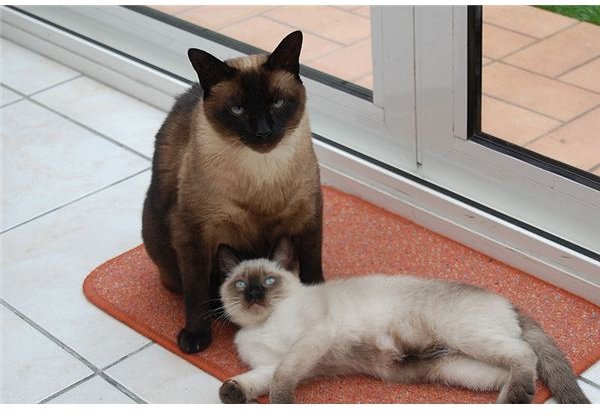
The mutation that causes colorpoints in cats has been identified as a point mutation, or single-nucleotide polymorphism (SNP) . It changes glycine to arginine in the tyrosinase protein, and is therefore a missense mutation . The identical mutation is seen in other breeds of cats, including mixed-breed cats that have a colorpoint pattern, so all pointed cats are thought to share a common descent. The original mutation occurred centuries ago in Thailand (formerly Siam), but the details of the history of the Siamese cat are cloaked in mystery. (Lyons et al. 2005)
Right: Two Siamese cats . The colorpoint gene can be found in cats of any base coat color. Image by Loïc Dreux. (CC) Some rights reserved.
The “Siamese Cat Gene” in Humans
Genetic researchers have identified a certain mutation in humans that causes defective tyrosinase that is temperature sensitive in the same way as in Siamese cats. The resulting genetic disorder is called type 1b temperature-sensitive oculocutaneous albinism (OCA 1b TS) (Giebel et al. 1991). The mutation causing OCA 1b TS has been identified as a different missense SNP in TYR, but it has similar effects on phenotype.
Left: The first champion Siamese cat in the United Kingdom (1898), “Wankee.” Little is known about the history of the Siamese cat before the 19th century.
Problems
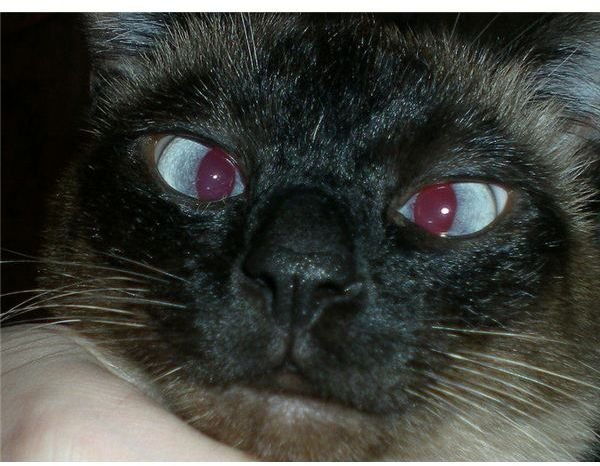
Unfortunately, temperature-sensitive TYR mutations do not affect only hair color (in humans) or fur color (in cats). Melanin is found in the retina and is necessary for normal vision. Defective tyrosinase can lead to incurable vision problems in sufferers of OCA 1b TS and other forms of albinism, including strabismus (crossed eyes), nystagmus (eye “trembling”). Siamese cats are also known to have vision abnormalities. In the past, many had crossed eyes (strabismus), a compensation for the abnormal visual field (Berman & Cynader 1972). In breeding this trait out of Siamese cats, breeders may actually have created cats with worse vision than their ancestors.
Right: Siamese cat with crossed eyes (strabismus). Selective breeding has made this trait rare, though it may actually improve the cats’ vision. Image by Mark Ekimov (public domain).
References
- Nancy Berman & Max Cynader. “Comparison of receptive-field organization of the superior colliculus in Siamese and normal cat.” Journal of Physiology, 1972, 224:363-389.
- L B Giebel, R K Tripathi, R A King, and R A Spritz. “A tyrosinase gene missense mutation in temperature-sensitive type I oculocutaneous albinism. A human homologue to the Siamese cat and the Himalayan mouse.” J Clin Invest. 1991 March; 87(3): 1119–1122.
- Lyons, L. A.; Imes, D. L.; Rah, H. C.; Grahn, R. A. “Tyrosinase mutations associated with Siamese and Burmese patterns in the domestic cat (Felis catus).” Animal Genetics, April 2005. 36(2):119-126.