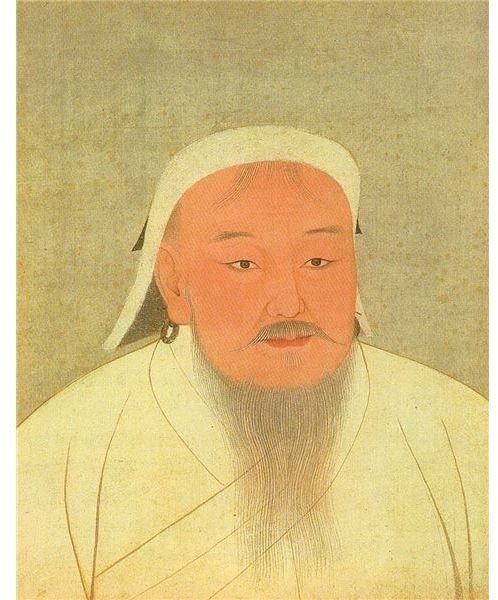
Genghis Khan was an empire builder and, it turns out, something of a family man as well. His genetic descendants are alive and well and spread out through China, Mongolia, Uzbekistan, Kazakhstan, and parts of Russia, Afghanistan, Pakistan, Iraq and Iran.
History of Genghis Khan
Genghis Khan inspires superlatives. He was the greatest of the Mongol rulers, the fiercest of warriors, and his Empire, extending from the Pacific Ocean to the Caspian Sea, one of the most extensive in history. Now it appears that he was also the most prolific, unsurpassed lover of all times. According to a study published in the American Journal of Human Genetics, there are more than 16 million of his descendants around in this modern age. Even the 18th century Moroccan ruler Moulay Ismail the Bloodthirsty, Guinness Book record holder for fathering 888 children from 500 wives and concubines, can’t hold a candle to that.
Genghis Khan and the Y chromosome
Oxford University biochemist Chris Tyler-Smith, together with Mongolian, Uzbek, Chinese and Pakistani researchers, conducted a ten year long genetic study of 40 populations living in and around the territory of the former Mongol Empire. The researchers collected blood samples and analyzed DNA of the Y chromosome to learn about the genetic history of these populations.
We inherit our genetic characteristics from our parents, with each parent contributing half of the DNA which combines and forms a new genetic blend. However the Y-chromosome doesn’t recombine as other parts of the genome do, and apart from some mutations it passes from father to son intact. By identifying these mutations (known as markers) it’s possible to trace them to the point at which they first occurred and thereby establish the lineage of descent.
In Tyler-Smith’s study, 16 populations carried a star-cluster of Y chromosomes having the same genetic pattern, indicating a close relationship. These star-cluster chromosomes were also seen in the Hazara people of Pakistan and Afghanistan (who traditionally claimed Mongol descent), but otherwise were conspicuously absent in other populations outside the boundaries of the former Mongol empire.
Russian scientists, in another study, carried out a survey of Y chromosomes of 1437 men from 18 Asian ethnic groups and found that 35% Mongolians and 8.3% Altai Kazakhs carried the Genghis Khan Y chromosome. While the Mongols held eastern Russia for 250 years, there are few Y chromosome carriers there.
Now if the genetic spread had been by chance or by general population expansion, the star-cluster chromosomes would have shown up with variations in other populations elsewhere. Also, if the spread had been due to the presence of the chromosomes in the dominant group in the region, the Mongols, all modern Mongolians would have the star-cluster chromosomes. Neither of these premises hold true. So it’s likely that the chromosomes owe their spread to the activities of a single individual and his direct descendants.
The observed genetic mutations suggest that the most recent common ancestor (TMRCA) existed around 1000 years ago, and as the largest numbers of different star-cluster Y chromosomes were seen in Mongolia, this seems the likely place of origin of this remarkable lineage.
Tyler-Smith put forth the idea that the signature chromosomes probably belonged to the ruling Mongol house, originating from Genghis Khan’s great-great-grandfather, and that the establishment of the Mongol empire led to the spread.
Genghis Khan – Patriarch Par Excellence
The Mongol policy of expansion after all involved wholesale slaughter of conquered male populations and outright rapes of the women. As Genghis Khan put it – “The greatest joy a man can know is to conquer his enemies and drive them before him. To ride their horses and take away their possessions. To see the faces of those who were dear to them bedewed with tears, and to clasp their wives and daughters in his arms.”
For over two centuries, women from the Mongol territories were fair game to the whims of the Mongol rulers and regularly added to their extensive harems. No one knows the exact number of Genghis Khan’s offspring, but his four sons by his first wife Boetia were productive enough, with the eldest son Juchi siring 40 sons. Kublai Khan, Genghis Khan’s grandson and founder of the Yuan Dynasty in China, had four wives, 22 sons and innumerable concubines in a continually expanding harem. And so the genetic legacy passed on and on and on.
Sounds plausible, but Tyler-Smith’s theory remains a theory until someone discovers the whereabouts of Genghis Khan’s grave and there’s an actual DNA examination of his remains. Currently, his burial place is unknown, and local Mongolian sentiments are opposed to any digging and disturbing of the dead.
Another possible explanation is that Genghis and his descendants weren’t the responsible parties, but some unknown man and his descendants from the same period and place were. Since the Khan family wasn’t renowned for their generous, sharing propensities in these matters and challengers to their hegemony didn’t last long, this seems unlikely.
In any case, this is the first known case of a single genetic lineage impacting such a wide swath of population, and a rare example of how culture affects human diversity.
References
https://www.pubmedcentral.nih.gov/articlerender.fcgi?artid=1180246
https://www.isteve.com/2003 _Genes_of_History_Greatest_Lover_Found.htm
https://www.dawn.com/weekly/science/archive/030301/science5.htm