Prokaryotic Cells - A Guide to a Prokaryotic Cell
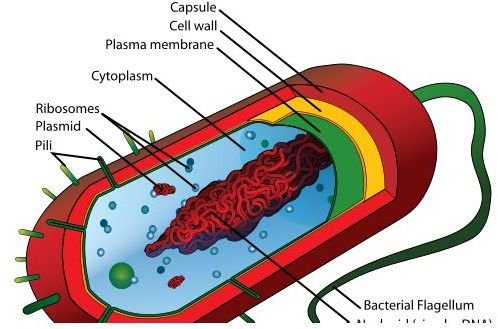
What Structures are Found in Prokaryotic Cells?
If you were to look inside a prokaryotic cell, one of the first things that would strike you is that there is no nucleus. And it’s not just an ‘intra-cellular brain’ that it lacks. In fact the prokaryotic structure is without any kind of membrane-bound organelle. The genetic material inside prokaryotic cells is contained in a circular loop known as a plasmid. Prokaryotic cells are much smaller and simpler than eukaryotic cells. And whilst their larger cousins make up organisms such as plants, animals, fungi, protozoans and algae, prokaryotic cells can be split into two groups - bacteria and archaea.
Other key prokaryotic structures included in our guide to a prokaryotic cell include;
Nucleoid - this is not an organelle, but the name given to the region where DNA is located
Ribosomes - they are smaller than eukaryotic ribosomes, but carry out the same function of translating the DNA message into protein
Capsule - this encloses the cell and is usually a polysaccharide coat, though sometimes it can be made of protein
Cell wall - maintains the overall shape of the cell
Storage granules - packed full of essential nutrients for the cell to survive
Endospore - a major survival mechanism during harsh conditions. Some bacteria are able to form these dehydrated structures
Flagella - these are long appendages on the outside of the cell that aid motility
Pili - these allow bacteria to adhere to each other and to surfaces. They are hollow structures with an adhesive tip
Plasma membrane - composed of phospholipids and proteins. Semi-permeable and determines what comes in and what goes out of the cell. It is also involved in the replication of DNA.
Prokaryotic Cell Shapes
Prokaryotic cells come in a number of different shapes; the main ones are rod-shaped (bacillus), spherical (coccus) and spirillum (spiral). And we have a lot to thank them for. It is a widely held belief that they were the first living organisms and that eukaryotic cells, (which gave rise to much more complex life forms) evolved out of them.
Further Reading
Guide to a Eukaryotic Cell
https://www.brighthub.com/science/genetics/articles/11474.aspx