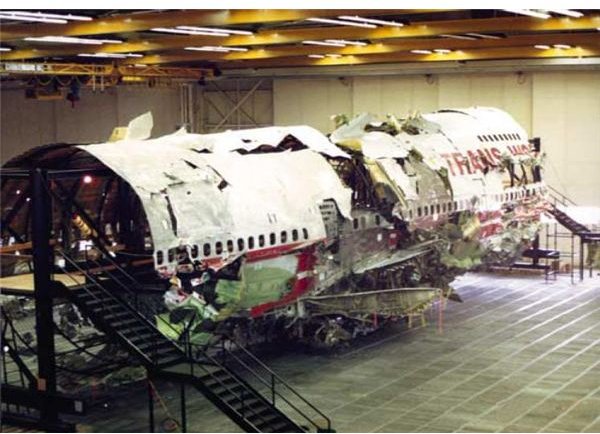
The FAA’s requirements are a landmark decision, intended to prevent disasters like the aircraft fuel tank explosion of TWA Flight 800. Learn more about the history and technology related to this decision.
TWA Flight 800
On the evening of July 17, 1996, a Boeing 747-100 departed from New York’s JFK as TWA Flight 800, bound for Rome, Italy. A little over ten minutes after takeoff, a catastrophic aircraft fuel tank explosion broke the plane apart off the coast of Long Island, killing all 230 people on board. The disaster sparked an exhaustive investigation that lasted over four years, and involved both the NTSB and the FBI. The investigation concluded in 2000, and the NTSB’s final report cited the cause of the incident to be an explosion the Center Wing Fuel Tank of the 747.
The fuel tank in question was empty at the time of the explosion, and the air inside was saturated with fuel vapors at very high temperatures. Prior to takeoff, the aircraft had sat at the gate for several hours in the sun with the on board air conditioning systems running. The air conditioning systems can generate a lot of heat and are located directly beneath the center wing fuel tank. The NTSB report states that faulty wiring in the fuel tank was the most likely source of a spark that caused the fuel vapors in the tank to ignite. The explosion, in turn, caused the internal structure of the aircraft to fail, resulting in the in-flight breakup of the airplane.
TWA 800 is not a unique case. According to the FAA, since 1960, 18 airplanes have suffered fuel tank explosions caused by ignited fuel vapors. Many of these explosions were catastrophic in nature.
The New FAA Ruling
The FAA’s new ruling will require domestic and foreign airlines flying with in the United States to retrofit passenger airplanes having high flammability fuel tanks with equipment that reduces the flammability of fuel vapors, by removing oxygen from the fuel tank, and replacing it with an inert gas such as nitrogen. Similar mechanisms have been routinely used by the U.S. military for decades with great success. Until the FAA mandate, however, airlines have resisted the implementation of such devices because of the additional expense, and because of the extra weight they would add to the aircraft.
Additionally, the FAA report reinforced previously-made requirements regarding the elimination of potential ignition sources for aircraft fuel tank explosions. A variety of problems were addressed, most of which were specific to various aircraft types.
2,700 Airliners to be Retrofitted
The FAA estimates in its ruling that, “approximately 2,700 existing Airbus and Boeing airplanes operating in the United States as well as 2,300 newly-manufactured airplanes that enter U.S. passenger service will be affected.” The ruling requires that all aircraft with high flammability fuel tanks must either be retrofitted or removed from service by 2016. The ruling also applies to aircraft in development such as the Boeing 787 and the Airbus A350 and which already have pending certification applications filed with the FAA. Cargo aircraft are excluded from having to meet the new requirements.
The FAA report takes into account the cost to the industry of the new requirements. While the costs are certainly significant, the report states that the technologies to fix the problem are much cheaper than they were in the past, and that the cost to the industry, even in purely monetary terms, of even a few more aircraft fuel tank explosion accidents would be far greater. Imporvements in airplane safety are being made constantly and improving fuel tanks is assuredly a great step foreward.
Reference
National Transportaion Safety Board, https://www.ntsb.gov/Publictn/2000/AAR0003.pdf
Image Source
TWA Flight 800 Reconstruction (Supplied by US Federal Government; Public Domain; https://upload.wikimedia.org/wikipedia/commons/2/26/TWA800reconstruction.jpg )