Do you know what a patent is? Do you know the purpose of a patent? In this article we explain what a patent is, what a patent does, and why you would want one.
Patents are protection for intellectual property created by invention. They are a form of intellectual property, like trademarks and copyrights. For additional information on intellectual property, this article discusses the differences between trademarks and patents .
Explaining Patents
A patent is protection for the creator of an invention.
Like copyright, it also gives exclusive rights to the inventor. Unlike copyright, inventing something does not provide automatic protection for the invention; a patent must be applied for through a process. Patents are also for much shorter periods of time than copyright now covers, although copyright was originally for a similarly short time period.
A patented invention is marked with the word patent, and the assigned number of the patent. Some are marked US Patent, and a number, indicating it was patented in the United States. One object can be covered by more than one patent, as in the c
ase of a computer. After a patent application is filed, an applicant is allowed to mark a product patent pending, but that does not convey any legal protection. It is illegal to mark an object as patented if it does not have a patent.
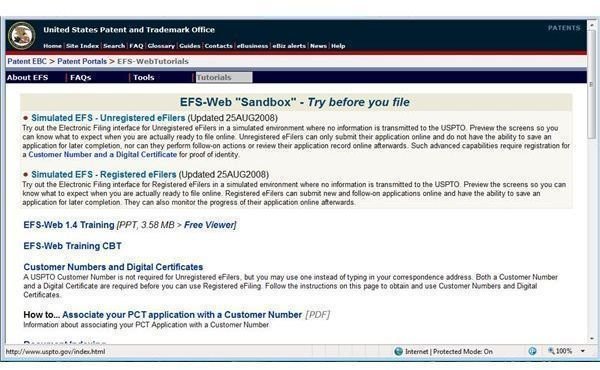
The United States Constitution provides Congress the ability to make laws covering patents. Patents in the US are overseen by the United States Patent and Trademark Office . Certain types of patents can now be filed electronically in the United States.
According to the World Intellectual Property Organization ,
An invention is a product or a process that provides, in general, a new way of doing something, or offers a new technical solution to a problem. In order to be patentable, the invention must fulfill certain conditions. The protection is granted for a limited period, generally 20 years.
There are di
fferent types of patents, depending on the type of invention, but there are three main types. These are Utility patents, Design Patents, and Plant patents. Within thise categories there can be divisions depending on what the patent covers, including software patents. Patents can also be made for hire, if there is an agreement for assigning the rights in the contract between employee and an employer.
According to the United States Patent and Trademark Office:
- Utility patents are given to inventions of articles, processes, machines, composition of matter, or new and useful improvements to any of these things.
- Design patents are for new, original or ornamental designs for things that can be manufactured. They are given for a 14-year period.
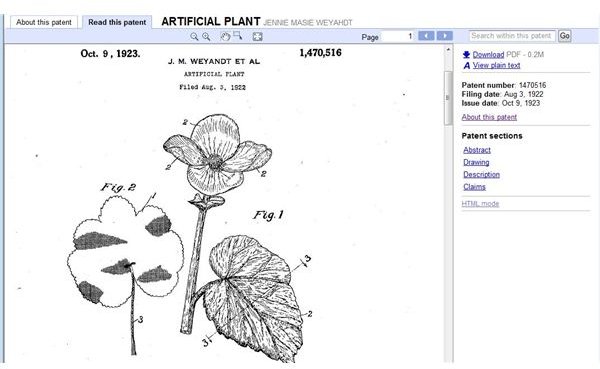
- Plant patents are for inventing or discovering and asexually reproducing new or distinct varieties of plants. Biopiracy is the practice of patenting plant resources that were already known and often had traditional uses in emerging countries.
Patents are generally not extended, but there are some exceptions.
Reproducing Information from Patents
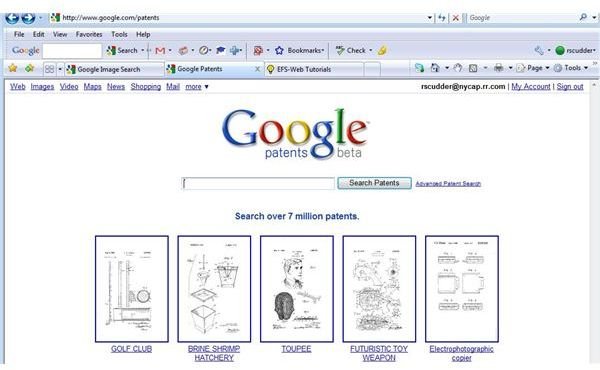
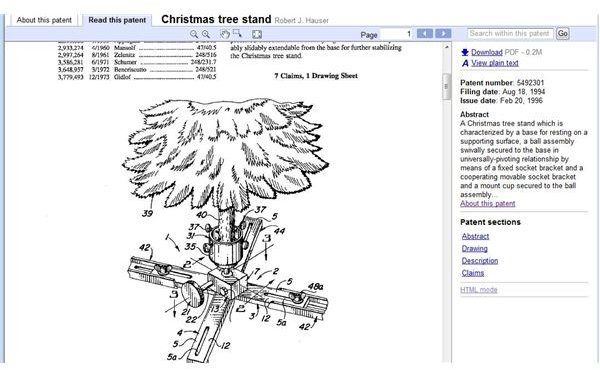
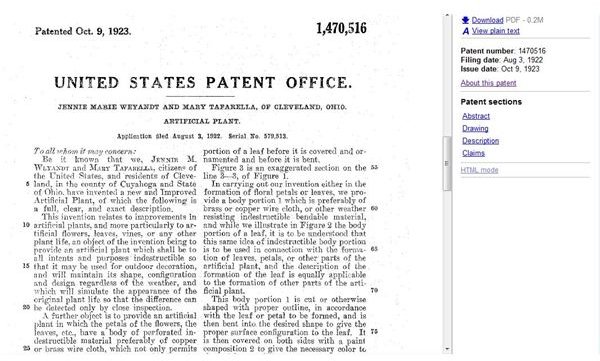
Issued Patents, such as the images from patents shown in this article, are public domain government information. Images of the of the entire database of US patents are available online through the USPTO website, and now can also be searched for on Google. The images in this article are reproduced from Google Patents beta , which is hosting a copy of the USPTO database.
What is the Purpose of a Patent?
The purpose of a patent is to give an inventor the right to exclusively manufacture or use their invention, or to sell or license rights to their inventions to someone else. Patents can be licensed by the patent holder to others, allowing them to legally manufacture the
invention. Sometimes they give exclusive rights and other times an invention can be licensed to multiple manufacturers.
A patent does not mean the invention must be used during that time of exclusive rights. While the patent is in effect, although others can not use it without permission, it is not required that the holder of the patent use it either.
- With a patent, an invention cannot be made, used, distributed or sold without the patent owner’s consent.
- Patents give rewards to inventors for originality, for creation of something beyond current knowledge.
An invention may do something, or do it better, than was done before, and patenting inventions give inventors the right to be reimbursed for their work. This encourages ongoing innovation, which means the quality of life continuously increases.
Corporations sponsor R & D departments because they are assured monetary benefit from spending the time and effort to come up with something new. Patenting also means that when the patent period is over, the invention is public knowledge.
Patents also, because the rights can be sold or assigned, allow small inventors to license the rights to manufacture their invention to a company, receive money from the licensing, and continue inventing something else.
So, Why Isn’t Everything Patented?
A patent cannot be obtained on any inventions published in this or other countries, or if the invention is manufactured a
nd sold before the patent is applied for. It cannot have been used publicly.
-
Merely changing the color or size of something does not make it novel enough to grant a patent.
-
It also must be applied for by the inventor, or in the case of death, the executer of the estate, even if the invention is going to become the property of an employer.
Advertisement -
It
must not be obvious or a trivial difference from an earlier invention.
Once a patent has been given, and the period of exclusive rights has passed, the patent is in the public domain, and can be used without fee by anyone. At that point, it can not be patented again as exactly the same thing. This means that almost every invention which has occurred in the world before 1989 is free to use and cannot be patented again.
Some inventions are released to the public deliberately, so that they will always be free to use. Ideas and suggestions cannot be patented.
This post is part of the series: Understand Intellectual Property and the Differences Between Copyright and Patent
Copyrights and Patents both protect Intellectual Property. Do you know the definition of intellectual property? Understand how copyright and patent differ, the purpose of a patent vs. a copyright, and see what types of intellectual property are covered by each protection.