Federal Reserve Open Market Operations' Impact on the Bond Market
The impact of the Federal Reserve on the bond market through open market operations is determined by the Fed’s monetary policy. This policy affects the volatility of bond returns, trading volume and bid-ask price. The main way the Fed handles this is through a system of repos which are repurchasing agreements in which the Reserve buys bonds from investors who promise to repurchase them back later.
The Federal Reserve used to use a policy called the Borrowed Reserves Targeting Operating Procedure. This allowed the Fed to possess private information and use its open market operations to smooth the impact of adjustments to the bond market. The Fed would adjust its procedures to the changes in the pressures of discount window borrowing.
In 1994, this was replaced by the policy of Fed Funds Targeting Operating Procedure. This new policy, the Fed adjusts the level of liquidity in the banking system in order to keep the nation’s interest rates on target. The bond market under this system is supposed to have less volatility because the Fed does not give the private sector any relevant information to pay-offs.
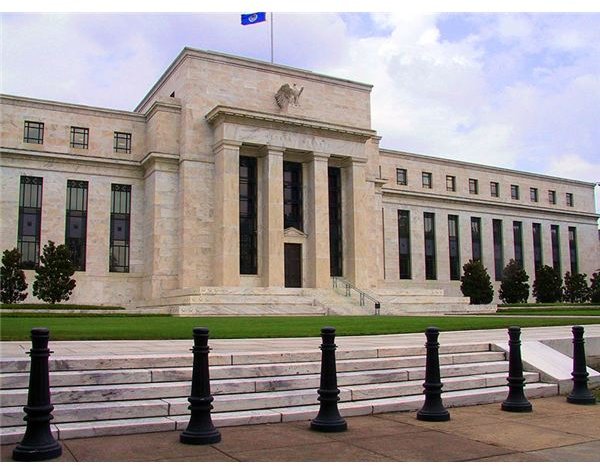
Above: The Federal Reserve Building (Image credit:Rdsmith4 at Wikimedia Commons, https://en.wikipedia.org/wiki/File:Federal_Reserve.jpg, Creative Commons Attribution ShareAlike 2.5.)
Efficiency of the Fed’s Policies
According to many economists, the policies enacted by the Federal Reserve fail to successfully stabilize the bond market. The Fed is effectively unable to predict the reserves deficiency in the banking system due to the time frame of the process. Much of the time, the ultimate investor response to the repo process is not known for six months or more. Also, intra-day behavior of the market is highly volatile. The spread between the overnight rate of the bonds and the key policy rate of the European Central Bank has created disorganization within the system.
The Fed does use temporary repos in its open market operations effectively to adjust the liquidity in the banking system. This increases the vulnerability of private bond market participation in regards to disturbances in the normal price formation process. Generally, The Fed conducts short-term open market operations prior to the opening of the market. It essentially refinances existing positions in the bonds. While this should not effect the volatility of the price formation process, some economists have found that the Fed’s actions impact the overall market negatively. On days when open market operations are not conducted, the market stabilizes.
On days when auctions occur, the volatility of the market also increases. Bond returns fluctuate heavily due to the repo and reverse repo process. The Fed uses a pay-your-bid auction method for primary dealers as well as offering other dealers an opportunity to refinance a leveraged position. This refinancing is generally a lower cost than in the private repo market, allowing the Fed to stabilize demand in funding. This does allow bond dealers to submit a larger portion of securities than it otherwise could at private auctions.
Measuring the Bond Market
Bond market volatility is measured in two ways. The first is the difference between the volume of the bids submitted for refinance by dealers and the volume that the Fed actually refinances. This shows the imbalance in the market. If there are a number of dealers which the Fed does not refinance, the market is poor. Economists can also look at the spread between the effective Fed funds rate and the weighted average repo rate during the auction. If the spread is large, there is more incentive for dealers to refinance. Bonds that are not refinanced are sent to the private repo market.
Additional Resources
The Federal Reserve and T-Bills
European Bond Investments