Intertidal Zone of Estuaries Defined & Habitat Functions of Estuarine Marsh Areas
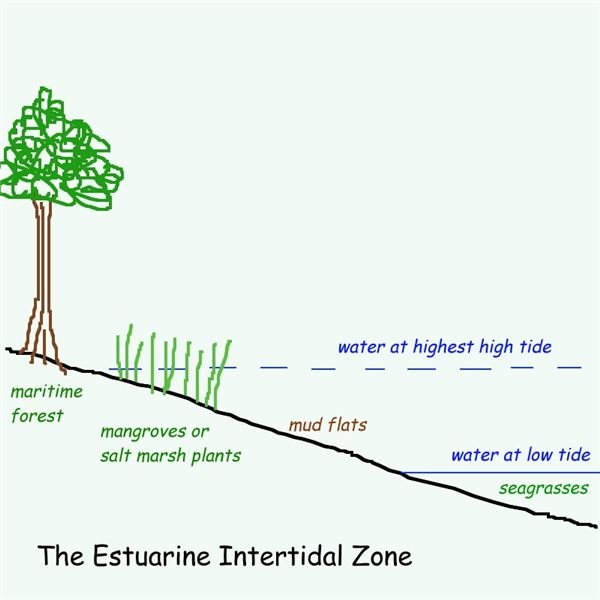
Estuarine Intertidal Zones
An estuary is, essentially, a place where rivers meet the sea. It’s a place where fresh river water mixes with salty ocean water, and water levels have a tidal cycle. River detritus and sediments bring in a lot of nutrients, and at the ocean end there are waves.
The lower two thirds of an estuary’s intertidal zone is mud flats. The upper third - up to the highest reaches of saltwater during spring high tides, where the treeline begins - is occupied by vascular plants that can tolerate salt and having their roots submerged part of the time. Mangrove forests dominate this area in the tropics, but give way to salt marsh in the temperate zone where they can’t survive winter.
Salt Marsh Plant Life
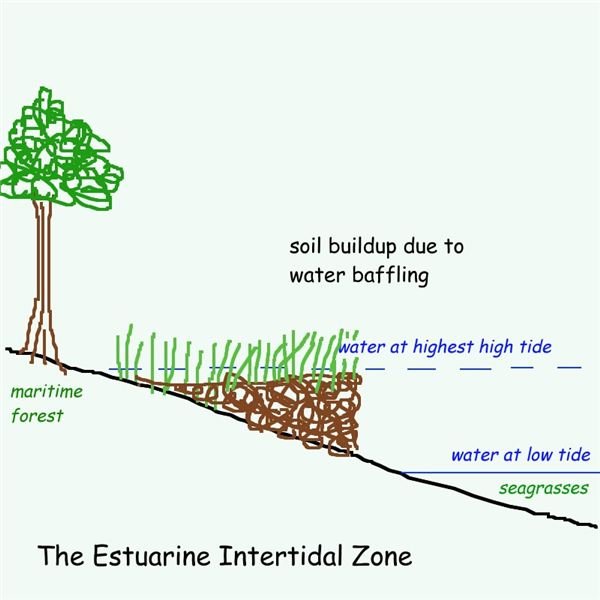
Salt marsh plants include a wide variety of tall reedy plants, like Spartina, Phragmites, and Juncus. Spartina in particular has a habitat function of raising the overall marsh elevation, both with below-ground growth of rhizomes which add bulk, and by functioning as water baffles during ebb tides, which causes soil to build up along the marsh edges to the same level as the highest high tide. The marsh edges creep out along the mud flats until they stop being wide, shallow areas, and instead are narrow, deep channels - which are called tidal creeks (more about tidal creeks on page 2).
Although tall reeds are the most obvious feature of a salt marsh, most of the primary production (the turning of sunlight into food) comes from benthic microalgae - mainly diatoms, also blue-green algae, dinoflagellates, and euglenids - which live on bottoms and other surfaces. Benthic microalgae are an excellent protein source compared to other plant sources of protein, about on par with animal protein sources, which makes them an excellent food source for grazing herbivores that are short-lived, or need to grow quickly. Phytoplankton, which float in the water column, provide high quality protein as well, but there is much less of it than benthic microalgae.
The Decomposers
In addition to the primary producers, well-established estuarine marsh areas contain highly diverse communities of bacteria. Along with fungi, these work together to decompose dead plant matter, detritus, and other organic waste brought in by the rivers, functioning as Nature’s septic system for everywhere upstream.
Many of the bacteria are obligate anaerobes, which means they cannot survive in an environment that contains oxygen. Many are ancient, having been in existence since life began. At that time, there was no oxygen in the atmosphere and they lived everywhere, excreting oxygen as the toxic waste product that it was until the world ran out of rocks to rust and it filled the atmosphere in the world’s first, most catastrophic, and most far-reaching pollution event.
Nowadays they have mostly been relegated to anoxic marsh muds. Although ancient, they are just as efficient and effective at decomposing things as the aerobes. Bacteria are an important food source for marsh detritivores (worms, shrimp). Many of the detritivores are actually bacteriovores that pass the detritus the bacteria were on through their systems without actually digesting it.
Decomposition of Organic Matter by Chemosynthesis
To the microbes, organic matter comes in the form of different types of carbon-carbon bonds, arranged in long chains. Energy comes from breaking apart the carbon-carbon bonds, which can be done through chemosynthesis in many different ways - such as by converting oxygen to carbon dioxide, nitrate to nitrogen, ferrous iron to ferric iron, sulfate to hydrogen sulfide, or hydrogen to methane.
Marsh muds tend to be high in organic matter and very low in oxygen, which diffuses in slowly and gets used up very quickly. Once there is no more oxygen to convert to carbon dioxide, which of the other reactions happens depends on which chemicals are in the soil and which will release the most energy. Different groups of bacteria specialize on each type of reaction, and also each type of carbon-carbon bond, and pass things around to each other accordingly.
Like all highly complex communities, it takes time for the bacteria to establish themselves and work out a balance of interactions with each other. Older salt marshes are much more efficient and effective at decomposing things than new ones.
Habitat Function of Salt Marsh Tidal Creeks
Aside from functioning as Nature’s septic system, the tidal creeks of estuarine marsh areas provide nursery habitat for a large number of marine fish and shellfish species. Some of these are residents in the estuaries throughout their life cycles (such as oysters, clams, mussels), and some live offshore as adults (lots of fish and shrimp species). Blue crabs actually have the opposite pattern of living in the estuary as adults while sending their larvae offshore.
Tidal creeks are small, blind channels that drain the marsh during low tide. They are areas where conditions are constantly changing, often unpredictably. Shallow water over black bottoms can become very hot. Marsh plants take up water and dump salt, making the water hypersaline. Then it can suddenly become cold and fresh in a thunderstorm. Oxygen level can be very high during the day due to photosynthesis, then plummet at night as everything uses it up. Nutrients, waste products, and pollutants can build up during low tide and dilute out over the marsh when it floods at high tide. Water can be anywhere from stagnant at the tops and bottoms of tides, to very fast-moving during ebb flow.
Despite the challenges, tidal creeks offer many benefits to the larval and juvenile stages of many marine animals. The higher heat lets them grow faster. There is lots of high protein food, both from the benthic microalgae and from bacteria. Large marine predators don’t go into tidal creeks because there isn’t enough oxygen to support them, and birds don’t eat things quite that small.
As the juveniles grow, they gradually move out of the tidal creeks and into deeper areas of the estuary. Those that are offshore as adults tend to leave all together in a particular egress season.
Image Notes
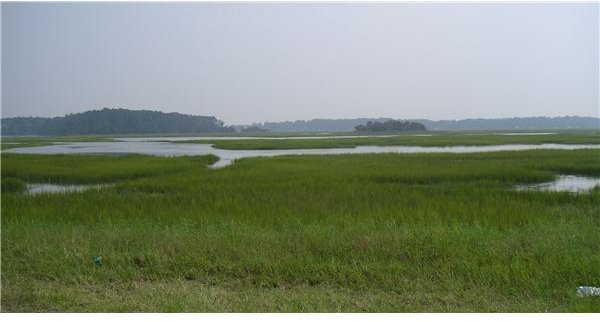
Picture of an estuarine salt marsh area, showing mostly Spartina with tidal creeks, from coastal Georgia, USA.
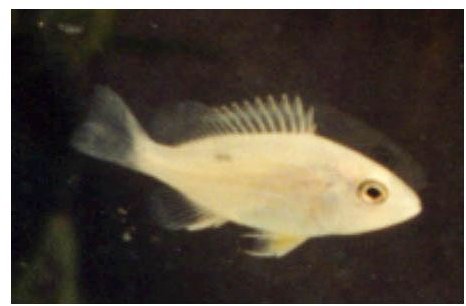
The juvenile lane snapper, Lutjanus synagris, is an example of an estuarine-dependent marine fish that lives offshore as an adult. It ingresses into the estuary at a size of around 20 mm (3/4th inch).
Both photos, plus salt marsh diagrams, by article author.