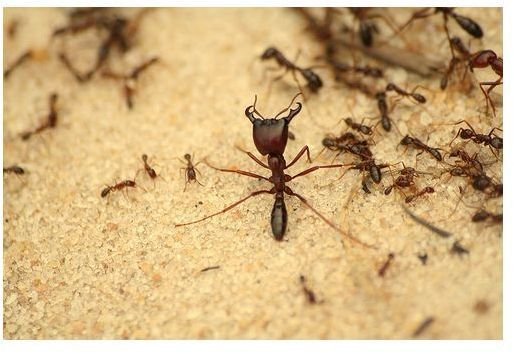
Army ants are interesting and intelligent social creatures that work together to make their colony operate efficiently. Each individual ant has certain established tasks to complete. The ants work together to form temporary nests on their nomadic travels in search for food.
Eciton Burchelli
Eciton burchelli is a species of army ants found in Central and South America. In appearance, army ants are sized between 3 mm to 12 mm, and have a head, a thorax and an abdomen, in that order, and joined by nodes. The head contains the scissor-like mandible, the simple eyes and the sensory antenna. Except the queen and the males, army ants are blind and must rely on their antenna to guide them in all matters.
Carnivorous and nomadic, army ants are well-known for their aggression and their ability to consume all food sources in their path. They have a distinct social hierarchy that determines the role of each individual ant in the ant colony.
Social Hierarchy of Army Ants
Army ant colonies consist of a queen ant, her brood, worker ants and soldier ants. The queen ant is a large, wingless fertile female that can live for several years and that spends nearly every day in this period laying eggs. The worker ants are infertile females that have three main duties, to forage for food, to take care of the queen and her brood, and to tend to the soldier ants; owing to their large mandibles, the soldiers cannot forage for themselves and need to be fed. The soldier ants are responsible for defending the colony from any attacks and also protecting the workers as they go around with their duties.
On the whole, an ant colony can include anywhere from 1000 to two million ants and the members communicate with one another with distinctive chemical messaging and trail pheromones. Different army ant colonies have different chemical messaging and trail pheromones. An army ant colony remains together only as long as the queen ant is alive. It was originally thought that the members were then killed off by neighboring army ant colonies, but this doesn’t seem to be always the case, according to research work carried out on army ants in Kenya by Daniel Kronauer of Harvard’s Society of Fellows. He found that when the queen dies, the colony members disperse and are usually accepted into other army ant colonies.
Nomadic Phase of Army Ants
A large army ant colony can exhaust food sources pretty quickly, and so the ants have to be constantly on the move. In the nomadic phase, which can last for 17 days, the army ants travel in the night time and rest during the day. Every day they form temporary nests to house the queen ant and her progeny. These temporary nests, which happen to be well-structured with corridors and chambers, are formed by the ants themselves by clinging to one another using their jaws or mandibles and their claws.
The ants can consume over 10,000 insects daily and are also capable of devouring larger prey like reptiles, animals and birds. The Eciton burchelli species are known for attacking or raiding in a swarm and flushing out their prey. Army ants are often followed by some birds, reptiles and mammals that feast on the creatures that break cover to escape the ants. Given the ferocity and determination of the ants, it is not uncommon for villages or homes in the path of the ants’ rampage to be abandoned until the ants have passed on; when the home owners return, it is to a home picked clean of all pests and parasites.