The Reef Fish Life Cycle from Spawning to Recruitment
Introduction
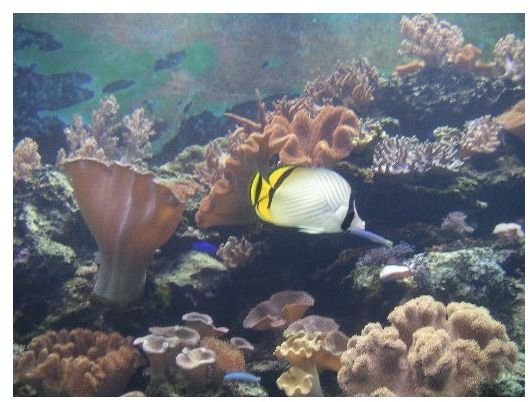
The basic life cycle of many reef fishes includes two major phases. The more well-known of these - where the reef fish is actually living at a reef as a reproductive adult - is called the demersal or benthic phase. Demersal means near the bottom; benthic means attached to the bottom. The fish associates itself with a particular area of complex hardbottom habitat (coral reef, rock reef, shipwreck, etc.) and orients its life to that area.
Reef Fish Life Cycle Begins With Spawning and Dispersal
Adult fish have two main methods of spawning. Most of them release their eggs and sperm together, either in groups or pairs, high in the water column and away from the reef to avoid having them eaten by corals, sponges, clams, and other reef residents that see the gametes as food. Spawning groups have safety in numbers, while spawning pairs must also evade predation on themselves - which leads to fairly elaborate courtship and mating behavior to coordinate their dash to the surface and then back to the safety of the reef as quickly as possible. After this type of spawning, which is known as broadcast spawning, fertilized eggs disperse into the open ocean.
Other species lay demersal eggs into nests, then guard them until they hatch. Some species guard their young after hatching as well, but many simply allow the newly-hatched yolk sac larvae to disperse into the water column - where they enter the other major life cycle phase.
The Planktonic Phase
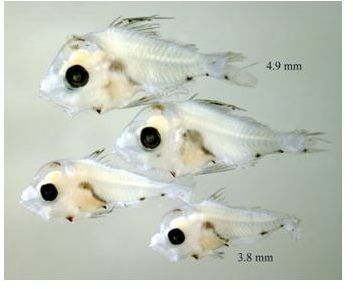
The planktonic phase is spent in the open ocean, often well away from any reefs. Plankton are any living thing of any size in the water column that swim too weakly to directly control where they go. Like other plankton, eggs and larval fish cannot actively swim long distances, but are carried by ocean currents. Larvae can, however, have some control of which direction they are carried by moving into and out of different currents, which flow in different directions depending on depth and often have tidal cycles near shore. In places where prevailing ocean currents have a known, predictable pattern, the location of larval fish at any given time will also have a pattern.
The planktonic phase usually lasts a few weeks to months. After the larval fish runs out of yolk, it eats plankton smaller than itself, such as diatoms, dinoflagellates, and copepods. Larval fish in turn are eaten by larger plankton, such as jellyfish, chaetognaths, and larval crabs.
Metamorphosis and Recruitment back to Reefs
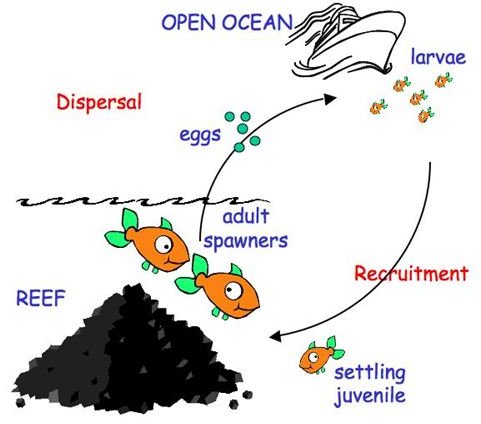
Assuming that the fish does not starve, get eaten, or become lost on the wrong ocean currents, near the end of its larval duration it begins searching for a suitable reef upon which to settle (or recruit). It might return to the reef where it was spawned, or it might find a completely different reef far from where it started. It all depends on the patterns of the currents.
Once it finds a suitable reef, the larva undergoes an extremely rapid transformation (or metamorphosis) into a juvenile stage that resembles a miniature adult. This typically occurs overnight, and the change can be quite dramatic. For example, larval flounder have an eye on each side of the head like other fish; during metamorphosis, one eye migrates over the top of the head and to the other side so that both eyes are on the same side, as in flounder adults, all within twelve hours.
Some species can delay metamorphosis for a limited time and remain in the larval stage if a suitable reef is not immediately found, or if timing with external cycles is not quite right - many reef fishes have a lunar cycle pattern to both spawning and recruitment. Once they are able to settle (have reached settlement competency), they delay their growth rate as they continue to search or wait. As the delay lengthens, the fish’s quality standards for what constitutes “suitable” will go down.
Once they have settled, juvenile reef fish remain at their chosen reef, or part of reef, for the rest of their lives, where they spawn to begin new life cycles.
References and Image Credits
Red snapper larvae (Lutjanus campechanus) from NOAA.
Coral reef fish picture and life cycle diagram by article author.
Article author’s MS thesis work was about larval snappers.
This post is part of the series: Fish Life Cycles: Marine Fish
Marine fish are highly diverse, with a wide variety of different life cycles. Many inhabit different types of marine environments at different parts of their life cycles. Some are wholly marine while others also use the brackish habitats of estuaries or even freshwater.