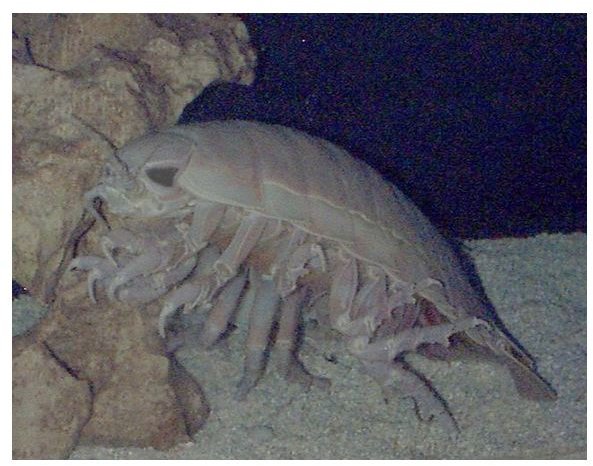
Research indicates the benthic environment may have the richest species diversity in the ocean, similar to a tropical rain forest.
Where is the benthic environment?
Benthic refers to the bottom of a body of water; in this case the bottom of the Atlantic and Pacific ocean. The Continental Shelf extends out from the shoreline about 50 miles and is about 500 miles deep. The shelf drops off on an angle and then levels out where the Abyssal plain or ocean bottom begins. The ocean bottom is just above freezing, very salty, low in oxygen, highly pressurized and dark.
The Abyssal Plain is about two miles deep, and mostly flat with occasional seamounts, islands, and deep rifts, The Pacific Rise has mid-ocean ridges with a few active volcanoes. Research estimates there are 50,000 seamounts in the Pacific and 100,000 throughout the rest of the ocean floor. The Atlantic Ocean is delineated on its north-south by the Mid-Ocean Ridge, a chain of mountains that extends 10,000 miles. The mountains mark the boundaries of tectonic plates which separate and help create the new sea floor. The Atlantic floor also has seamounts and hydrothermal vents.
What lives in the benthic environment?
For many years scientists believed the deep sea environment was barren and lifeless, yet research has shown that it may have the richest diverstiy of species in the ocean, similar to a tropical rain forest.
Most of the abyssal floor is made of thick sediments; in northern and southern latitudes sediments are around 500 feet thick, and near the equator they are around 1,700 feet thick. Since there’s also very little oxygen, the sediments are made up primarily of anerobic bacteria. Everything in the abyssal biome also decays slowly.
Abyssal food chains begin with phytoplankton detritus, fecal mattter and organic debris, rather than with living producers. Since there’s no light, there aren’t any photosynthetic producers. The only food, with the exception of a dead whale, cold water reefs and a few other sources, is what falls down from above.
Animals that live in the sediment are either deposit feeders or predators. They reproduce continually, have small broods, grow slowly, and live longer then animals closer to the water suface. In this environment, tiny deep sea animals provide the most diversity: there are many species of worms, bivalve mollusks, and isopods, plus small invertebrates called meiofauna. There are also 230 species of shelled protozoans , called foraminifera, in the top centimeter of sediment. Large numbers of sea cucumbers, sea stars, sea pens, various crab species, basket stars and brittle stars also make the ocean floor their home.
Animals in this biome have many unique adaptations. Many are bioluminescent – meaning they emit light – to attract mates or food. Other animals have strange shapes, enormous eyes that can detect even the very faintest light, or huge mouths. Larger animals on the ocean bottom include hagfish, squid, deep rays, monkfish, octopus, rattail fish and hatchet fish which have all adapted to their unique environment.