What is El Niño? Historically, it was a local phenomenon to coastal Peru and the anchovy fishery. But today we know there’s a much larger picture involving the entire tropical Pacific Ocean and the rest of the globe as well.
From a Historical Standpoint
An El Niño event is when the surface waters of the tropical Pacific Ocean are much warmer than normal. Fishermen of the northwestern coast of South America have known about the phenomenon for hundreds of years, because it drastically reduces the fishing harvest. The lack of fish also causes the local seabird populations to crash from starvation. In addition, there tends to be much more rainfall in the area, which affects farming and can cause flooding.
El Niño, which means “the little boy” in Spanish, is a reference to the Christ child because it tends to start around Christmas. It then continues throughout the summer and fades in the fall (in the southern hemisphere, summer begins in December and ends in March).
Based on evidence from ancient Pacific coral skeletons, El Niño events have been occurring for at least 125 thousand years. It’s possible they go back to 5 million years ago when the Isthmus of Panama joined North and South America to each other, and completed the separation of the Pacific Ocean from the Atlantic Ocean.
The Scientific Definition: First, What’s Normal?
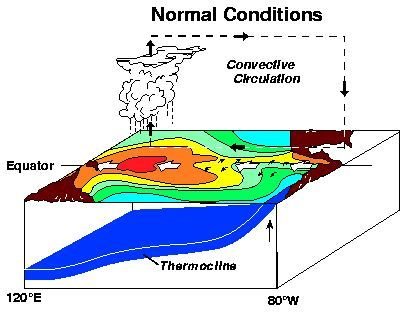
In a normal year, the trade winds blow across the tropical Pacific Ocean from east to west. (They’re called trade winds because seafaring traders used to sail by them to cross the oceans.) As they blow, they pile up water at the other end, so that sea levels end up a foot or two higher in Indonesia than Ecuador.
As the wind moves the warm surface waters from east to west, deeper waters well up from below, in a process called “upwelling,” to fill in the vacated space at the east. This cold, deep water is rich in nutrients that are good for supporting the growth of phytoplankton, especially when it’s close to the surface where the sunlight is.
The phytoplankton in turn supports lots of zooplankton, which gets eaten by small fish like the Peruvian anchovy. The anchovy becomes food for much larger fish like salmon and tuna, seabirds like pelicans and cormorants, and commercial fishermen.
What is El Niño?
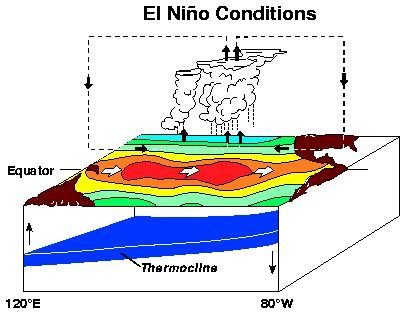
In an El Niño year, the trade winds stop blowing as hard in the central and western parts of the tropical Pacific. The warm surface waters don’t get moved westward, which means the deeper waters can’t upwell their nutrients to the surface. Phytoplankton and zooplankton can still grow (not as well), and fish still eat them, but it all happens much deeper than usual - where they’re harder to catch by fishing and where seabirds can’t reach. The collapse of the Peruvian anchovy fishery in the 1970s was partly due to not accounting for the effects of El Niño in estimating sustainable annual harvest.
In addition, many global weather patterns shift eastward. Places that normally get rain might see drought, while places to the east of them that are usually dry might see more rain. Tropical storms (hurricanes, typhoons) form more easily in the eastern Pacific due to the extra warm waters.
What About La Niña?
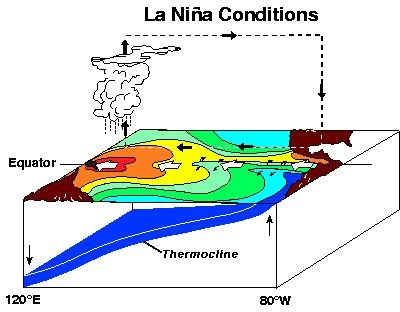
La Niña, which means “little girl” in Spanish, is the opposite extreme from El Niño. In a La Niña year, the trade winds blow extra hard across the tropical Pacific. The water off the coast of South America is extra cold, which is great for fishing but often comes with drought. Many global weather patterns shift westward.
Together, El Niño and La Niña are the opposing ends of what’s called El Niño - Southern Oscillation, or ENSO.
Resources and Credits
ENSO images and Detailed Information about El Niño from NOAA / PMEL / TAO Project
El Ni ñ o Years (1950 to present) - NOAA National Weather Service Climate Prediction Center
Carol M. Lalli and Timothy R. Parsons. Biological Oceanography: An Introduction, 2nd ed. Butterworth-Heinemann. 1997.