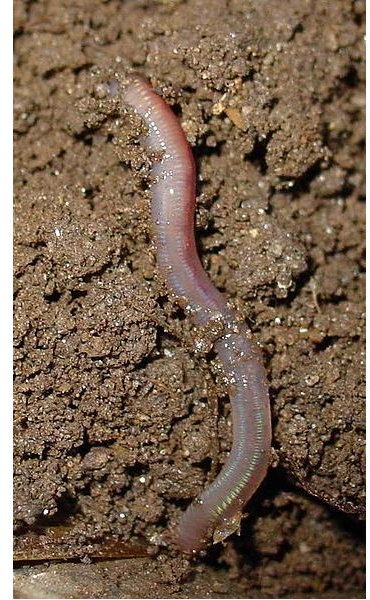
Everyone has met an earthworm at some point in their life. Whether you think they’re neat or gross, earthworms are little creatures that play a big role in the ecosystem. Learn about interesting earthworm facts such why they come out of the ground when it rains.
Biology and Habitat
Think an earthworm is just an earthworm? Think again. It is a not so common earthworm fact that there are 23 families, over 700 genera and more than 7,000 species of earthworms. They can grow anywhere from two inches to two yards, depending on the species. Even though there are many different types of earthworms, all share some basic features. Earthworms are cold-blooded, segmented worms, that are hermaphroditic which means each worm has both female and male sexual organs. They mate by joining their clitella, exchanging sperm and then forming their own egg capsule. Baby worms hatch from tiny cocoons.
Earthworms breathe through their skin and will live wherever there’s food, oxygen and humidity. Earthworms use brain for basic functions such as directing worms towards light when they sense openings in the soil. If you removed a worm’s brain, it’s most likely that the worm would continue functioning normally! Furthermore, earthworms have over five hearts which help them digest their food and till through the soil.
There may be more earthworms living near you than you would think—one acre of land can be home to over one million earthworms. It is also estimated that earthworms digest over half of the soil in one acre which amounts to over 16,000 pounds of soil! This process is so important because earthworms reinvigorate the nutrients in the soil allowing plants to grow more efficiently.
Behavior and Diet
Earthworms compost and recycle. They dig deep tunnels into the ground and till soil in the process. They decompose dead and
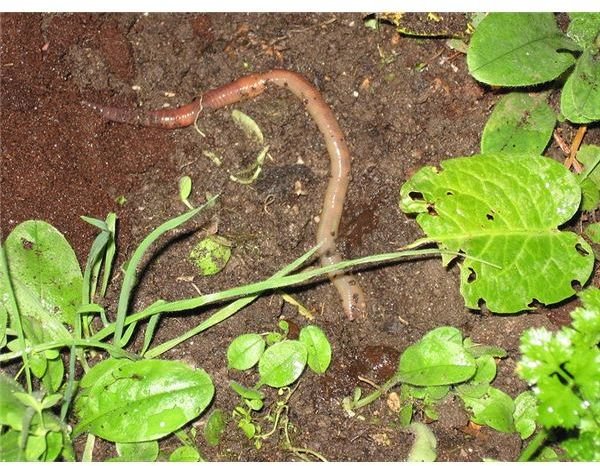
organic matter and clean their food from any bacteria and fungi growing nearby. Charles Darwin once hypothesized that if earthworms digested an acre of land over 10 years, they would contribute an extra two inches to the soil!
Earthworms also do bizarre things. Have you ever wondered why do earthworms come out in the rain? Typically, earthworms stay underground for much of their lives but prefer to mate above-ground. When it rains, moisture and humidity are created and earthworms decide to come out to access oxygen and find a suitable partner. If earthworms are lucky, they may be able to complete both of these processes, however, if they fail to travel back underground, they risk drying out.
If environment conditions change, such as becoming too cold or too hot, what do earthworms do? The most common thing earthworms do to avoid danger is to tunnel deeper into the soil. They can also go into a form of hibernation by secreting a mucous that allows their organs to function at a lower level. This is called estivation and earthworms typically escape this process when conditions improve.
Ecological Importance

As worms dig through dirt, they mix topsoil with subsoil and secrete a slime full of nitrogen, which is important for plants. Earthworms increase microbial activity by cycling nutrients via digestion. Their excrement contains higher levels of microorganisms than the originally-consumed matter. This excrement creates a soil called aggregate soil that’s mixed into deep layers. Earthworms act as one collective garden ho, tilling the soil and mixing in more nutrients.
So what does this have to do with plants? Plants need air and water to grow and access nutrients, and without earthworms, it is most likely that plants would have a harder time growing and adapting to environments. Charles Darwin even suggested that “it may be doubted if there are any other animals which have played such an important part in the history of the world as these lowly organized creatures.” If huamn agriculture did not have earthworms, it is certain that our food today would be quite different.
References
Sources:
- Conrad, Jim. “Earthworms.” https://www.backyardnature.net/earthwrm.htm
- Peck. “Fun Facts About Worms.” https://ed101.bu.edu/StudentDoc/current/ED101sp09/eflukes/wormfacts.html
- “Worm Facts.” https://urbanext.illinois.edu/worms/facts/index.html
Images:
- Linnenbach, Michael. “Lumbricus terrestris.” https://commons.wikimedia.org/wiki/File:Lumbricus _terrestris.JPG
- Mesaytsegaye. “Soil.” https://commons.wikimedia.org/wiki/File:Soil.jpg
- Sanchez, Luis Miguel Bugallo. “Minoca.” h ttp://commons.wikimedia.org/wiki/File:Mi%C3%B1oca066eue.jpg
This post is part of the series: All About Earthworms
Want to know some interesting earthworm facts or information about their anatomy? Read this series to get well acquainted with one of Earth’s most valuable farmers.