Six animals and four plants are presented as representatives of the many species that have become extinct since 1910. Their extinction is due to stresses brought about by hunting, habitat destruction and introduced predators and diseases.
Modern Extinctions
Dinosaurs and dodos are associated with species extinction more than any other organism. Lesser known are the animals and plants that survived to modern times yet were unable to face its challenges. These modern extinctions cut across different groups, from birds to big mammals, tiny bryophytes to large trees. If there is any lesson that can be learned from the demise of these creatures, it is that no species is completely out of danger of extinction. Even the most abundant plants and animals today may face extreme challenges that will wipe them out tomorrow. Human consumption, habitat degradation, diseases, and predation are factors that have caused extinction in the past, and continue to impose stresses on surviving species today and in the future.
Following is a sample of the organisms that were thriving at the start of the last century, but now are no more.
Six Extinct Animals
* Passenger Pigeon (Ectopistes migratorius)
In the early 1800s, Passenger Pigeons existed in huge flocks numbering in the billions, all over North America. Their stunningly rapid extinction has been attributed to over-hunting using increasingly effective methods to catch both mature and juvenile birds. The last bird was recorded in the wild in 1900. Fourteen years later, the last Passenger Pigeon died in the Cincinnati Zoo.
* Carolina Parakeet (Conuropsis carolinensis)
The extinction of the Carolina Parakeet was due to a combination of challenges to its diet and habitat, and a bright set of feathers that were sought after as hat accessories. Large flocks of these birds fed on cultivated fruit and grain. This conflict with farmers who were protective of their crops, and the destruction of the birds’ forest habitats, proved to be deadly to the parakeets. The last of them, a captive specimen in the Cincinnati Zoo, died in 1918.
* Darwin’s Galapagos Mouse (Nesoryzomys darwini)
N. darwini was first identified in 1906 in the Galapagos island of Santa Cruz. The introduction into the island of rats (Rattus rattus) which competed with the Galapagos Mouse for food and also brought in new diseases, eventually led to the extinction. N. darwini was last seen in 1930.
* Toolache Wallaby (Macropus greyi)
Common in Australia until 1910, the Toolache Wallaby’s population slowly dwindled due to hunting, predation by foxes and habitat destruction. This kangaroo relative was highly prized for its fur and as a game trophy. By 1924, only a few individuals lived in the wild. Beginning in 1982, numerous surveys have failed to observe any remaining specimens, leading to the species being declared as extinct.
* Black Andean Toad (Atelopus ignescens)
Previously so abundant as to be present in every forest and backyard in Ecuador, the Black Andean Toad has altogether vanished, along with numerous other toad and frog species in South America. Various explanations for the disappearance of the toads have been proposed, including increased temperatures, pollution, habitat destruction and fungal infection. The Black Andean Toad was last observed in 1988 and declared extinct in 2004.
* Thick-billed Ground-dove (Gallicolumba salamonis)
This bird species was identified only from two specimens collected from the Solomon Islands in 1882 and in 1927. Little is known about the Thick-billed Ground-dove. Its decline is thought to be due to new predators being introduced into its habitat and the destruction of forests in which it lived. After numerous unsuccessful attempts to find the bird, it was designated extinct status in 2005.
St. Helena Olive
Four Extinct Plants
* Sri Lanka Legume Tree (Crudia zeylanica)
This large tree was endemic to Sri Lanka. The last specimen, reported in the Peradeniya Botanical Garden, wasn’t found during a survey in 1998.
* Arunchal Hopea Tree (Hopea shingkeng)
This small tree was harvested extensively for the construction of house posts in India. It was declared extinct in 1998.
* Radula visiniaca Bryophyte
This liverwort was endemic to Italy and was last observed in 1938. Recent efforts to locate specimens were unsuccessful, leading to its extinct status in 2000.
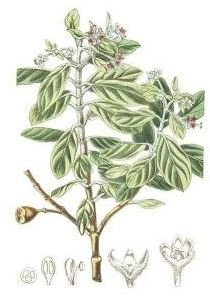
* St. Helena Olive (Nesiota elliptica)
The St. Helena Olive was a flowering plant endemic to the island of St. Helena. By 1977, only one tree was found in the wild, from which a single cutting was successfully cultivated. When the tree died in 1994, the survival of the species depended on a handful of seedlings derived from the cultivated cutting. These plants eventually perished until the last of the species died in December 2003. Deforestation, over-grazing and the tree’s self-incompatibility are the factors responsible for its extinction.
Additional reading
Additional reading:
https://www.puce.edu.ec/zoologia/noticias/Cesar _notes.htm)