Learn interesting information and facts about the notoriously vocal, intelligent, and boisterous Blue jay. These Blue jay facts about its diet, behavior and habitat are amazing and fun to read!
Meet the Blue Jay
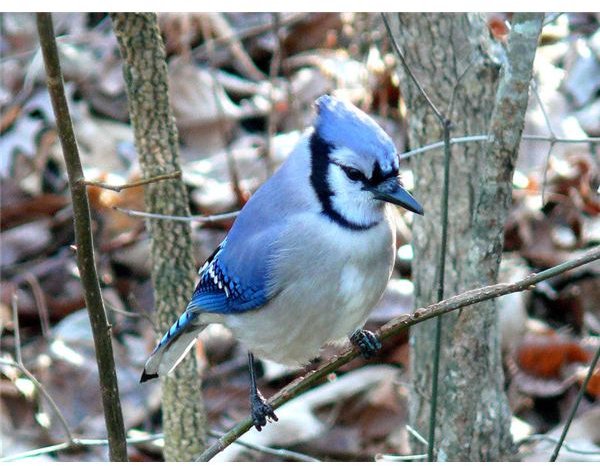
The blue jay is a large, songbird of 10 to 12 inches, with a wingspan of 13-17 inches. It is distinguished by its bright blue beautiful wing feathers, blue-gray body, and white or gray belly. The blue jay is smaller than a crow but larger than a robin. Blue jays have a feathered crest on their head that can be raised or lowered and have a distinct black collar around their necks.
- Common Name: Blue Jay
- Scientific Name: Cyanocitta cristata
- Kingdom: Animalia
- Phylum: Chordata
- Class: Aves
- Order: Passeriformes
- Family: Corvidae
- Genus: Cyanocitta
Biology and Habitat
Blue jays are abundant in the Eastern United States. They are also found in Southern Canada down to the Gulf of Mexico and in the Central US. The birds can be found in mixed forest and woodlands–particularly around forest edges–and in a deciduous or coniferous forest. They also live in urban and suburban areas, especially if those areas are populated by oak trees.
Blue jays are partially migratory, meaning some jays migrate south each year and others stay do not. Certain jays have been observed to migrate every other year. Ornithologists are unclear why there is no consistent pattern of blue jay migration. Blue jays that migrate do so in large flocks of hundreds of birds.
Blue jays breed from mid-March through July with peak breeding in mid-April to May. A typical blue jay clutch consists of 2-7 eggs, with incubation lasting about 17 days. Nests are constructed from sticks and twigs in the thick outer branches of a deciduous or coniferous tree, usually 10-25 feet above the ground. The male and female share in gathering and building the nest but mostly the male gathers and the female builds the nest.
Behavior
There’s no mistaking when a blue jay is near. They are notoriously noisy birds with songs consisting of a large variety of calls, the most popular being a harsh “jeer” and a loud “Jay! Jay! Jay!” Blue jays have been known to imitate calls of hawks. By nature, they are very aggressive and territorial. They squawk to warn predators to stay away or to call their flock. They protect against hawks, raccoons, cats, snakes, squirrels, falcons and even humans from their nests. At other times, the Blue jay sings softly like a songbird.
Blue jays are intelligent. Captive blue jays have been known to use tools. When a piece of food drops outside of their cage, the birds have been known to make tools out of strips of newspaper to push the food within reach. They are able to store their food underground for later use and they are able to warn when danger is near.
Diet
Even though blue jays are omnivorous, they eat a mostly vegetarian diet consisting of acorns, nuts, fruits and seeds. They may also eat mice, frogs, and insects. Many people complain about blue jays eating eggs and nestlings of other birds, but they are thought to be the minority.
Interesting and Fun Facts
Whether you are a student or a bird watcher, these facts are fun just to learn!
- Blue jays are monogamous and mate for life. They will stay with their mate until one of them dies.
- The average life span of a Blue Jay is 7 years, but one was studied in the wild to live to 17 years old and one in captivity is reported to live 26 years!
- Blue jays seem to be susceptible to the West Nile Virus.
- When a blue jay crouches down and fluffs up its feathers, it may be a sign of submission during mating or a fight.
- The Blue jay is the mascot for the professional baseball team, The Toronto Blue Jays and the mascot for the Hopkins Blue Jays, a lacrosse team of John Hopkins University.
- Because Blue jays “save food” by burying it, they are thought to help the ecology by planting acorns into new oak trees.
Continue reading the reference section for an in-depth look at this amazing bird! You can even listen to the Blue Jay sing on the Cornell website.
References
- Cornell Lab of Ornithology: http://www.birds.cornell.edu/birdsleuth/modules/exploring-bird-behavior/bird-guide/blue-jay
- Cornell Lab of Ornithology: http://www.allaboutbirds.org/guide/Blue _Jay/id
- Georgia Wildlife Web, Species Description: http://naturalhistory.uga.edu/~gmnh/gawildlife/index.php?page=speciespages/species _page&key=ccristata
- Megan Bissett & C. R. Jurica-Suchy Nature Museum: http://www1.ben.edu/museum/bluejay.asp
- Frysinger, J. 2001. “Cyanocitta cristata” (On-line), Animal Diversity Web. Accessed March 26, 2011: http://animaldiversity.ummz.umich.edu/site/accounts/information/Cyanocitta _cristata.html.
- Image Credit: http://en.wikipedia.org/wiki/File:Blue _Jay-27527.jpg Ken Thomas
- Atwell, J., Huizinga, M., and Veldman, J.: http://www.hope.edu/academic/biology/naturepreserve/Birds/Cyacri.htm