Discover how carbon credit trading works in a national and voluntary level. Find out how carbon credit scams take advantage of ordinary people who want to contribute to a greener environment.
What are Carbon Credits?
A carbon credit is a certificate or permit that allows the emission of one ton of carbon dioxide or other equivalent gas in the atmosphere. There’s a whole market dealing with carbon trading at both national and voluntary levels. The idea is based on giving an incentive to reduce CO2 emissions and then use the carbon credits to finance the development of various “green” projects.
National Level Carbon Credit Trading
Carbon credits can be purchased either by commercial users, companies, countries or individuals. In a national level, countries such as New Zealand and Ireland have used this approach to offset their CO2 emissions and develop practices such as farming, planting trees, and investing in wind power generation infrastructures. Nations that participated in the Kyoto meeting in 1997 (Kyoto Protocol) are allowed to emit certain amounts of CO2 as long as they manage to offset this emissions with “green” actions. In case a nation is producing more CO2 than it can absorb, it must purchase carbon credits from another nation to offset its carbon production balance.
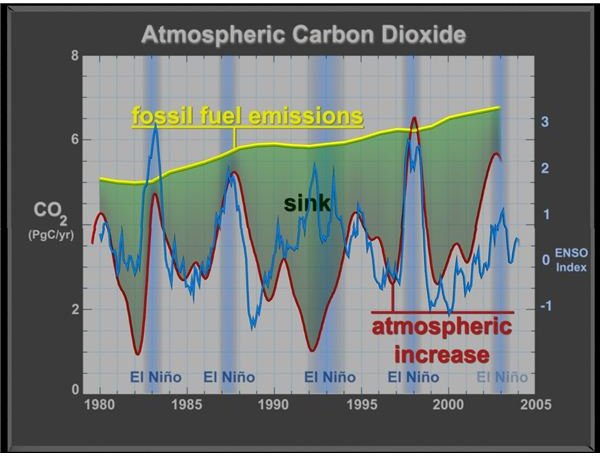
The Global Emission of Carbon Dioxide in the Atmosphere from 1980 to 2005
The Intent of Cap and Trade
Cap and trade is intended to reduce global warming by reducing the emissions of greenhouse gases. The following material is from “Cap and Trade 101” and was created by the Center for American Progress. It is used with permission.
The cap: Each large-scale emitter, or company, will have a limit on the amount of greenhouse gas that it can emit. The firm must have an “emissions permit” for every ton of carbon dioxide it releases into the atmosphere. These permits set an enforceable limit, or cap, on the amount of greenhouse gas pollution that the company is allowed to emit. Over time, the limits become stricter, allowing less and less pollution, until the ultimate reduction goal is met. This is similar to the cap and trade program enacted by the Clean Air Act of 1990, which reduced the sulfur emissions that cause acid rain, and it met the goals at a much lower cost than industry or government predicted.
The trade: It will be relatively cheaper or easier for some companies to reduce their emissions below their required limit than others. These more efficient companies, who emit less than their allowance, can sell their extra permits to companies that are not able to make reductions as easily. This creates a system that guarantees a set level of overall reductions, while rewarding the most efficient companies and ensuring that the cap can be met at the lowest possible cost to the economy.
Voluntary Level Carbon Offsets and Carbon Credit Scams
The voluntary market involves carbon credit trading among individuals and companies. Many companies offer them through their sites, as a way for the individuals to lessen their personal carbon footprint due to transportation, electricity use, etc. These companies cooperate with a number of affiliates and urge people to shop online or use promotional coupons and codes from their everyday shopping, in order to earn carbon credits. Paying bills is another way to collect carbon credits. Other sites request help in various forms including money donations or unpaid assistance (written content and reports).
The holders may spend their credits on buying affiliate products or donating them, e.g. to public services and organizations. In some occasions, the amount of credits required for some green products is remarkably high. Another common policy is to invest the carbon credits on ecologically sound projects such as the spreading of solar ovens use, the building of a dam for small hydro generators in distant countries, etc. A well-known carbon credit program comes from Farmers Union allowing crop producers and landowners to earn income by simply trading these offsets like any other agriculture commodity.
Conclusion
Although the national carbon credit trading systems seems to be reliable, the case may be rather different as far as individuals are concerned. The carbon credit trading offered by some sites can easily take advantage of the naiveté and good will of some people to contribute to a greener environment. There is no solid proof that the earnings are invested as claimed, and this could actually be an easy and deceitful way to make huge profits out of it. People who want to mitigate their carbon footprint should be more skeptical about where their money is actually ending up. The story of Al Gore , the former US vice president, and his “carbon offset” company has revealed a great deal about how such things work.
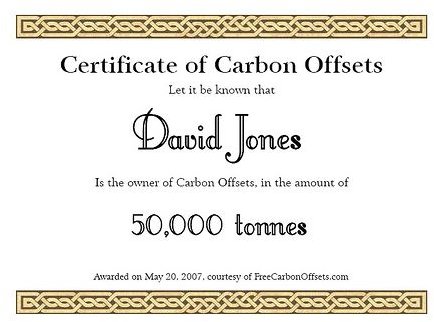
A Certificate of Carbon Offsets
Sources:
- Farmer’s Union, Carbon Credit Program
- Center for American Progress , Cap and Trade 101
- https://www.nasaimages.org/
- https://www.carboncreditz.org/
- https://www.savetheplanet.co.nz /: Carbon Credits Explained
- https://freecarbonoffsets.com/